Oil Erases Losses With US Fuel Stockpiles, Geopolitics In Focus

Oil climbed as a US government report signalled sturdy domestic demand as rising global geopolitical tensions also added market support.
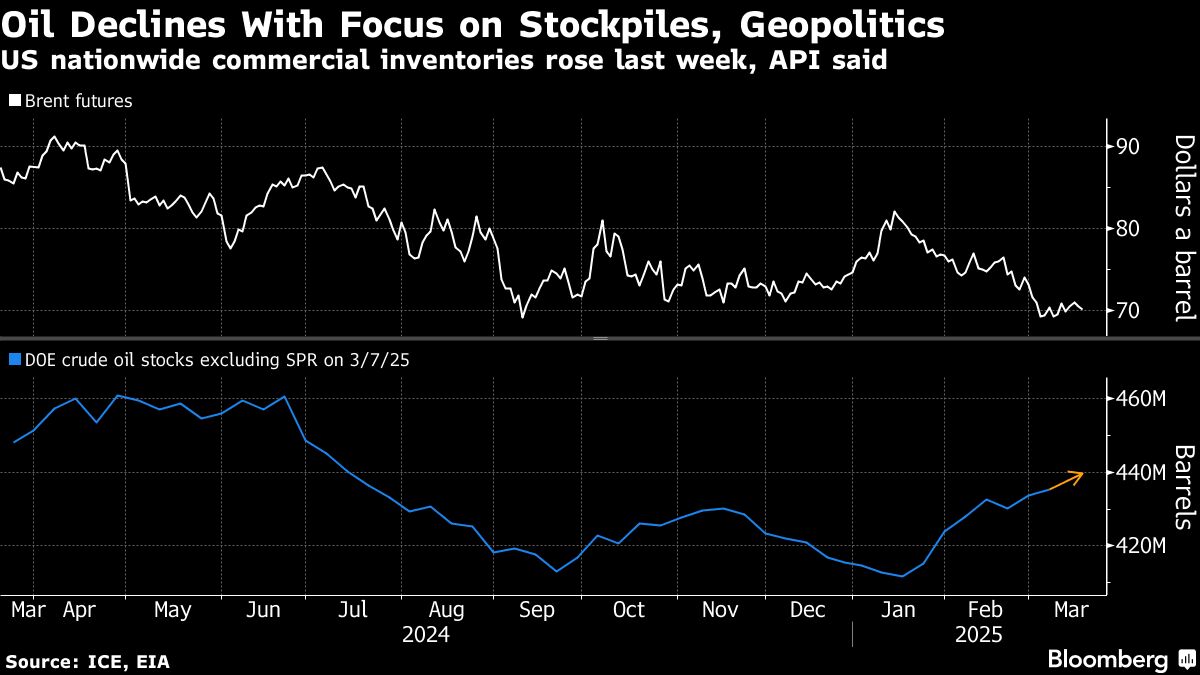
West Texas Intermediate crude traded above $67 a barrel, erasing earlier losses of as much as 1%. Overall US distillate inventories dropped to the lowest in a year, while gasoline stockpiles hit January lows, government figures showed. That helped to rein in trader fears over declining demand amid economic worries.
“There's a lot of concern about the US economy right now, and this belies it to a degree,” said John Kilduff, a partner at Again Capital. “It's is a very hopeful sign for demand.”
The official data also showed a smaller gain for crude stockpiles than estimated by the American Petroleum Institute, while reserves fell at the Cushing hub.
Still, investors remain in a holding pattern ahead of a Federal Reserve interest-rate decision later Wednesday, where Chair Jerome Powell is expected to comment on the state of the economy as President Donald Trump amps up his trade war.
Crude still remains markedly lower from a peak in January, as several bearish drivers combine to pressure prices. On the supply side, OPEC and its allies are preparing to increase production, while the escalating trade frictions are threatening a hit to demand just as consumption in China remains weak.
Economic data “will remain the salient driving force of sentiment and consequently prices,” said Tamas Varga, an analyst at brokerage PVM Oil Associates Ltd.
Geopolitical concerns lifted prices on Monday. Trump has pressed Iran to rein in the Houthis, treating attacks from the Yemeni militant group as Tehran's direct responsibility. Russian President Vladimir Putin, meanwhile, declined the US president's bid for a ceasefire in Ukraine, agreeing instead to limit attacks on the country's energy infrastructure.
Prices
WTI for April delivery traded 0.4% higher at $67.14 a barrel as of 12:35 p.m. in New York.
Brent for May settlement was up 0.4% to trade at $70.83 a barrel.

-
Talking Points This Week: Tech Nerves, FII Buying, And A Faraway Banking Shock

The global markets are not shining this Diwali. The exception in the large markets is, India.
-
Midterm Rally Lasted A Day. The Hard Reality Of A Divided US May Last Two Years | Opinion
Between a contested AI boom, a debt ceiling that arrives in 2027 and a president with every incentive to act alone, the next two years may prove more volatile than the first day's rally suggests.
-
Blue Wave Will Derail the AI Trade but Won't Dismantle the AI Era | Unhedged Position
The Democrats' sweep of the US Congress will see politics collide with economic forces both over the long and short term.
-
It's Time To Take The GST Council's Bet On Trust Global
Payment records can prove India's services exports, and clear, proportionate rules can bring foreign digital sellers into the tax net.
-
Opinion | India at 38: From Innovation Overperformer to Innovation Powerhouse
India now has 453 VC-backed deep science startups, 18 of them late-stage, after 117 percent growth since 2020. Laurus Labs, at USD 9.3 billion, is the most valuable deep science company in any middle-income economy outside China.
-
Navigating Energy Crossroads: S Jaishankar's Call For Diversified Supply Chains At G20 Ministerial Meeting
As geopolitical fault lines continue to test maritime trade routes and commodity flows, Jaishankar's message remains pertinent: true economic resilience requires open markets, protected transit lines, and a genuine commitment to multilateral cooperation rather than coercion.
-
Indians Are Travelling, But Not Every Journey Is A Holiday | The Week In Whys
Pilgrims, patients and working women are the real travellers, and the system hasn't quite caught up with them.
-
Getting To Work Costs Women More | The Reason Why
It is not just about women paying more than men. It is about women paying much more in cities than in villages.
-
AI Bias In Investing Cannot Be Eliminated, But It Can Be Governed
Framing is a particularly important example as identical financial information presented in terms of gains rather than losses can lead an LLM to reach a different assessment.









