Offshore Yuan Gains Seen Allaying China’s Currency Woes, For Now

(Bloomberg) -- The offshore yuan's rally is set to boost the onshore unit once trading resumes after the Golden Week holidays in China, taking the pressure off the central bank to defend the currency.
That's because the offshore yuan is poised for its biggest weekly gain since May on the back of the dollar's retreat, as traders bet the Federal Reserve may ease off on its policy tightening. It portends a strong opening for the currency traded in Shanghai after a seventh straight month of losses.
The moves may reduce the need for the People's Bank of China to support the yuan in the near term, but pressure on the currency is expected to remain as China's easy monetary policy stance and the rising risk of deflation in the domestic economy, battered by Covid curbs and a flagging property sector, drive outflows.
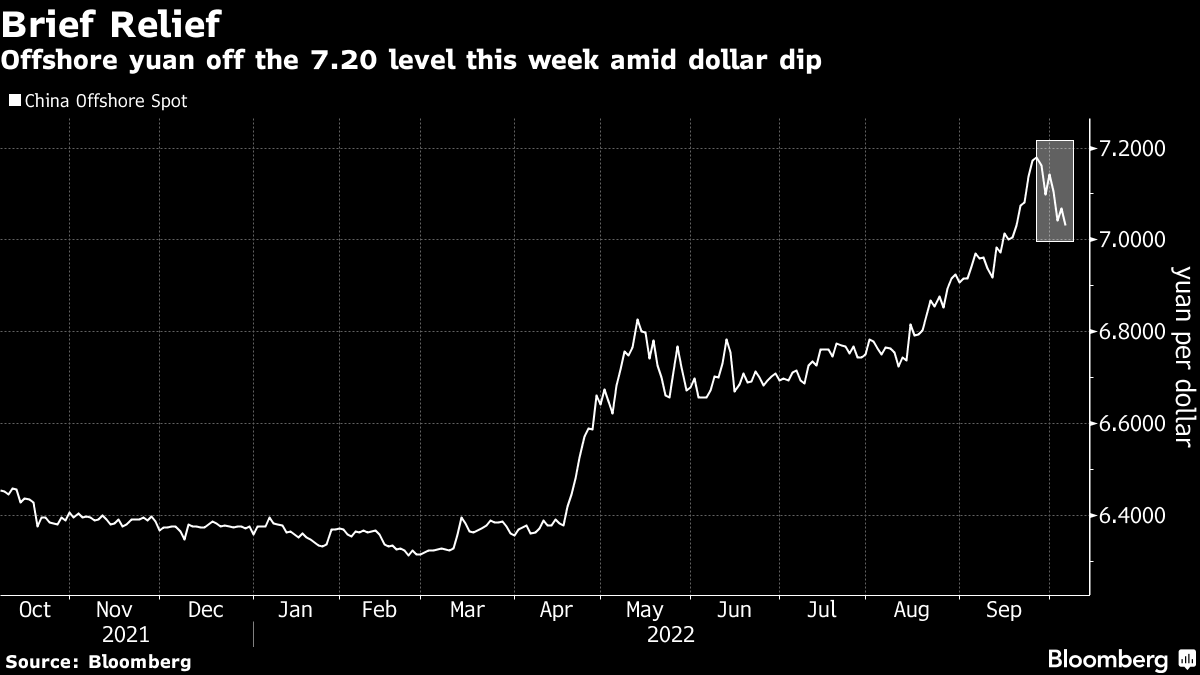
The offshore yuan's strength is largely driven by the pullback in the dollar, said Khoon Goh, head of Asia research at Australia & New Zealand Banking Group in Singapore. “The yuan will remain under pressure this year as the dollar dominance is set to continue,” he said, adding that the yuan may trade between 7-7.05 per dollar in the near term before weakening to 7.20 early next year.
Last week, the onshore yuan fell to the lowest since 2008 while the offshore unit depreciated to the weakest in data going back to 2010. The PBOC set a string of stronger-than-expected yuan fixings to cap the losses. It also imposed a risk reserve requirement of 20% on currency forward sales by banks to make it more expensive to short the yuan. That's after it reduced the foreign-currency reserve requirements for bank deposits.
The fundamental drivers for orderly yuan weakness haven't changed, according to Citigroup Inc. The expected gradual normalization of China's trade balance with lower export growth and higher import growth should weaken the yuan against a basket of its trading partners' currencies, the firm's strategists Gaurav Garg and Philip Yin wrote in a note.
The onshore yuan closed at 7.1211 per dollar on Friday, while the offshore yuan rose 0.2% to 7.0544 per dollar at 4:43 pm in Hong Kong.
(Adds analyst comment sixth paragraph and updates yuan level in final paragraph.)
More stories like this are available on bloomberg.com
©2022 Bloomberg L.P.

-
Love, Sex Aur Dhokha: The Audacious Plot To Spy On Jensen Huang

A Taipei dinner, a Singapore chip buyer and a suspected Chinese asset: inside the alleged spy operation that got close to NVIDIA's Jensen Huang.
-
Ten Things I Learnt This Samvat
Patience can be a trap. Cheap stocks can stay cheap. Leverage can wipe you out. What did Samvat 2082 teach us? Niraj Shah writes on 10 lessons from the year gone by.
-
Talking Points This Week: Tech Nerves, FII Buying, And A Faraway Banking Shock
The global markets are not shining this Diwali. The exception in the large markets is, India.
-
Midterm Rally Lasted A Day. The Hard Reality Of A Divided US May Last Two Years | Opinion
Between a contested AI boom, a debt ceiling that arrives in 2027 and a president with every incentive to act alone, the next two years may prove more volatile than the first day's rally suggests.
-
Blue Wave Will Derail the AI Trade but Won't Dismantle the AI Era | Unhedged Position
The Democrats' sweep of the US Congress will see politics collide with economic forces both over the long and short term.
-
It's Time To Take The GST Council's Bet On Trust Global
Payment records can prove India's services exports, and clear, proportionate rules can bring foreign digital sellers into the tax net.
-
Opinion | India at 38: From Innovation Overperformer to Innovation Powerhouse
India now has 453 VC-backed deep science startups, 18 of them late-stage, after 117 percent growth since 2020. Laurus Labs, at USD 9.3 billion, is the most valuable deep science company in any middle-income economy outside China.
-
Navigating Energy Crossroads: S Jaishankar's Call For Diversified Supply Chains At G20 Ministerial Meeting
As geopolitical fault lines continue to test maritime trade routes and commodity flows, Jaishankar's message remains pertinent: true economic resilience requires open markets, protected transit lines, and a genuine commitment to multilateral cooperation rather than coercion.
-
Indians Are Travelling, But Not Every Journey Is A Holiday | The Week In Whys
Pilgrims, patients and working women are the real travellers, and the system hasn't quite caught up with them.









