Nike Falls As Trump’s Reciprocal Tariff Plan Sinks Retailers

The world's largest footwear and apparel companies are facing a shock to their supply chains after President Donald Trump announced new tariffs on Vietnam and other critical production hubs.
The US imposed a 46% reciprocal tariff rate on Vietnamese goods on Wednesday as part of Trump's growing trade war with countries around the world. Other new tariffs include 49% on Cambodia, 34% on China and 32% on Indonesia.
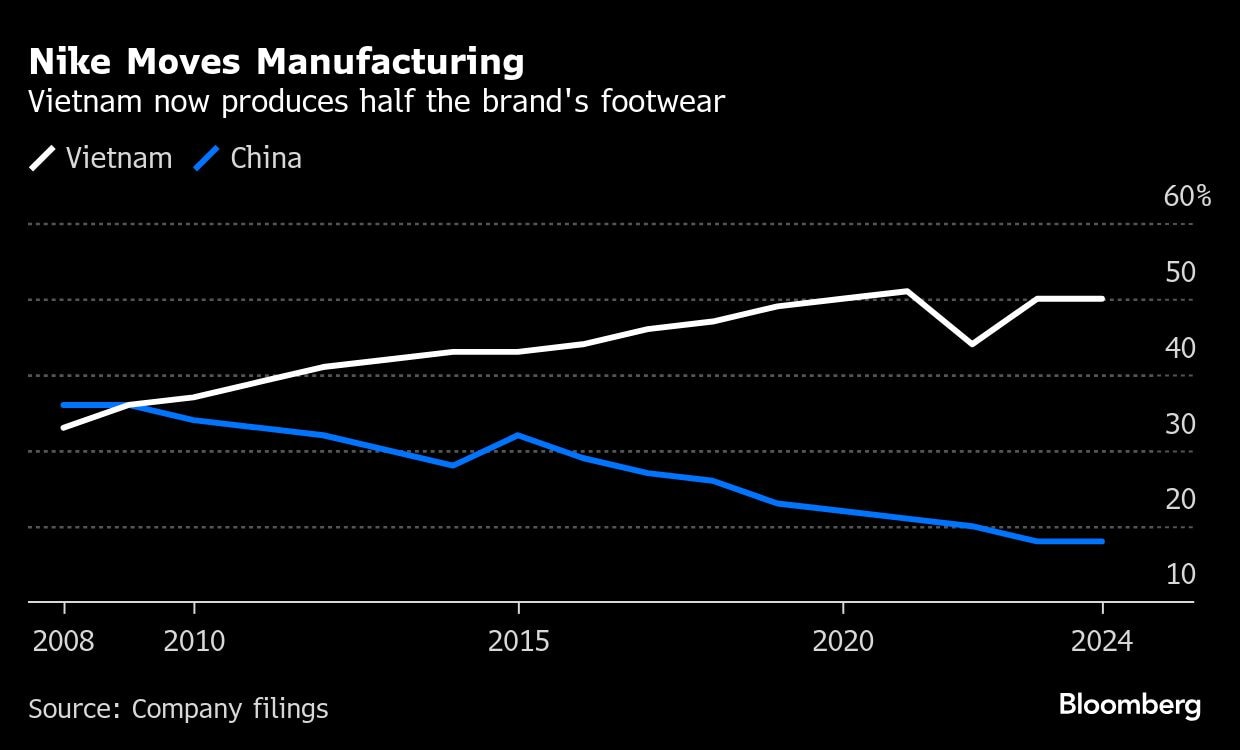
Nike Inc. and Adidas AG made big bets on Vietnam over the last decade. Today, about half of all Nike shoes and 39% of Adidas shoes are made in the country, according to regulatory filings. Vietnam is the largest supplier of footwear for both companies, and shoes produced in the country account for more than $20 billion in combined annual revenue.
Nike shares fell 6.4% in extended trading at 5:06 p.m. New York time. Lululemon Athletica Inc., which makes 40% of its products in Vietnam and 17% in Cambodia, tumbled almost 9.6% in late trading. Shares of Abercrombie & Fitch Co., which gets 35% of its merchandise from Vietnam and 22% from Cambodia, fell 7.7%. Gap Inc., which buys about 27% of its goods from Vietnamese factories and 19% from Indonesia, slid 11%.
“More tariffs equal more anxiety and uncertainty for American businesses and consumers,” National Retail Federation Executive Vice President of Government Relations David French said on Wednesday. “Tariffs are a tax paid by the U.S. importer that will be passed along to the end consumer.”
Tariffs add to the trade turbulence that shoe sellers are trying to navigate. Nike already said it expects its gross margin to decline sharply this quarter, in part due to US tariffs on products from China and Mexico.
“Shifting supply chains is not an option given performance footwear requires a very specific skill set and factories,” said Poonam Goyal, an analyst at Bloomberg Intelligence. “I can't see how prices to consumers don't go up.”
Nike and Adidas didn't immediately respond to requests for comment.
Major fashion retailers such as Uniqlo owner Fast Retailing Co. and Hennes & Mauritz AB also count Vietnam as one of their biggest suppliers. The country exported $44 billion in textiles last year, with the US as its largest market, according to the Vietnam Textile and Apparel Association.
The footwear and apparel industries boosted production in Vietnam during Trump's first term in the White House as the trade war with China escalated. Vietnam has low labor costs, a skilled workforce already adept at manufacturing shoes and clothes, transportation infrastructure, and was seen as less of a threat to be involved in geopolitical clashes. It also boasted trade agreements with the US and the European Union.
Hints that Vietnam could get entangled in Trump's trade wars began in 2019, when Trump said that Vietnam took advantage of the US “even worse than China.” Retail lobbyists feared that Trump was near enacting tariffs on Vietnam in the last month of his first term, according to people familiar with the matter.
Vietnam emerged a big winner as brands reduced their exposure to China. Footwear and textiles are now among Vietnam's most vital exports, and the industry flourished as brands like Nike and Adidas linked with dozens of sneaker factories. Neither company produces more than 20% of its footwear in China anymore.
Vietnam has been among Asia's fastest growing economies. Its gross domestic product grew 7.1% last year, surpassing both government projections and estimates from analysts surveyed by Bloomberg.
Just days after Trump re-entered the White House in January, Secretary of State Marco Rubio encouraged senior officials in Vietnam to address trade imbalances. Vietnam's trade surplus with the US was more than $123 billion last year, according to US Census Bureau data, and officials have said they've been urging increased purchases of US products.
Only China and Mexico have larger trade surpluses with the US.
Vietnam Prime Minister Pham Minh Chinh said in January that he'd be willing to visit Trump at Mar-a-Lago to “golf all day long” if it helps resolve trade quarrels. Since then, the government has been trying to appease the Trump administration by cutting its own tariffs on US cars, ethanol and liquefied natural gas.

-
Talking Points This Week: Tech Nerves, FII Buying, And A Faraway Banking Shock

The global markets are not shining this Diwali. The exception in the large markets is, India.
-
Midterm Rally Lasted A Day. The Hard Reality Of A Divided US May Last Two Years | Opinion
Between a contested AI boom, a debt ceiling that arrives in 2027 and a president with every incentive to act alone, the next two years may prove more volatile than the first day's rally suggests.
-
Blue Wave Will Derail the AI Trade but Won't Dismantle the AI Era | Unhedged Position
The Democrats' sweep of the US Congress will see politics collide with economic forces both over the long and short term.
-
It's Time To Take The GST Council's Bet On Trust Global
Payment records can prove India's services exports, and clear, proportionate rules can bring foreign digital sellers into the tax net.
-
Opinion | India at 38: From Innovation Overperformer to Innovation Powerhouse
India now has 453 VC-backed deep science startups, 18 of them late-stage, after 117 percent growth since 2020. Laurus Labs, at USD 9.3 billion, is the most valuable deep science company in any middle-income economy outside China.
-
Navigating Energy Crossroads: S Jaishankar's Call For Diversified Supply Chains At G20 Ministerial Meeting
As geopolitical fault lines continue to test maritime trade routes and commodity flows, Jaishankar's message remains pertinent: true economic resilience requires open markets, protected transit lines, and a genuine commitment to multilateral cooperation rather than coercion.
-
Indians Are Travelling, But Not Every Journey Is A Holiday | The Week In Whys
Pilgrims, patients and working women are the real travellers, and the system hasn't quite caught up with them.
-
Getting To Work Costs Women More | The Reason Why
It is not just about women paying more than men. It is about women paying much more in cities than in villages.
-
AI Bias In Investing Cannot Be Eliminated, But It Can Be Governed
Framing is a particularly important example as identical financial information presented in terms of gains rather than losses can lead an LLM to reach a different assessment.









