Merkel Signals New Era for Europe as Trump Smashes Consensus
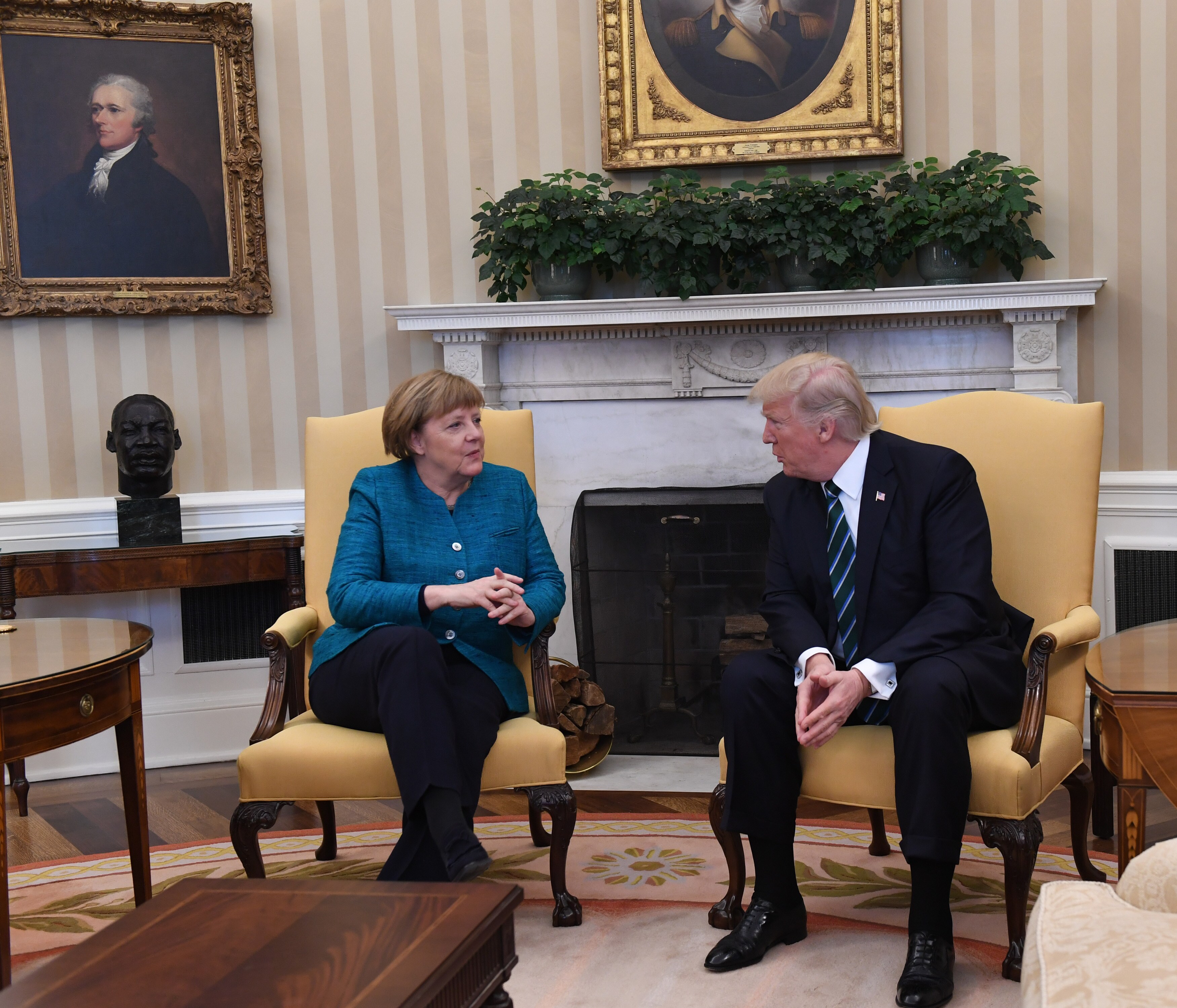
(Bloomberg) -- German Chancellor Angela Merkel gave her strongest indication yet that Europe and the U.S. under President Donald Trump are drifting apart, saying reliable relationships forged since the end of World War II “are to some extent over.”
Merkel's comments at a campaign rally signal that last week's Group of Seven and NATO summits will reinforce her effort to unite the European Union behind a global agenda that clashes with Trump's in key areas. She's receiving Indian Prime Minister Narendra Modi on Monday, hosts his Chinese counterpart, Li Keqiang, on Thursday, and is looking for a fresh start in German-French ties with newly elected President Emmanuel Macron.
Merkel and Seehofer sit in a beer tent,
The leader of Europe's biggest economy offered a glimpse of her world view after Trump concluded a nine-day foreign trip during which he hectored NATO allies for allegedly not spending enough on defense, called Germany's trade surplus “very bad” and brought the U.S. to the brink of exiting the global Paris climate accord.
“The times when we could fully rely on others are to some extent over -- I experienced that in the last few days,” Merkel told supporters in Munich on Sunday, a day after the G-7 meeting ended. “We Europeans must really take our destiny into our own hands.”
“Of course we need to have friendly relations with the U.S. and with the U.K. and with other neighbors, including Russia,” she said. Even so, “we have to fight for our own future ourselves.”
Being Honest
Merkel was speaking as a “deeply committed trans-Atlanticist,” her chief spokesman Steffen Seibert told reporters in Berlin on Monday. “Honestly pointing out differences is the right thing to do, precisely because trans-Atlantic relations are so important.”
The venue for Merkel's comments, a beer tent festooned with blue-and-white bunting set up by the chancellor's Bavarian allies in the Christian Social Union, showed the German leader in campaign mode ahead Germany's election in September. Before that, she'll host a Group of 20 summit in Hamburg in July.
Seeking her fourth term, Merkel, 62, brandished a tankard of beer after projecting herself as a defender of global stability after almost 12 years in office. She cited election victories over nationalist movements in France and the Netherlands as evidence that EU are voters were retreating from a populist surge.
‘Watershed Moment'
Richard Haass, president of the U.S. Council on Foreign Relations, called Merkel's comments on trans-Atlantic ties a “watershed” in a Twitter message, saying the scenario is “what U.S. has sought to avoid” since World War II.
Faced with a more unpredictable world, Europeans may now “move closer together and address what has been missing for so long, namely institutional reform and a way forward for the European Union, and the euro zone in particular,” Burkhard Varnholt, Credit Suisse Group's deputy chief investment officer, said in a Bloomberg Television interview.
Trump spurned overtures by mostly European leaders to commit to the Paris climate treaty at the weekend G-7 meeting, a development Merkel called “very unsatisfactory.” After first meeting Trump in Washington in March, Merkel has had little success in finding common ground with her new American counterpart.
Merkel speaks with Trump at the G7.
Despite Merkel's commitment to working toward NATO's goal for each member country to spend the equivalent of 2 percent of its economic output on defense by 2024, Trump dressed down the leaders of the alliance at a summit meeting on May 25 for “not paying what they should.” He spoke shortly after Merkel gave a two-minute speech lauding the alliance's common purpose.
Lederhosen and Dirndls
The German leader has hit back repeatedly as the Trump administration lambastes the country's trade surplus with the U.S. On climate, European officials have braced for a possible U.S. exit from the first international agreement that sets commitments on limiting global warming -- an accord put together in 2015 by almost 200 countries and strongly backed by Merkel.
Relations between Germany and the U.S. were strained in 2002-2003 when then-Chancellor Gerhard Schroeder refused to support the U.S. invasion of Iraq under President George W. Bush. Merkel's comments, though, signaled a broader trans-Atlantic split.
Merkel's line on reliability, Europe's need to plot its own course and her pledge to “fight” in Europe's interest drew extended applause from supporters dressed in lederhosen and dirndls.
Election Mode
Bavarian premier Horst Seehofer, who heads the CSU, shared the stage with Merkel and praised her for “representing our fatherland excellently” abroad.
The kudos by Seehofer, who pilloried Merkel throughout the country's refugee crisis for not doing enough to stem the flow of migrants, marked a turnaround. After three state election wins by her Christian Democratic Union since March, she's rebounded in polls against her main challenger, Social Democrat Martin Schulz.
Merkel's CDU and the CSU jointly lead the Social Democrats by 13 percentage points, according to an Emnid poll published Saturday, capturing a turnaround after Schulz lifted the SPD to a dead heat with the chancellor's bloc in February and March.
--With assistance from Nejra Cehic and Rainer Buergin
To contact the reporter on this story: Patrick Donahue in Munich at pdonahue1@bloomberg.net.
To contact the editors responsible for this story: Alan Crawford at acrawford6@bloomberg.net, Tony Czuczka, Kevin Costelloe

-
Navigating Energy Crossroads: S Jaishankar's Call For Diversified Supply Chains At G20 Ministerial Meeting

As geopolitical fault lines continue to test maritime trade routes and commodity flows, Jaishankar's message remains pertinent: true economic resilience requires open markets, protected transit lines, and a genuine commitment to multilateral cooperation rather than coercion.
-
Indians Are Travelling, But Not Every Journey Is A Holiday | The Week In Whys
Pilgrims, patients and working women are the real travellers, and the system hasn't quite caught up with them.
-
Getting To Work Costs Women More | The Reason Why
It is not just about women paying more than men. It is about women paying much more in cities than in villages.
-
AI Bias In Investing Cannot Be Eliminated, But It Can Be Governed
Framing is a particularly important example as identical financial information presented in terms of gains rather than losses can lead an LLM to reach a different assessment.
-
Joining The Dots | Dark Skies, Steady Diya: Why Hope Holds This Diwali
With war, a weak rupee and foreign outflows weighing on sentiment, policymakers at the NDTV World Summit and market veterans at NDTV Profit Ignite: Diwali Edition offered the same advice: stay invested and filter out the noise.
-
The Curious Case of Equitas Small Finance Bank And A CEO Who Quit For Stock
PN Vasudevan believes persistent investor concerns over a perceived conflict of interest had become a governance overhang on Equitas Small Finance Bank's stock, even as the lender improved profitability and asset quality.
-
Talking Points This Week: AI Cash Burn, A Tiger Comeback And An India That Still Finds Its Own Path
India is not immune to higher oil or tighter global liquidity, yet its earnings base is broader, its domestic policy levers are still available.
-
Foreign Investors Own Half Of HDFC Bank and ICICI Bank. An LTCG Cut Could Matter Most Here
Foreign portfolio investors have US$115 billion parked in HDFC Bank, ICICI Bank. If the government cuts long-term capital gains tax, Jefferies says returning foreign money could land here first.
-
'Never Seen This Level Of Negativity': Sandeep Tandon Says The Next Rally May Be Closer Than You Think
Veteran investor Sandeep Tandon says foreign selling is easing, large-caps are due a comeback and mid-caps are crowded, while he turns positive on gold, power and pharma this Diwali.










