Indian Fund Breaks Into Private-Equity Big Leagues By Raising Record $1.7 Billion

(Bloomberg) -- Kedaara Capital has broken the mold for Indian private equity firms, raising a record $1.7 billion to put it on par with the deep-pocketed global players that have dominated the space for years.
Fresh off the capital injection, Kedaara is now betting its local expertise and deep knowledge of the health, consumer and finance sectors will make it easier to work with firms like Blackstone Inc. and Carlyle Group Inc. that are hunting for deals in the world's fastest-growing major economy.
“Exits to global sponsors who have so much dry powder but not the same level of deal flow in the segment for larger deals will become a greater option for us,” Kedaara Co-Founder Sunish Sharma said in an interview from Mumbai.
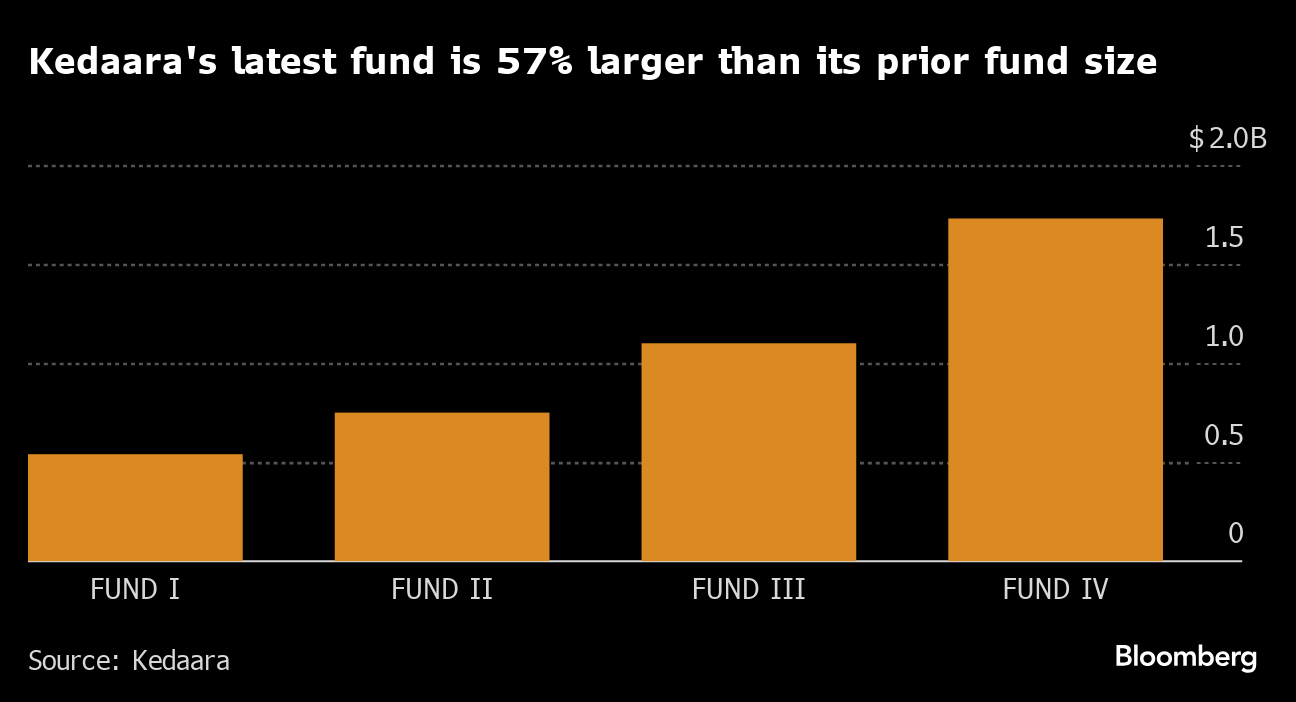
While raising $1 billion or more is common for giants like KKR & Co., it's rare in India, and Kedaara has now done it twice, following a $1.1 billion fund three years ago. As it puts more fresh money to work, Kedaara's portfolio investments could be targets for global players looking for majority stakes in fast-growing firms. Blackstone alone aims to add $25 billion in Indian assets, while KKR and Goldman Sachs Group Inc. are eyeing deals.
Read more: KKR Bets on Domestic Consumption, Private Credit in India Push
The new fund marks a watershed for Kedaara, a company backed by Clayton Dubilier & Rice LLC that was co-founded more than a decade ago by Sharma, along with Nishant Sharma and Manish Kejriwal, the former India head of Temasek Holdings Pte.
The three partners worked together at McKinsey & Co. and have built a team of 40 executives, including 24 investment professionals. Sunish and Nishant Sharma — no relation — are the deal makers, while Kejriwal and Sunish Sharma manage investors and fundraising. The firm runs about $5.6 billion in assets.
Kedaara Capital Investment Managers Ltd., which counts several Canadian pension funds, insurance giant Allianz SE and HarbourVest Partners LLC among its investors, generated a gross internal rate of return of 40% to March 24 for its first $540 million fund in 2013, Nishant Sharma said. The latest fund, which closed last month, brought in new investors including Singapore's GIC Pte and the University of Minnesota endowment, according to people familiar with the matter.
Kedaara is looking to make four investments a year from its latest fund, writing equity checks of $75 million to $200 million, while bringing in additional capital for larger deals. Kedaara aims to take three companies public this year and in 2025, Nishant Sharma said.
“When you get a window for an IPO, you take it and don't try to over-optimize it,” he said, adding that IPOs have been the dominant exit route for Kedaara, including Vedant Fashions Ltd. and microlender Spandana Sphoorty Financial Ltd.
Domestic Consumption
Kedaara has made 29 investments across its three funds in consumer-focused businesses, including financial services and adjacent industries like packaging materials. Those include AU Small Finance Bank Ltd., whose stock has more than doubled since going public in 2017. The fund also backed Vishal Mega Mart Pvt., which could raise as much as $1 billion in its initial public offering.
To capture new opportunities, Kedaara is building out its investment thesis around the intersection of health and consumers, where more businesses like Estee Lauder Cos-backed Forest Essentials skincare company will emerge in the next five years, according to Sunish Sharma.
In addition, the firm is exploring investments in consumer-driven preventive health businesses, and will draw on its experience with Vishal Mega Mart to expand in the packaged-food businesses.
“A big proportion of India still likes its biscuits and chips,” said Sunish Sharma.
In a sign of growth, Kedaara has moved to new offices in the Altimus building in Mumbai that's more than 60% larger than its previous space. Office neighbors include global firms like TPG Inc., Morgan Stanley and Ontario Teachers' Pension Plan.
International Hires
While Kedaara's investment focus will continue to be on India's domestic consumption, it's also looking to hire executives in the US to explore opportunities between the two countries, according to Nishant Sharma.
The firm plans to recruit a senior operating partner with a background in tech services and an understanding of the US to mentor the management teams at its portfolio companies, he said.
The US accounts for between 70% and 100% of the market for some Indian technology services companies, and many Indian entrepreneurs are creating firms there, Sunish Sharma said.
“The intent is to have a foot in both countries to build a channel for investments in India, and to take Indian companies to the world,” he said.
More stories like this are available on bloomberg.com
©2024 Bloomberg L.P.

-
Talking Points This Week: Tech Nerves, FII Buying, And A Faraway Banking Shock

The global markets are not shining this Diwali. The exception in the large markets is, India.
-
Midterm Rally Lasted A Day. The Hard Reality Of A Divided US May Last Two Years | Opinion
Between a contested AI boom, a debt ceiling that arrives in 2027 and a president with every incentive to act alone, the next two years may prove more volatile than the first day's rally suggests.
-
Blue Wave Will Derail the AI Trade but Won't Dismantle the AI Era | Unhedged Position
The Democrats' sweep of the US Congress will see politics collide with economic forces both over the long and short term.
-
It's Time To Take The GST Council's Bet On Trust Global
Payment records can prove India's services exports, and clear, proportionate rules can bring foreign digital sellers into the tax net.
-
Opinion | India at 38: From Innovation Overperformer to Innovation Powerhouse
India now has 453 VC-backed deep science startups, 18 of them late-stage, after 117 percent growth since 2020. Laurus Labs, at USD 9.3 billion, is the most valuable deep science company in any middle-income economy outside China.
-
Navigating Energy Crossroads: S Jaishankar's Call For Diversified Supply Chains At G20 Ministerial Meeting
As geopolitical fault lines continue to test maritime trade routes and commodity flows, Jaishankar's message remains pertinent: true economic resilience requires open markets, protected transit lines, and a genuine commitment to multilateral cooperation rather than coercion.
-
Indians Are Travelling, But Not Every Journey Is A Holiday | The Week In Whys
Pilgrims, patients and working women are the real travellers, and the system hasn't quite caught up with them.
-
Getting To Work Costs Women More | The Reason Why
It is not just about women paying more than men. It is about women paying much more in cities than in villages.
-
AI Bias In Investing Cannot Be Eliminated, But It Can Be Governed
Framing is a particularly important example as identical financial information presented in terms of gains rather than losses can lead an LLM to reach a different assessment.









