Michael Burry, Raghuram Rajan Saw The 2008 Crash Coming — They're Sounding The Alarm Again
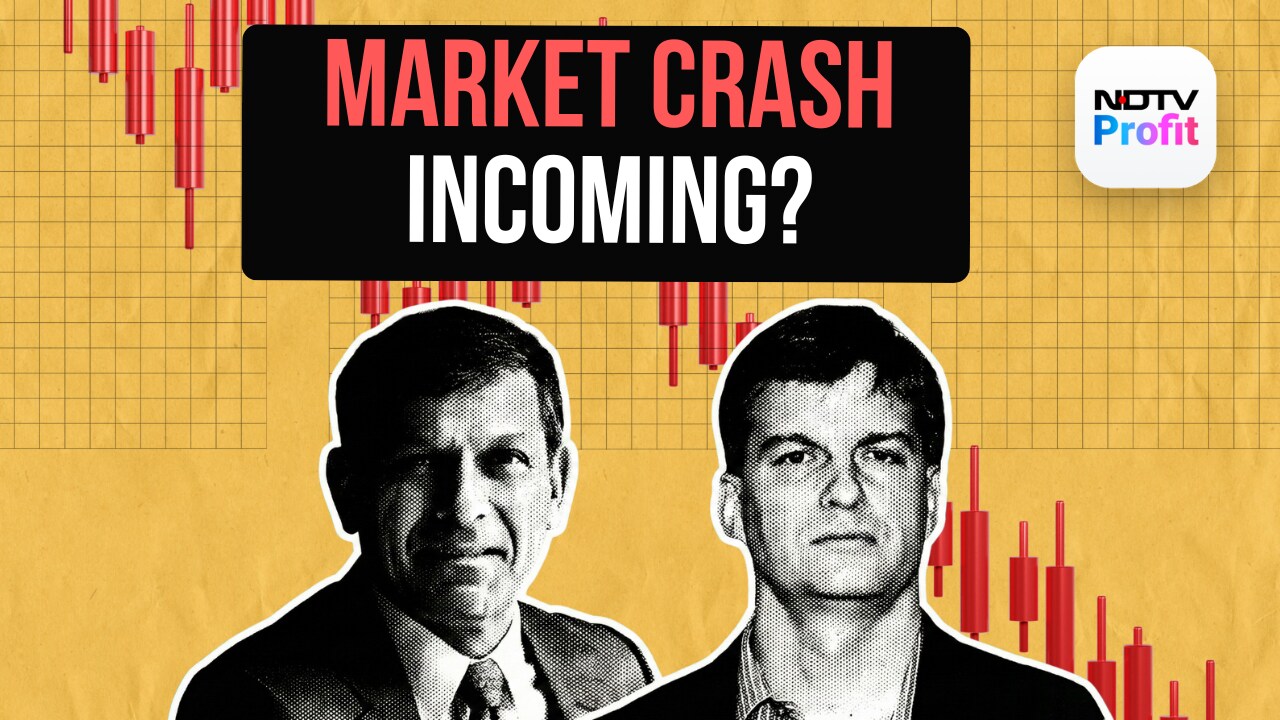
The 2000 dot-com bubble, and the 2008 market crash altered global markets and economies. During those times, a few economists and market watchers had warned of the tsunami that was about to hit. Those murmurs are back and this time the AI bubble may make things worse still.
But should you really be concerned?
Three experts that called the crashes — Michael Burry, Raghuram Rajan, and Howard Marks — and they're are calling it again, and think you should be moderately cautious.
The Big Short Strikes Again?
American investor Michael Burry, in a recent podcast 'Against The Rules', said that he thinks, "the whole thing is just going to come down. And it would then be very hard to protect your stock portfolio."
He backed his claim up by noting that currently, over 50% of the money in the stock markets is invested in passive money. He also said that only a mere 10% is invested for the long-term. This, he claims, will be the reason for a "longer bear market that is akin to the 2000 bubble."
Burry advises the listeners that if you own something that has risen a lot, "and is shooting straight up, and you think it's overvalued, you should sell it."
A Mix Of 2001-2008?
Economist and Former RBI Governor Raghuram Rajan was deemed a person who was afraid of progress when he presented a paper in 2005, warning of a great financial bubble.
At a recent UBS conference in Zurich, he said that now have a combination of the 2001 and 2008 bubbles. Rajan remarked, "I think it's early days, but it's time to get cautious." He said that the frenzy over AI reminds him of the dot com craze in 2000, and the credit ballooning and liquidity by the central banks is eerily similar to 2008.
Rajan noted that many of the now top-scaling AI companies were using internal cash flows to invest in AI. However, now they are forming special purpose vehicles (circular financing with their peers, for example) for additional financing. He cautioned that it all depends on the unknown AI demand.
Is It A Bubble?
Another American investor Howard Marks has a similar sentiment. After calling the slow trainwreck that was soon to come before the 2008 crash, and holding on to $11 billion in cash, he made sure to start investing in September 2008 when the crash was at its peak.
In a recent memo, titled 'Is It A Bubble?' uploaded on his company Oaktree Capital's website, he wrote that “in the current market, I'd advise that no one should go all-in without acknowledging that they face the risk of ruin if things go badly. But no one should stay all-out either. Adopt a moderate approach.”
Red Flags Of The AI Bubble
In November, Ruchir Sharma, the chairperson of Rockefeller International, said that the current wave of enthusiasm from investors across domestic and global markets to invest in artificial intelligence is "the most hated bubble in history".
He pointed to certain factors that have been consistent before some of teh most impactful market crashes in history — increasing valuations, fast spikes in investment and increasing leverage.
No Magic Words In Investing
The AI bubble finally bursting may be the onset of emotionally complicated times, and market veterans have started calling it.
As Marks put it in his memo, "it's essential to bear in mind that there are no magic words in investing. These days, people promoting real estate funds say, “Office buildings are so yesterday, but we're investing in the future through data centers,” whereupon everyone nods in agreement. But data centers can be in shortage or in oversupply, and rental rates can surprise. As a result, they can be profitable . . . or not."

-
High US Salaries, No Green Card Certainty: The Financial Calculation Facing Indian H-1B Families

The suspension of PERM processing at eight technology employers does not cancel existing H-1B visas. What it does is force a question many Indian families have been avoiding: is the US salary worth tying your career and family plans to one employer?
-
Swiggy vs Eternal: Food Delivery's Two Rivals Are No Longer In The Same Race
Eternal is building a private AI assistant, dark.ai. Swiggy is still working out how to make Instamart pay, with an operating loss of Rs 895 crore in the July-September quarter while Blinkit stayed profitable.
-
Where You Live Shapes How You Get To Work | The Reason Why
Two-wheelers are the most popular way to get to work in India, accounting for nearly 43% of workplace commutes.
-
Unhedged Position: Can India See An Indonesia-Style Time Correction?
The Nifty is trading below levels it first clocked in 2024. Is there, then, as I have suggested in the headline, potential that the current time correction drags on painfully for the next three-five, even ten years?
-
Navigating Friction And Energy Realities: An Analysis Of Marco Rubio's October Visit To India
Occurring at a critical juncture marked by stalled trade negotiations and escalating geopolitical pressures over global energy supplies, the visit offers a profound window into modern US-India relations.
-
India Exports Capital. Why Not Export Trusteeship?
The big question, then, is whether India can build an institution that global borrowers, investors, banks, and lawyers can trust, even without an Indian connection.
-
France's Economy & Politics Are In Crisis | The Reason Why
Let's look at how the French economy and politics evolved under Nicolas Sarkozy, Franois Hollande and Emmanuel Macron.
-
You May Inherit The Business. You Must Earn Its Credibility.
Succession tests the founder's ability to share authority as much as it tests the next generation's readiness to assume it.
-
Signing Deals Is One Thing; Making Them Work Is Another | The Week In Whys
Sometimes, things don't turn out as planned. Indian companies have lost some bids to rivals, some projects won't produce until 2030.
-
FOMC Wall, PERM Suspension, Hospital Stocks | Talking Points This Week
A PERM suspension would directly affect green-card sponsorship rather than H-1B visas, so the near-term earnings impact could remain relatively limited. The key question is whether this marks a new phase in US scrutiny of Indian IT.









