L&T Q2 Review: Shares Volatile Even As Profit Beats Estimates
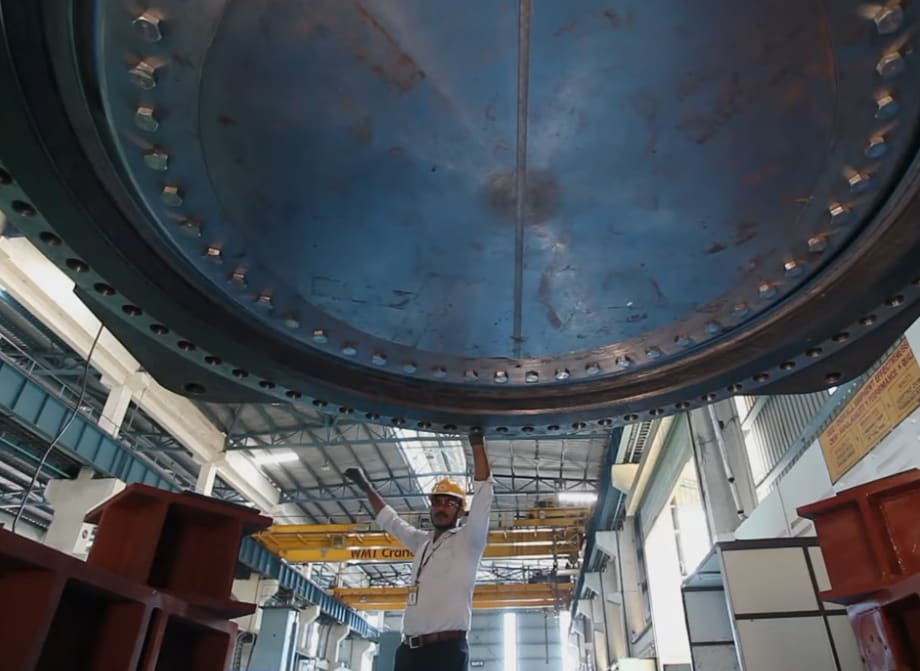
Shares of Larsen & Toubro Ltd. were volatile even as its second-quarter profit beat analysts' estimates.
Most brokerages said that core Ebitda margin was below their estimates due to commodity headwinds during the last phase of projects. The company's management, however, has said that's unlikely to recur in the third quarter.
L&T's net profit rose 26% year-on-year to Rs 2,819 crore in the three months ended Sept. 30, according to an exchange filing. That compares with the Rs 2,334.4-crore consensus estimate of analysts tracked by Bloomberg. The earnings were largely driven by strong performance across segments, primarily led by information technology and financial services.
L&T Q2 FY23 Highlights (YoY)
Revenue from operations rose 23% to Rs 42,762.6 crore, compared with the estimated Rs 39,149.3 crore.
Operating profit rose 23% to Rs 4,899.4 crore against the Rs 4,378-crore forecast.
Operating margin came in at 13.7%, against 11.5% a year earlier.
Here's what brokerages made of L&T's quarterly results:
Nomura
Maintains ‘Buy' but increases target price to Rs 2,425, implying a potential upside of 20%.
The brokerage said that L&T delivered a robust Q2FY23 on execution and order inflows, but infrastructure segment Ebitda margins were impacted by 80 basis points due to close-out challenges in a couple of projects, which are now behind us.
Nomura expects Ebitda margins to rebound from H2FY23 as commodity prices have corrected sharply. Further, divestment of road concessions (management expects in FY23) can act as catalyst.
The brokerage factors 10 basis points/20 basis points higher core Ebitda margin for FY24/25 as commodity prices correct.
Core Ebitda margin at 8.1% was below their estimate of 8.8% due to commodity headwinds from the closeout challenges of several projects (management estimates impact of 80 basis points), a result of job-mix and cost pressure in certain cost jobs. Core Ebitda margins will normalize to 10% by FY24, said Nomura.
Management stated that closeout challenges are unlikely to recur in Q3FY23.
Revenue and order inflow guidance retained for FY23 but appears conservative against present trends. Based on the tender-to-award ratio of 50-55% in H2FY23, the brokerage estimates FY23 order inflow growth at 20% annually.
Similarly, based on H1FY23 execution rate and with only 3-4% slow-moving orders in order book, Nomura estimates 17% sales growth against guidance of 12-15%.
Jefferies
L&T's Q2FY23 Ebitda was 7% better than expectations. Order flow growth was strong at 23% YoY driven by domestic projects.
Prospect pipeline is down 7% YoY. Management maintained its 12-15% YoY order flow and revenue growth guidance with confidence in touching upper-end, though a caution was sounded on margin improvement.
The brokerage believes L&T should benefit from execution and margin recovery as impact of supply disruptions and sharp commodity price rise has eased.
Centre and PSUs are driving spend, while states are yet to pick up in execution and award-to-tender ratio.
Private sector capex is 18-20% of the prospect pipeline and directionally more than 10% higher YoY.
Buildings and factories, and minerals and metals segments are the main drivers.
Middle East spend is on both hydrocarbon and green energy infrastructure. India's infra spend is broad-based and across sub-sectors, but for L&T the transport vertical is weaker given the selective approach.
L&T's first-half order flow was up 36% YoY; domestic up 54% and international 15%.
Oil prices between $80-100 is a positive for L&T as both India and ME tend to do well on capex and FY23E is one of those few years in the company's history that the outlook for both is bright.
Operating margins in Q2FY23 were 80 bps lower YoY at 8.2% and should recover as execution momentum is maintained.
Management mentioned that weaker margins in solar EPC projects were already factored in the 9.5% FY23E margin guidance. Thermal plants of 4 GW are providing an additional opportunity.
Morgan Stanley
Management reiterated guidance for revenue and order inflow growth of 12-15% and is likely to hit the upper end.
FY23 core margin outlook is seen at 9.5%, but commodity prices are trending lower and should help procurement in second-half of the fiscal year.
Net working capital/sales was 20.2% down 180 basis points YoY.
Return on equity was 12.1%, up 30 basis points YoY.
Order inflows were driven by infrastructure and hydrocarbon segments.
Infra execution was driven by a strong order book and improved collections.
Supply-chain related challenges affected hydrocarbon. Lower order book affected power.
Management sees healthy prospects pipeline for H2FY23.
Order book: domestic 72%, Middle East 22%, and Rest of the world 5%.
The brokerage sees Increased spending by the government as a positive risk to the stock.
The other positives include moderation in steel and other material prices during the year.
A pickup in the economy may lead to a higher-than-anticipated private capex which would help the stock positively.
Slowdown in government-led infra capex can be seen as a downside risk.
The other negative for the stock would be deterioration in domestic execution cycle and geopolitical risks that may affect the execution of international projects.
A sharp increase in material costs would be other risk to the downside.

-
It's Time To Take The GST Council's Bet On Trust Global

Payment records can prove India's services exports, and clear, proportionate rules can bring foreign digital sellers into the tax net.
-
Opinion | India at 38: From Innovation Overperformer to Innovation Powerhouse
India now has 453 VC-backed deep science startups, 18 of them late-stage, after 117 percent growth since 2020. Laurus Labs, at USD 9.3 billion, is the most valuable deep science company in any middle-income economy outside China.
-
Navigating Energy Crossroads: S Jaishankar's Call For Diversified Supply Chains At G20 Ministerial Meeting
As geopolitical fault lines continue to test maritime trade routes and commodity flows, Jaishankar's message remains pertinent: true economic resilience requires open markets, protected transit lines, and a genuine commitment to multilateral cooperation rather than coercion.
-
Indians Are Travelling, But Not Every Journey Is A Holiday | The Week In Whys
Pilgrims, patients and working women are the real travellers, and the system hasn't quite caught up with them.
-
Getting To Work Costs Women More | The Reason Why
It is not just about women paying more than men. It is about women paying much more in cities than in villages.
-
AI Bias In Investing Cannot Be Eliminated, But It Can Be Governed
Framing is a particularly important example as identical financial information presented in terms of gains rather than losses can lead an LLM to reach a different assessment.
-
Joining The Dots | Dark Skies, Steady Diya: Why Hope Holds This Diwali
With war, a weak rupee and foreign outflows weighing on sentiment, policymakers at the NDTV World Summit and market veterans at NDTV Profit Ignite: Diwali Edition offered the same advice: stay invested and filter out the noise.
-
The Curious Case of Equitas Small Finance Bank And A CEO Who Quit For Stock
PN Vasudevan believes persistent investor concerns over a perceived conflict of interest had become a governance overhang on Equitas Small Finance Bank's stock, even as the lender improved profitability and asset quality.
-
Talking Points This Week: AI Cash Burn, A Tiger Comeback And An India That Still Finds Its Own Path
India is not immune to higher oil or tighter global liquidity, yet its earnings base is broader, its domestic policy levers are still available.










