JPMorgan Holds Off On Adding India To Bond Index, Keeps On Watch

(Bloomberg) -- JPMorgan Chase & Co. is keeping Indian government bonds off its emerging-market sovereign bond index for now, citing investment hurdles that must be resolved for the inclusion to take place.
The decision to refrain from adding the bonds to the JPMorgan Government Bond Index-Emerging Markets -- while keeping them under review for inclusion -- was based on investor feedback, the index provider said Tuesday.
“Investors cited investment hurdles that need to be resolved, including a lengthy investor registration process and the operational readiness required for trading, settlement and custody of assets onshore,” the team led by the firm's global head of index research, Gloria Kim, said in a statement.
Last month, India ruled out any change to tax policies to make it easier for its bonds to be included in global indexes, Bloomberg reported, citing people familiar with the matter. The government wanted to be self-reliant in its funding, was concerned foreign inflows would increase market volatility and didn't plan to waive capital gains taxes -- a stumbling block in previous negotiations, they said.
India Unwilling to Bend for Index Inclusion to Bring in Billions
The country's debt will remain on watch for index inclusion and will continue to fall under the so-called Fully Accessible Route, or FAR, JPMorgan said. FTSE Russell kept the nation's bonds on index watch in its review last week.
Investor Expectations
The announcement is expected to weigh on market sentiment, disappointing investors who expected the bonds to be finally included in the bank's key gauges -- a move that would have made it easier for overseas investors to put their money into Asia's third-biggest economy with its $1 trillion government debt market. Expectations for index inclusion had surged after Morgan Stanley last month said the index provider was consulting investors for a possible change after Russia's removal due to the war in Ukraine.
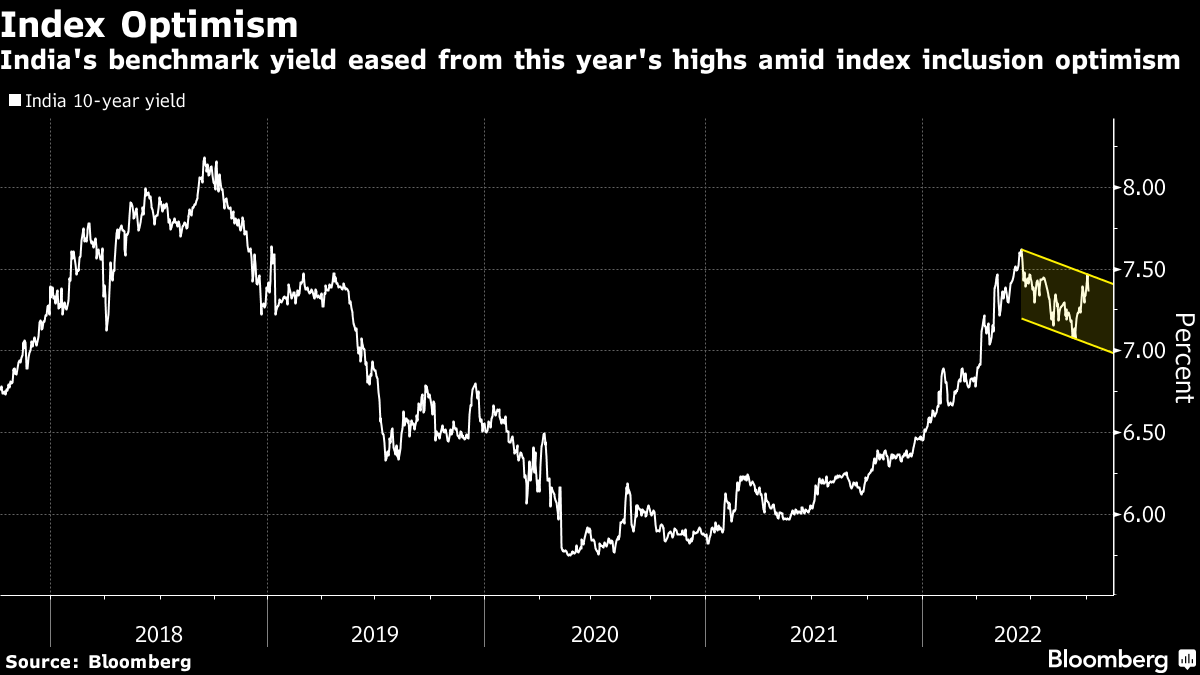
Renewed speculation surrounding index inclusion contributed to about 40 billion rupees of inflows into the FAR bonds in September, following a 42 billion rupees-inflow in August, the biggest amount in seven months. The yield on benchmark 10-year bonds eased more than 20 basis points since this year's high reached mid-June amid index-inclusion optimism.
Any inclusion into JPMorgan's index may be delayed to early next year, Reuters reported on Sept. 27, citing people it didn't name.
“Euphoria in the market was because the index review was happening,” said Rajeev Pawar, head of treasury at Ujjivan Small Finance Bank Ltd. in Mumbai. “We expect, maybe, in the February budget some announcements to come. Then, maybe index inclusion to follow after that.”
Problematic Areas
JPMorgan cited several areas that investors found problematic with Indian bond markets, including the three- to six-month registration timeline for investors to set up new accounts. Investors also highlighted delays -- especially around monthly and quarter-end rebalancings -- in the repatriation of proceeds from bond sales beyond the settlement period, typically tied to tax liability snafus, the indexer said. There was also some risk tied to the failure of onshore bond trades that fail to be matched on the same day, according to the firm's investor feedback.
“We will continue to engage with the regulators and market participants, and gather feedback on sufficient resolutions for the remaining hurdles,” JPMorgan's Kim said.
Bloomberg LP is the parent company of Bloomberg Index Services Ltd, which administers indexes that compete with those from other service providers.
(Updates with context on government concerns and potential delay timeline.)
More stories like this are available on bloomberg.com
©2022 Bloomberg L.P.

-
Love, Sex Aur Dhokha: The Audacious Plot To Spy On Jensen Huang

A Taipei dinner, a Singapore chip buyer and a suspected Chinese asset: inside the alleged spy operation that got close to NVIDIA's Jensen Huang.
-
Ten Things I Learnt This Samvat
Patience can be a trap. Cheap stocks can stay cheap. Leverage can wipe you out. What did Samvat 2082 teach us? Niraj Shah writes on 10 lessons from the year gone by.
-
Talking Points This Week: Tech Nerves, FII Buying, And A Faraway Banking Shock
The global markets are not shining this Diwali. The exception in the large markets is, India.
-
Midterm Rally Lasted A Day. The Hard Reality Of A Divided US May Last Two Years | Opinion
Between a contested AI boom, a debt ceiling that arrives in 2027 and a president with every incentive to act alone, the next two years may prove more volatile than the first day's rally suggests.
-
Blue Wave Will Derail the AI Trade but Won't Dismantle the AI Era | Unhedged Position
The Democrats' sweep of the US Congress will see politics collide with economic forces both over the long and short term.
-
It's Time To Take The GST Council's Bet On Trust Global
Payment records can prove India's services exports, and clear, proportionate rules can bring foreign digital sellers into the tax net.
-
Opinion | India at 38: From Innovation Overperformer to Innovation Powerhouse
India now has 453 VC-backed deep science startups, 18 of them late-stage, after 117 percent growth since 2020. Laurus Labs, at USD 9.3 billion, is the most valuable deep science company in any middle-income economy outside China.
-
Navigating Energy Crossroads: S Jaishankar's Call For Diversified Supply Chains At G20 Ministerial Meeting
As geopolitical fault lines continue to test maritime trade routes and commodity flows, Jaishankar's message remains pertinent: true economic resilience requires open markets, protected transit lines, and a genuine commitment to multilateral cooperation rather than coercion.
-
Indians Are Travelling, But Not Every Journey Is A Holiday | The Week In Whys
Pilgrims, patients and working women are the real travellers, and the system hasn't quite caught up with them.









