It May Be A Good Time To Pull Back From Indian Equities, Says Deutsche Bank
.jpg?downsize=1010:568 "It May Be A Good Time To Pull Back From Indian Equities, Says Deutsche Bank")
The party may soon be over for Indian equities, warns a research report put out by Deutsche Bank. One of India's benchmark indices, the S&P BSE Sensex is just 3.5 percent from its all-time high of 30,024.74, gaining 8.8 percent so far in the first two months of 2017, on the back of surging domestic fund flows and a pick up in foreign institutional investments, post the Union Budget which was tabled on February 1. But the brokerage house in its report warns that this “liquidity-driven” expansion in valuations is unlikely to sustain much longer, and it might be “time for a pullback.”
The recent rally has made India the second-best-performing market, after the Hang Seng index in Asia this year. And at 28,984, the closing price as on March 1, the Sensex index is trading at 16.85 times its earnings forecast by Bloomberg for calendar year 2018, making it one of the most expensive emerging market indices, at the moment.
“With no material change in earnings estimates and no visible evidence suggesting the risk of consensus earnings downgrades – seen over the past three consecutive years - is now firmly behind us, the liquidity driven expansion in valuations looks unlikely to sustain,” the bank said in its markets research report titled Lights turning amber, time for pullback.
While we remain excited about the roll-out of the GST (Goods and Services Tax) in July, we see this impacting consensus earnings in 2H (second half) following the rollout. The BSE Sensex is now trading at a 12-month forward P/E (price-to-earnings ratio) of 17 times (consensus), which is in line with its past five-year average.Deutsche Bank Report.
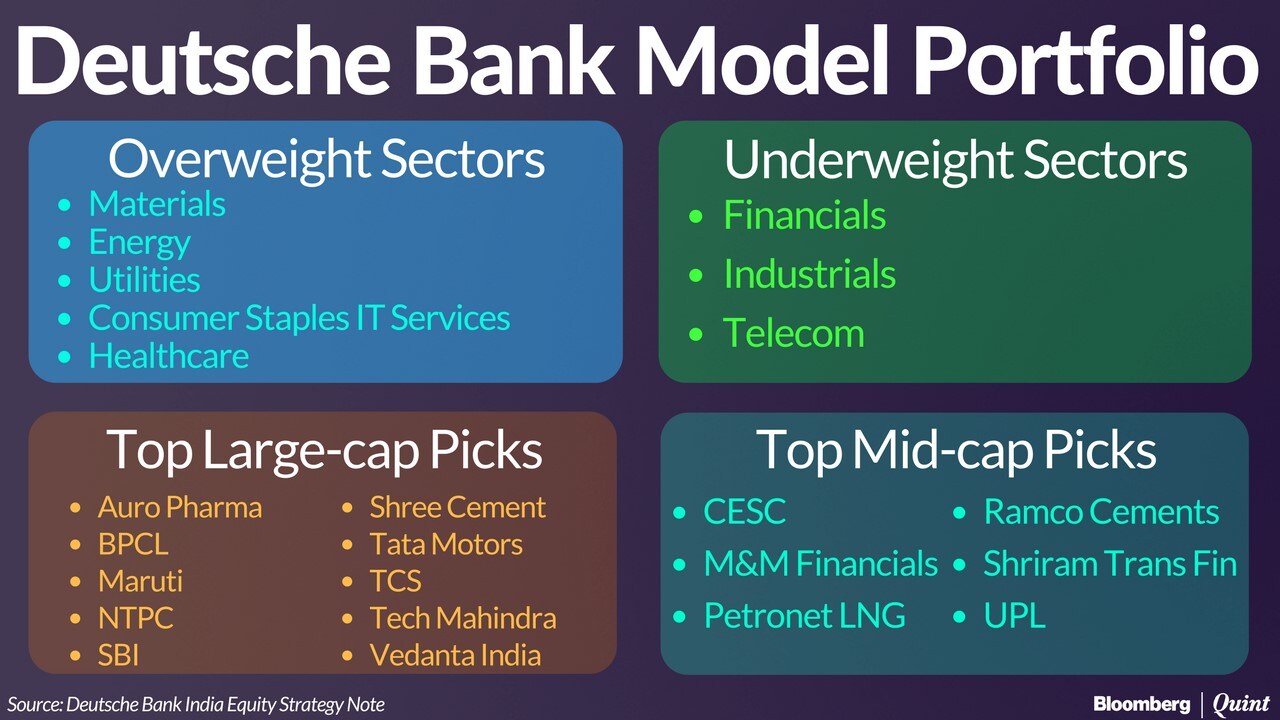
As much as 55 percent of Deutsche Bank's coverage universe is currently trading either at or above the five-year average valuations. Its the private banks, select non-banking financial companies (NBFCs), cement and consumer staples that look to be the most expensive, according to the brokerage house's calculations.
The financial sector is the “biggest underweight” in the model portfolio, as Deutsche Bank sees near-term headwinds for Indian financial institutions.
Muted loan growth is expected to continue to weigh in on net interest margins (NIMs), while treasury gains – a key source of earnings for financial institutions – is also at risk after bond yields spiked by 45-50 basis points, post the Reserve Bank of India's (RBI) last monetary policy, says the brokerage house.
Slow loan growth is likely to result in lower net interest margins (NIMs), while treasury gains – a key source of earnings – are also at risk after a 45-50-basis-point spike in bond yields post the Reserve Bank of India (RBI) monetary policy. Reliance on treasury has been high recently, even as banks have used it to make high provisions. Post demonetisation, the rush of deposits was used to buy government bonds which may also be out of money now.
Unlike the past, higher bond yields are not associated with better growth and improving NIMs. Even asset resolutions remain slow.
Also Read: M&A Optimism Leads Morgan Stanley To Raise Sensex Target To 33,000
On the other hand, its the pharmaceutical sector that's back in favour with Deutsche Bank which has raised it to the ‘overweight' category. The reason for this upgrade is the brokerage house's belief that the U.S. Food and Drug Administration (FDA) worries appear to be ‘overdone' and the below-average valuations make it a good time to invest in the sector.
“Pharmaceuticals appear to offer value with five out of eight companies under coverage trading sharply below the past five year average valuations,” the report added.
While the sector has seen a severe de-rating over past twelve months due to multiple headwinds, over the past three months, the larger drug manufacturing companies like Lupin Ltd., Cadila Healthcare Ltd., Aurobindo Pharma Ltd., Glenmark Pharmaceuticals Ltd. and Cipla Ltd. have received fewer observations and have successfully resolved their outstanding U.S. FDA issues. “We believe that Sun Pharmaceutical Industries Ltd.'s valuation de-rating appears excessive (stock trading at valuation which is 31 percent below past five year average) and worries overdone,” the report added.
According to the report, Bajaj Finance Ltd., Yes Bank Ltd., Whirlpool India Ltd., Bharat Forge Ltd. and Indraprastha Gas Ltd. stand out with valuations far above the mean. Sun Pharmaceuticals, Jubilant Foodworks Ltd., Cipla, ICICI Bank Ltd. and Wipro Ltd. on the other hand, trade at valuations below mean.

-
Navigating Energy Crossroads: S Jaishankar's Call For Diversified Supply Chains At G20 Ministerial Meeting

As geopolitical fault lines continue to test maritime trade routes and commodity flows, Jaishankar's message remains pertinent: true economic resilience requires open markets, protected transit lines, and a genuine commitment to multilateral cooperation rather than coercion.
-
Indians Are Travelling, But Not Every Journey Is A Holiday | The Week In Whys
Pilgrims, patients and working women are the real travellers, and the system hasn't quite caught up with them.
-
Getting To Work Costs Women More | The Reason Why
It is not just about women paying more than men. It is about women paying much more in cities than in villages.
-
AI Bias In Investing Cannot Be Eliminated, But It Can Be Governed
Framing is a particularly important example as identical financial information presented in terms of gains rather than losses can lead an LLM to reach a different assessment.
-
Joining The Dots | Dark Skies, Steady Diya: Why Hope Holds This Diwali
With war, a weak rupee and foreign outflows weighing on sentiment, policymakers at the NDTV World Summit and market veterans at NDTV Profit Ignite: Diwali Edition offered the same advice: stay invested and filter out the noise.
-
The Curious Case of Equitas Small Finance Bank And A CEO Who Quit For Stock
PN Vasudevan believes persistent investor concerns over a perceived conflict of interest had become a governance overhang on Equitas Small Finance Bank's stock, even as the lender improved profitability and asset quality.
-
Talking Points This Week: AI Cash Burn, A Tiger Comeback And An India That Still Finds Its Own Path
India is not immune to higher oil or tighter global liquidity, yet its earnings base is broader, its domestic policy levers are still available.
-
Foreign Investors Own Half Of HDFC Bank and ICICI Bank. An LTCG Cut Could Matter Most Here
Foreign portfolio investors have US$115 billion parked in HDFC Bank, ICICI Bank. If the government cuts long-term capital gains tax, Jefferies says returning foreign money could land here first.
-
'Never Seen This Level Of Negativity': Sandeep Tandon Says The Next Rally May Be Closer Than You Think
Veteran investor Sandeep Tandon says foreign selling is easing, large-caps are due a comeback and mid-caps are crowded, while he turns positive on gold, power and pharma this Diwali.










