Intel Slides After Tepid Forecast Shows Comeback Challenges
(Bloomberg) -- Intel Corp., the biggest maker of personal computer processors, tumbled in late trading after giving a lackluster forecast for the current period, indicating that it's still struggling to return to the top tier of the chip industry.
Sales in the second quarter will be about $13 billion, the company said in a statement Thursday. That compares with an average analyst estimate of $13.6 billion, according to data compiled by Bloomberg. Profit will be 10 cents a share, minus certain items, versus a projection of 24 cents.
The outlook signals that a push by Chief Executive Officer Pat Gelsinger to revitalize Intel is going to take more time and money. Once the world's dominant chipmaker, the company is lagging behind rivals such as Nvidia Corp. and Taiwan Semiconductor Manufacturing Co. in revenue and technological know-how.
While acknowledging that business has been slower than expected, Chief Financial Officer Dave Zinsner said he expected an improvement later this year. Intel also wasn't able to meet all the demand for processors used in new AI-enabled PCs because its packaging facilities weren't able to produce enough components.
“The first half of the year has been a bit softer than we'd have liked,” he said in an interview. “The back half of the year is going to have some pretty good strength in it.”
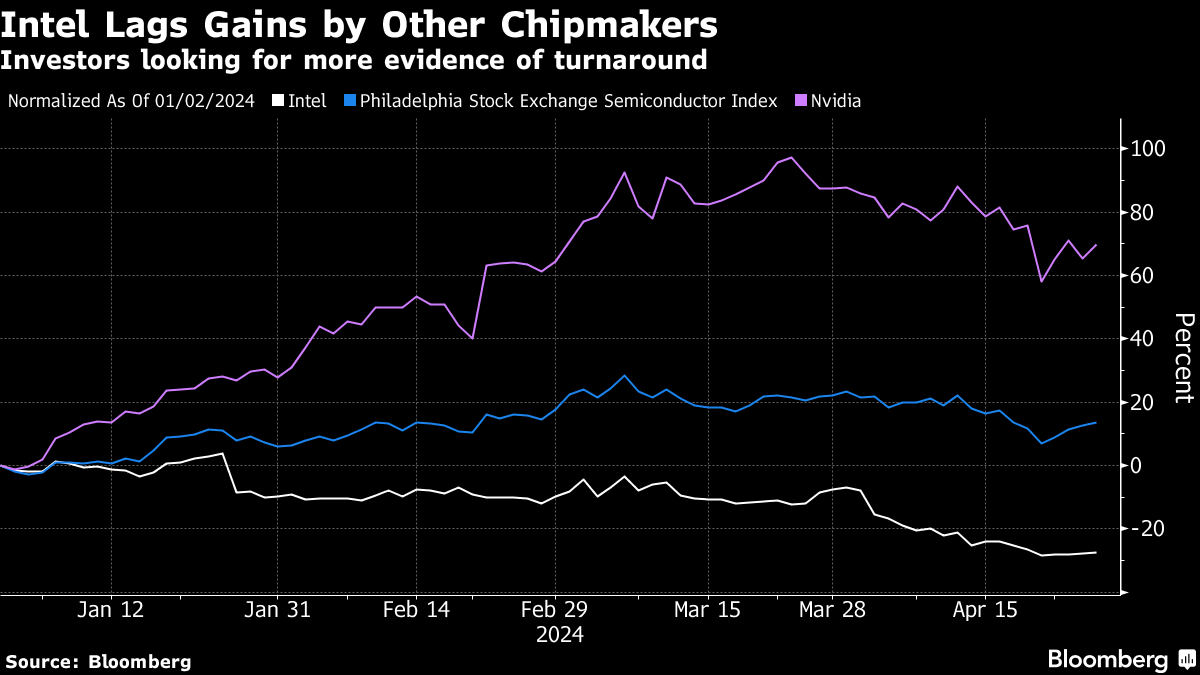
Intel shares fell as much as 9.4% in extended trading after the report was released. The stock had already declined 30% this year through the close, making it the second-worst performer on the Philadelphia Stock Exchange Semiconductor Index.
In the first quarter, the Santa Clara, California-based company had a profit of 18 cents a share, excluding certain items, and revenue of $12.7 billion. Analysts had estimated a profit of 13 cents a share and sales of $12.7 billion.
The chipmaker is reporting earnings for the first time under a new business structure that shows the financial performance of its manufacturing operations. Gelsinger has said the approach is a necessary step to make operations more efficient and competitive. Intel also has been building up a foundry business, which manufactures components for outside companies on a contract basis.
Read More: Intel Suffers Worst Decline in Two Months on Downbeat Outlook
Earlier this month, the company gave investors the first look at the financial state of its factory network. It wasn't encouraging. Spending on new plants has caused losses to widen, and Intel doesn't expect the business to reach a break-even point for several years.
Intel Foundry, the new division responsible for manufacturing, had sales of $18.9 billion in 2023, down from $27.5 billion the previous year. The unit had revenue of $4.4 billion in the first quarter of 2024.
The foundry business had an operating loss of about $2.5 billion in the first quarter, wider than the losses posted in the preceding quarter and the one a year earlier.
The company's PC-related chip sales were $7.5 billion, compared with an average estimate of $7.4 billion. Its data center and AI division had revenue of $3 billion, in line with Wall Street projections. Networking chips provided nearly $1.4 billion of sales, beating an average estimate of $1.3 billion.
Gross margin — or the percentage of sales remaining after deducting the cost of production — was 45.1% in the quarter. That closely watched measure, which reflects the efficiency of Intel's manufacturing operations, will be 43.5% in the current period. Historically Intel has posted margins of more than 60%.
Intel remains optimistic about the second half of the year because it's rolling out a new version of the Gaudi chip — its answer to the red-hot AI accelerators sold by Nvidia. That product line will bring in about $500 million in sales this year, once the latest version goes on sale, Intel projected.
The company also is making progress at reining in costs and expects the manufacturing business to break even in the “next couple of years,” Zinsner said.
Gelsinger said the company has signed up another customer for a production technology called 18A, which Intel will introduce in 2025. That brings the total to six. The customer, which Intel didn't identify, is in the aerospace-defense industry and wants production located in the US, Gelsinger said.
So far, the chipmaker has only been able to name one company that's signed up to use 18A: Microsoft Corp. It plans to rely on Intel to produce certain types of in-house chip designs that the software maker is working on.
(Updates with comments on foundry business, AI chips in penultimate paragraph.)
More stories like this are available on bloomberg.com
©2024 Bloomberg L.P.

-
It's Time To Take The GST Council's Bet On Trust Global

Payment records can prove India's services exports, and clear, proportionate rules can bring foreign digital sellers into the tax net.
-
Opinion | India at 38: From Innovation Overperformer to Innovation Powerhouse
India now has 453 VC-backed deep science startups, 18 of them late-stage, after 117 percent growth since 2020. Laurus Labs, at USD 9.3 billion, is the most valuable deep science company in any middle-income economy outside China.
-
Navigating Energy Crossroads: S Jaishankar's Call For Diversified Supply Chains At G20 Ministerial Meeting
As geopolitical fault lines continue to test maritime trade routes and commodity flows, Jaishankar's message remains pertinent: true economic resilience requires open markets, protected transit lines, and a genuine commitment to multilateral cooperation rather than coercion.
-
Indians Are Travelling, But Not Every Journey Is A Holiday | The Week In Whys
Pilgrims, patients and working women are the real travellers, and the system hasn't quite caught up with them.
-
Getting To Work Costs Women More | The Reason Why
It is not just about women paying more than men. It is about women paying much more in cities than in villages.
-
AI Bias In Investing Cannot Be Eliminated, But It Can Be Governed
Framing is a particularly important example as identical financial information presented in terms of gains rather than losses can lead an LLM to reach a different assessment.
-
Joining The Dots | Dark Skies, Steady Diya: Why Hope Holds This Diwali
With war, a weak rupee and foreign outflows weighing on sentiment, policymakers at the NDTV World Summit and market veterans at NDTV Profit Ignite: Diwali Edition offered the same advice: stay invested and filter out the noise.
-
The Curious Case of Equitas Small Finance Bank And A CEO Who Quit For Stock
PN Vasudevan believes persistent investor concerns over a perceived conflict of interest had become a governance overhang on Equitas Small Finance Bank's stock, even as the lender improved profitability and asset quality.
-
Talking Points This Week: AI Cash Burn, A Tiger Comeback And An India That Still Finds Its Own Path
India is not immune to higher oil or tighter global liquidity, yet its earnings base is broader, its domestic policy levers are still available.










