India’s Long Bonds Have Become A Crowded Trade, Edelweiss Warns

(Bloomberg) -- An Indian bond fund manager says a rally in the nation's 30-year bonds has gone too far, as traders hyped up expectations for policy rate cuts and increased purchases by foreign funds.
The trade has become crowded as investors eager to ride a paradigm shift in the nation's rates bet the 30-year debt is the best vehicle to do so, according to Dhawal Dalal, who oversees 820 billion rupees ($10 billion) of assets as the head of fixed income at Edelweiss Asset Management Ltd.
“We believe there won't be a secular decline in India's bond yields in the medium term,” Dalal, a 27-year market veteran said in an interview in Mumbai. “We are yet to become a developed country where inflation remains between 2% and 3%.”
The addition of Indian bonds into JPMorgan Chase & Co.'s index last month has turned the market into a focal point for global investors, accentuating the different playbooks employed by local funds to gain an advantage. While rivals such as Bandhan Asset Management have gone massively overweight — in some cases as much as 90% of total assets — on long bonds, Dalal is urging caution given how thinner liquidity leads to volatility.
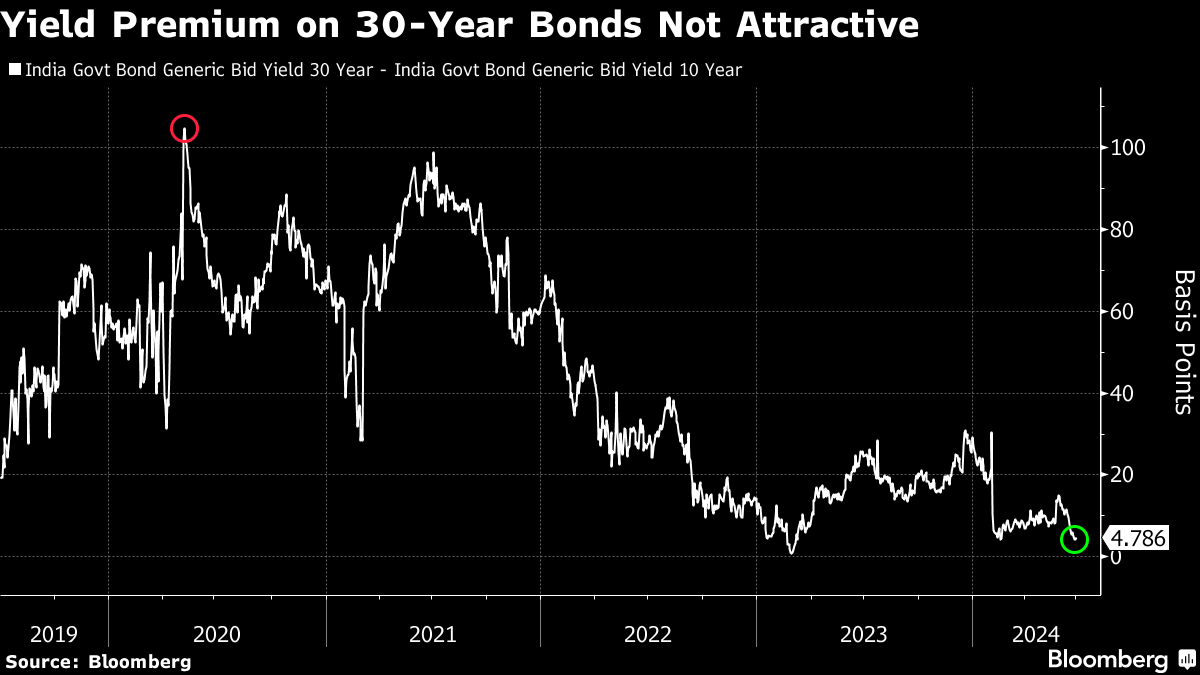
The premium that the 30-year benchmark sovereign debt has over the 10-year bond has narrowed to about five basis points recently from 100 basis points in 2020. That's the narrowest since March 2023.
While Dalal's firm still has about 25% of its assets in 30-year bonds, he says there's better value in the more liquid 10 to 15 years debt. The money manager has allocated some 40% of assets in 10-year bonds, he said.
The Reserve Bank of India will probably engage in only a “shallow rate-cutting cycle wherein they'll probably cut one or two times,” this fiscal year, Dalal said. Should that happen, the 10-year bonds may see yields decline by 25 basis points, he said.
“We don't know whether there'll be a parallel shift downward or there'll be a widening of the spread between the 10 and 30,” Dalal said. “That has to be seen.”
The Reserve Bank of India has kept the policy rate unchanged at 6.5% for more than a year now to control inflation. While the price index has eased in recent months, it's still at 4.75%, above the central bank's 4% target.
Even while foreign investors have raised holdings of Indian sovereign bonds since JPMorgan's announcement in September to include Indian bonds into its emerging-market index, their long-term participation remains to be seen, Dalal said.
Foreign bond investors may follow the path of equities, where they book profits and reinvest when they see an opportunity, Dalal added. “By the same logic, I would believe that portion of the money that they are investing in debt will also be probably moving in and out depending on relative valuations and other opportunities.”
Edelweiss Government Securities Fund, with 1.48 billion rupees of assets, was among the top performers, with a return of 5.64% in the past six months, according to ValueResearch's ranking of 31 funds.
“We have to be a little cognizant of all these factors before blindly building a 30-year Indian government bond portfolio,” Dalal said.
--With assistance from Subhadip Sircar.
More stories like this are available on bloomberg.com
©2024 Bloomberg L.P.

-
Talking Points This Week: Tech Nerves, FII Buying, And A Faraway Banking Shock

The global markets are not shining this Diwali. The exception in the large markets is, India.
-
Midterm Rally Lasted A Day. The Hard Reality Of A Divided US May Last Two Years | Opinion
Between a contested AI boom, a debt ceiling that arrives in 2027 and a president with every incentive to act alone, the next two years may prove more volatile than the first day's rally suggests.
-
Blue Wave Will Derail the AI Trade but Won't Dismantle the AI Era | Unhedged Position
The Democrats' sweep of the US Congress will see politics collide with economic forces both over the long and short term.
-
It's Time To Take The GST Council's Bet On Trust Global
Payment records can prove India's services exports, and clear, proportionate rules can bring foreign digital sellers into the tax net.
-
Opinion | India at 38: From Innovation Overperformer to Innovation Powerhouse
India now has 453 VC-backed deep science startups, 18 of them late-stage, after 117 percent growth since 2020. Laurus Labs, at USD 9.3 billion, is the most valuable deep science company in any middle-income economy outside China.
-
Navigating Energy Crossroads: S Jaishankar's Call For Diversified Supply Chains At G20 Ministerial Meeting
As geopolitical fault lines continue to test maritime trade routes and commodity flows, Jaishankar's message remains pertinent: true economic resilience requires open markets, protected transit lines, and a genuine commitment to multilateral cooperation rather than coercion.
-
Indians Are Travelling, But Not Every Journey Is A Holiday | The Week In Whys
Pilgrims, patients and working women are the real travellers, and the system hasn't quite caught up with them.
-
Getting To Work Costs Women More | The Reason Why
It is not just about women paying more than men. It is about women paying much more in cities than in villages.
-
AI Bias In Investing Cannot Be Eliminated, But It Can Be Governed
Framing is a particularly important example as identical financial information presented in terms of gains rather than losses can lead an LLM to reach a different assessment.









