Dalal Street Rallies As India-Pakistan Ceasefire Boosts Investor Sentiment

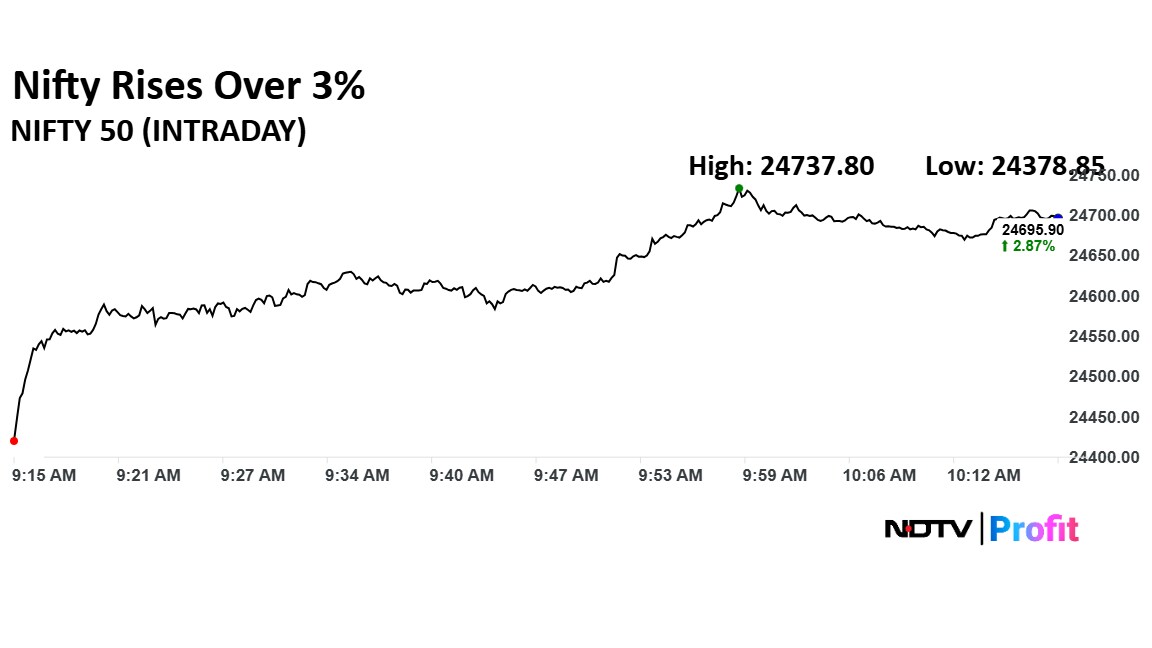
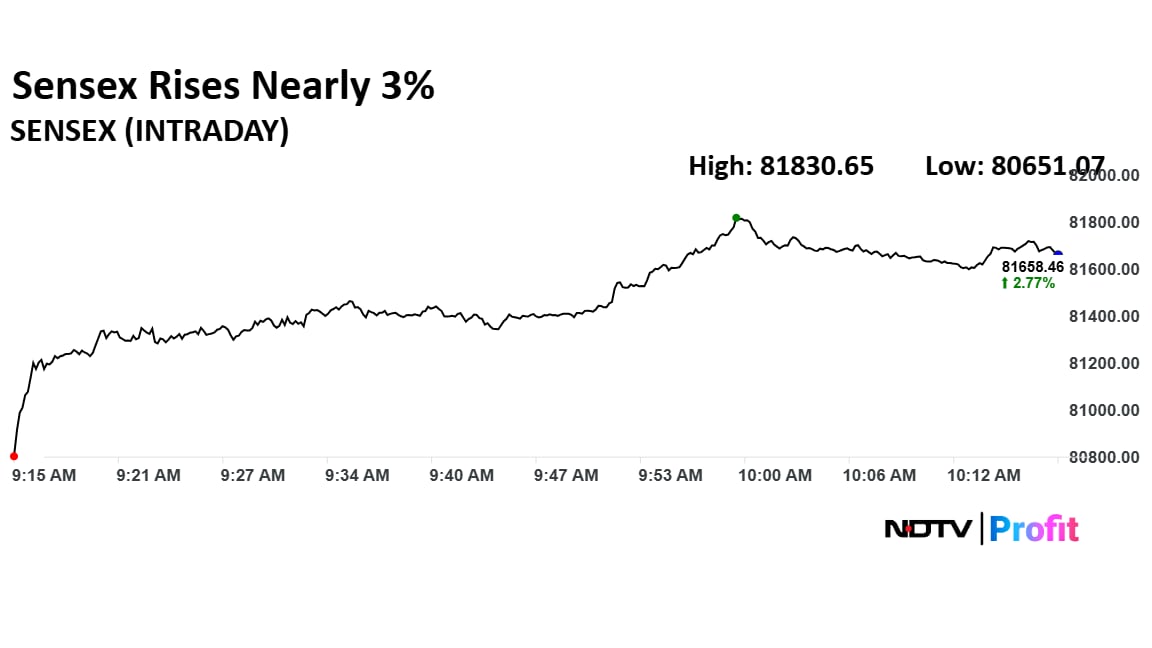
Indian equity markets surged on Monday morning, buoyed by improved investor sentiment following a significant de-escalation in tensions between India and Pakistan.
This development, combined with encouraging signals from the ongoing US-China trade negotiations, lifting the benchmark indices nearly 3%.
The BSE Sensex jumped 3.73%, or nearly 2,900 points intraday to reach 82,419.17, and closed 2,923.39 points or 3.68% higher. Meanwhile, the NSE Nifty closed 3.78% or 907.50 points higher at 24,915.50 after it climbed 3.84% intraday to touch 24.930, breaking out of the narrow trading range it had been confined to over the previous week.
Both the benchmarks touched their highest levels and their highest closing since October. The Nifty 50 recorded the best intraday gain since Feb. 2, 2021, while for Sensex it's the best intraday gain since June 5, 2024.
Except for the Nifty Pharma index, all sectoral indices advanced during the open. The pharma index buckled under pressure after US President Donald Trump stated that the US would significantly slash pharmaceutical prices, aiming to bring them among the lowest globally. As Indian pharmaceutical firms are major exporters of generic drugs to the US, such a move could negatively impact their revenues.
However, while closing the trading session, all the sectors ended positively.
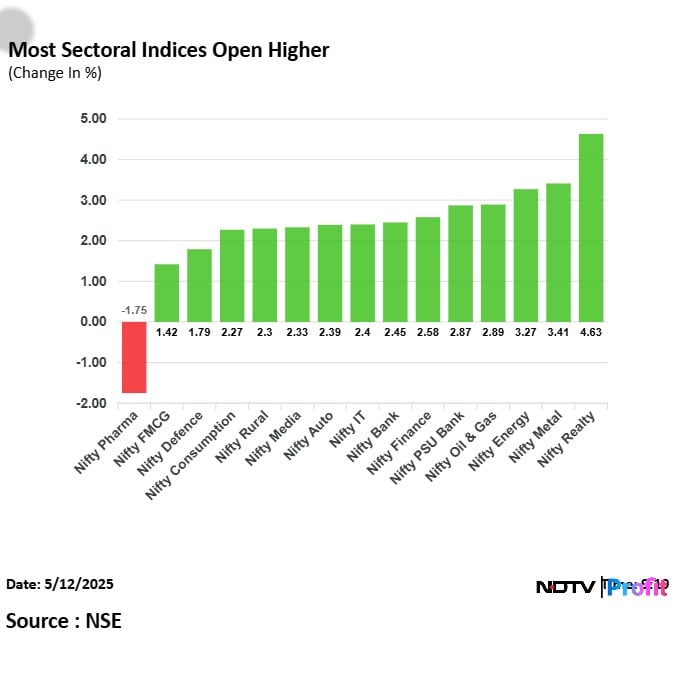
The Nifty PSU Bank index climbed over 3%, showing strong buying interest in state-owned lenders. Nifty IT gained 3.74%, while Nifty Auto added 2.47%. Leading the gains was the Nifty Realty index, which surged more than 4% during early trading hours.
Broader markets echoed the upbeat mood, with the Nifty Smallcap 250 and Nifty Midcap 150 both rallying close to 4%.
Among the top performers on the Nifty 50 were Adani Enterprises Ltd., Jio Financial Services Ltd., Adani Ports and Special Economic Zone Ltd., Shriram Finance Ltd., and Trent Ltd. Sun Pharmaceutical Ltd. was the only stock in the red.
India-Pakistan Ceasefire
The two nations reached a mutual agreement on Saturday to halt hostilities across land, air and sea, which provided a shot of confidence to financial markets that had been treading cautiously in recent sessions.
Calm prevailed in the border regions of Punjab, Jammu & Kashmir, and Rajasthan following the ceasefire. Indian Foreign Secretary Vikram Misri urged Pakistan to uphold the commitment seriously and responsibly. He added that Indian armed forces would firmly respond to any future violations along the Line of Control or the international border.
US-China Trade Talk
Meanwhile, optimism also came from Washington, where US Treasury Secretary Scott Bessent and Trade Representative Jamieson Greer announced “substantial progress” in trade talks with China. Although details remain confidential, markets interpreted the tone positively.
Global Markets
Global equity markets responded positively to the US-China Trade talk progress. Wall Street futures pointed to gains with Dow futures up 1.03%, S&P 500 futures gaining 1.31%, and Nasdaq futures up 1.71%.
Asian markets opened higher. Japan's Topix extended its winning streak to 12 sessions—its longest since October 2017—while the US dollar also strengthened amid risk-on sentiment.

-
Where You Live Shapes How You Get To Work | The Reason Why

Two-wheelers are the most popular way to get to work in India, accounting for nearly 43% of workplace commutes.
-
High US Salaries, No Green Card Certainty: The Financial Calculation Facing Indian H-1B Families
The suspension of PERM processing at eight technology employers does not cancel existing H-1B visas. What it does is force a question many Indian families have been avoiding: is the US salary worth tying your career and family plans to one employer?
-
Unhedged Position: Can India See An Indonesia-Style Time Correction?
The Nifty is trading below levels it first clocked in 2024. Is there, then, as I have suggested in the headline, potential that the current time correction drags on painfully for the next three-five, even ten years?
-
Navigating Friction And Energy Realities: An Analysis Of Marco Rubio's October Visit To India
Occurring at a critical juncture marked by stalled trade negotiations and escalating geopolitical pressures over global energy supplies, the visit offers a profound window into modern US-India relations.
-
India Exports Capital. Why Not Export Trusteeship?
The big question, then, is whether India can build an institution that global borrowers, investors, banks, and lawyers can trust, even without an Indian connection.
-
France's Economy & Politics Are In Crisis | The Reason Why
Let's look at how the French economy and politics evolved under Nicolas Sarkozy, Franois Hollande and Emmanuel Macron.
-
You May Inherit The Business. You Must Earn Its Credibility.
Succession tests the founder's ability to share authority as much as it tests the next generation's readiness to assume it.
-
Signing Deals Is One Thing; Making Them Work Is Another | The Week In Whys
Sometimes, things don't turn out as planned. Indian companies have lost some bids to rivals, some projects won't produce until 2030.
-
FOMC Wall, PERM Suspension, Hospital Stocks | Talking Points This Week
A PERM suspension would directly affect green-card sponsorship rather than H-1B visas, so the near-term earnings impact could remain relatively limited. The key question is whether this marks a new phase in US scrutiny of Indian IT.
-
Everything, Everywhere, All At Once: Dalal Street's Week To Forget | Joining The Dots
Visa curbs, a Starlink spat and cancer drug caps: what connects this week's shocks for Indian markets