HDFC To Raise Rs 11,100 Crore From Investors Including KKR, GIC, Premji Invest
Housing Development Finance Corporation Ltd.'s board approved raising over Rs 11,000 crore by selling shares to a consortium of investors including private equity firm KKR and Singapore's sovereign wealth fund GIC.
India's largest mortgage lender will raise Rs 11,103.6 crore by issuing 6.4 crore shares at Rs 1,726.05 per share, according to its exchange filing. HDFC will allot shares to the following investors on a preferential basis:
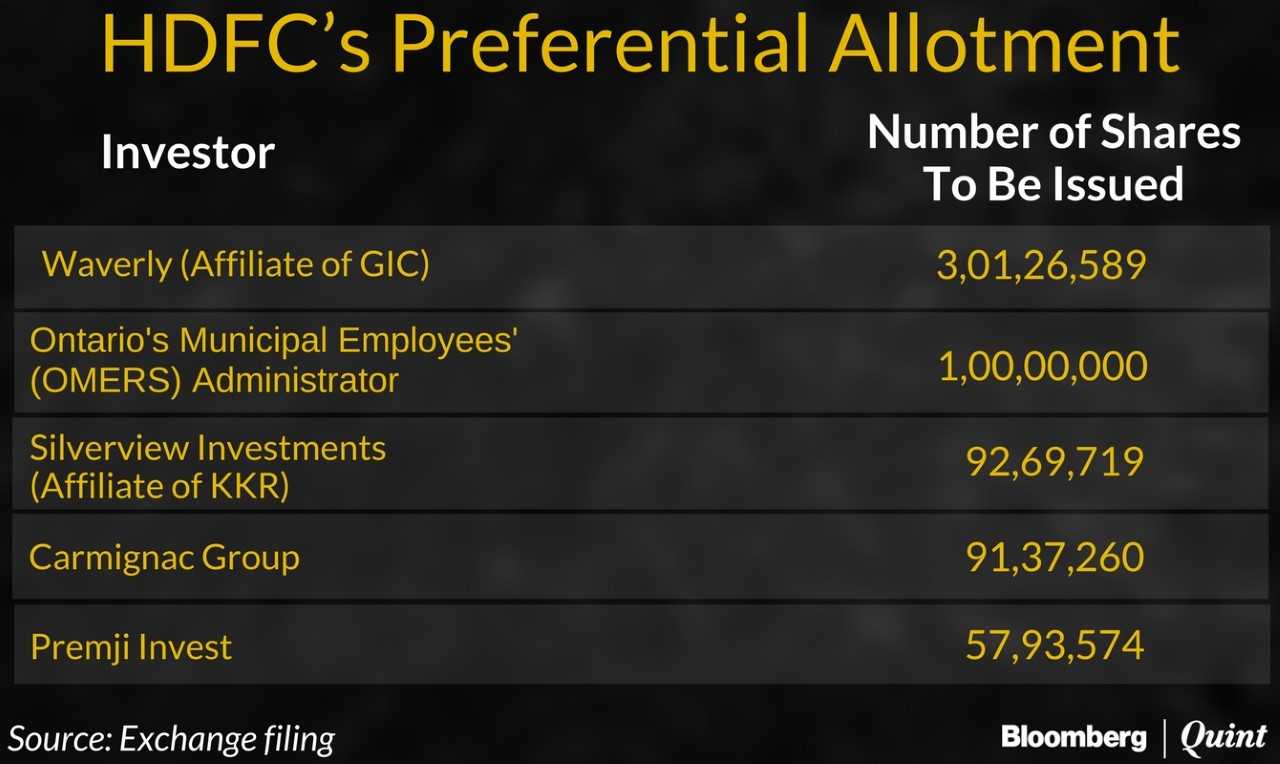
The preferential allotment, which represents 3.87 percent of HDFC's enhanced equity share capital post the issue, will be completed within 15 days of shareholders' approval.
QIP Issue
HDFC's board has also approved raising Rs 1,896 crore via a qualified institutional placement. The QIP will be completed within 12 months of shareholders' approval.
BloombergQuint had reported on Dec.15 that HDFC plans to raise up to Rs 12,800 crore from a consortium of lenders led by private equity firm KKR and Singapore's sovereign wealth fund GIC.
Also Read: HDFC Bank Lines Up Rs 24,000 Crore In Equity Fund Raising
Rationale For Fund Raising
Up to Rs 8,500 crore of the funds raised will be used to subscribe to the preferential allotment of its banking arm HDFC Bank Ltd.
The Keki Mistry-led HDFC wants to participate in HDFC Bank's institutional share sale to ensure that its stake does not fall. Along with its subsidiaries, HDFC owns 21 percent in the bank.
India's largest mortgage lender will direct the rest of the amount raised to fund its new initiatives. It is exploring opportunities in health insurance with its subsidiary HDFC Ergo General Insurance Company. “We would like to be in health insurance in a big way. But that would require a reasonably large amount of investment,” HDFC Chief Executive Officer Keki Mistry had said at a press conference on Dec. 19.
The mortgage lender is also mulling the acquisition and resolution of stressed assets in the country's beleaguered real estate sector.

-
A New Samvat Wishlist: Inclusive Prosperity And Human Development

India has strengthened its economic foundations through infrastructure, digital access and enterprise. Its next growth chapter must deepen productivity, create better livelihoods and widen participation in prosperity.
-
Love, Sex Aur Dhokha: The Audacious Plot To Spy On Jensen Huang
A Taipei dinner, a Singapore chip buyer and a suspected Chinese asset: inside the alleged spy operation that got close to NVIDIA's Jensen Huang.
-
Ten Things I Learnt This Samvat
Patience can be a trap. Cheap stocks can stay cheap. Leverage can wipe you out. What did Samvat 2082 teach us? Niraj Shah writes on 10 lessons from the year gone by.
-
Talking Points This Week: Tech Nerves, FII Buying, And A Faraway Banking Shock
The global markets are not shining this Diwali. The exception in the large markets is, India.
-
Midterm Rally Lasted A Day. The Hard Reality Of A Divided US May Last Two Years | Opinion
Between a contested AI boom, a debt ceiling that arrives in 2027 and a president with every incentive to act alone, the next two years may prove more volatile than the first day's rally suggests.
-
Blue Wave Will Derail the AI Trade but Won't Dismantle the AI Era | Unhedged Position
The Democrats' sweep of the US Congress will see politics collide with economic forces both over the long and short term.
-
It's Time To Take The GST Council's Bet On Trust Global
Payment records can prove India's services exports, and clear, proportionate rules can bring foreign digital sellers into the tax net.
-
Opinion | India at 38: From Innovation Overperformer to Innovation Powerhouse
India now has 453 VC-backed deep science startups, 18 of them late-stage, after 117 percent growth since 2020. Laurus Labs, at USD 9.3 billion, is the most valuable deep science company in any middle-income economy outside China.
-
Navigating Energy Crossroads: S Jaishankar's Call For Diversified Supply Chains At G20 Ministerial Meeting
As geopolitical fault lines continue to test maritime trade routes and commodity flows, Jaishankar's message remains pertinent: true economic resilience requires open markets, protected transit lines, and a genuine commitment to multilateral cooperation rather than coercion.









