HDFC, HDFC Bank Shares End Lower A Day After Merger Deal Is Announced
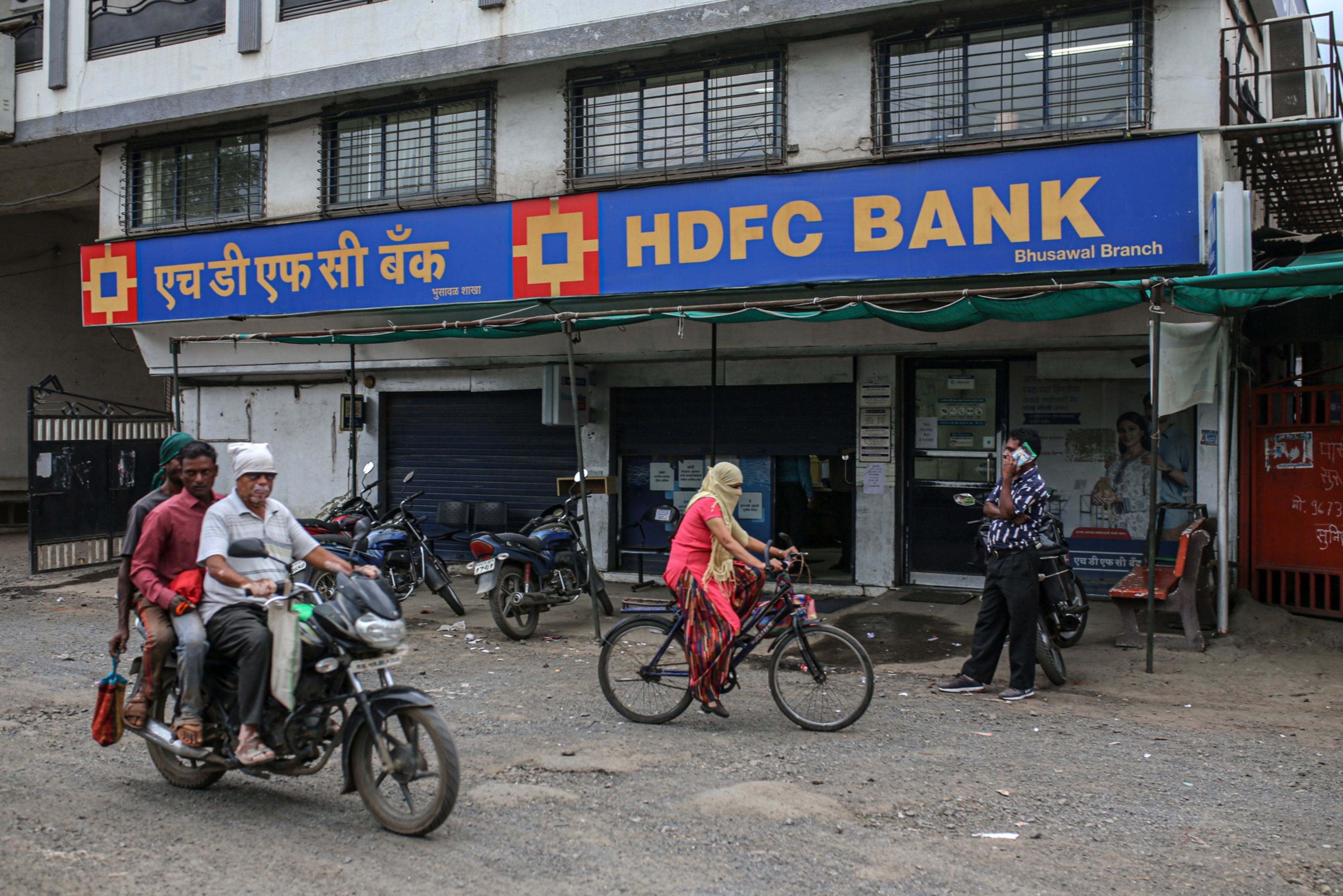
Analysts expect HDFC Bank Ltd.'s proposed merger with HDFC Ltd. to help India's most valuable lender to gain product expertise in mortgage space and improve cross-selling opportunities, while the home financier to benefit from the bank's lower funding cost.
The deal will create a financial behemoth with a combined balance sheet of Rs 17.87 lakh crore and a net worth of Rs 3.3 lakh crore. The two-step merger is likely to be completed in 12-14 months, subject to regulatory approvals.
Sashidhar Jagdishan, chief executive officer at HDFC Bank, will remain the CEO of the merged entity. Keki Mistry, vice chairman at HDFC, will stay in his role until the merger is complete.
The HDFC merger deal comes when regulations for banks and mortgage financiers have slowly been harmonised, making it less lucrative for the two businesses to be housed in separate entities.

Shares of HDFC Bank and HDFC closed 3.13% and 2.17% down, respectively, on Tuesday. The stocks had surged reacting to the merger announcement on Monday.
Of the 43 analysts tracking HDFC Bank, 40 maintain a ‘buy' and three recommend a ‘hold', according to Bloomberg data. The 12-month consensus price target implies an upside of 18.5%.
All 31 analysts tracking HDFC suggest a ‘buy', with the consensus return potential of 18.6%.
Here's what brokerages have to say about the proposed merger...
Nirmal Bang
The announced merger is best of both worlds and had long been anticipated by investors. Cost of regulatory compliance remains a key concern.
The underlying rationale for this merger is to create a strong bank with a formidable position in the mortgage segment, which complements HDFC Bank's existing presence in retail assets (ex-mortgage).
The biggest benefit to HDFC will be by way of lower cost of funds, leading to a more competitive positioning in the mortgage segment.
KRChoksey
The combined entity will integrate the two companies' complementary strengths, providing a fulfilling customer relationship.
After the merger, HDFC Bank consumers will be able to access mortgages as a core product seamlessly and will use the long-term mortgage relationship to offer a variety of credit and deposit products made possible by better insights across the customer lifecycle. This will improve all combined entity customers' value proposition and customer experience.
HDFC Bank is a private sector bank with a customer base of about 6.8 crore. The bank platform will provide a well-diversified low-cost funding base for growing its acquired long-term loan book.
HDFC Bank will be benefitted with a secured and long tenor product portfolio leading to robust asset portfolio mix for the bank.
The merging of HDFC and HDFC Bank is entirely complementary to and expands on the value proposition of HDFC Bank.
HDFC Bank would benefit from a larger balance sheet and net worth, which would allow underwriting of larger ticket loans and enable a greater flow of credit into the Indian economy.
The loan book of HDFC is diversified having cumulatively financed over 90 lakh dwelling units. With HDFC's leadership in the home loan arena, HDFC Bank would be able to provide to customers flexible mortgage offerings in a cost-effective and efficient manner.
HDFC Bank has access to funds at lower costs due to its high level of CASA ratio. With the amalgamation of HDFC with HDFC Bank, HDFC Bank will be able to offer more competitive housing products.
HDFC's rural housing network and affordable housing lending is likely to qualify for HDFC Bank as priority sector lending and will enable a higher flow of credit into priority sector lending, including agriculture.
The merger is expected to bolster the capital base and bringing in resiliency in the balance sheet of HDFC Bank. The combined entity's balance sheet is expected to stand at Rs 17.87 lakh crore, while the net worth at Rs 3.3 lakh crore enabling lager underwriting scale
Dolat Capital
The amalgamation, subject to regulatory approvals, will result in total loan book of about Rs 18 lakh crore, materially narrowing the gap in market share with the largest lender State Bank of India (at Rs 27 lakh crore).
The merger is expected to be consummated by Q2/Q3 of FY24.
Back of envelope calculations allude to limited impact from higher statutory liquidity ratio/ cash reserve ratio requirements given the excess liquidity buffers with both entities. Impact from purchase of priority sector lending certificates to meet priority sectors lending requirements on profit and loss should be around 6%, excluding of any synergies.
Current regulatory and competitive environment favours a merger: While a possible merger had been a discussion point since long, reduced SLR/CRR requirements over the last few years for banks, harmonisation of regulations between banks and non-banks, LCR requirements for HFCs and the immense potential in housing space ensures that the pain in balance from high SLR/CRR/PSL requirements and tech/people integration are worth taking.
While HDFC benefits from lower cost of funds after merger, HDFC Bank gets inroads into the high potential housing segment along with improved cross-sell opportunity.
70% of HDFC customers are not banking with HDFC Bank and a similar share of HDFC Bank's customers do not have a mortgage, implying huge cross-sell potential within existing customer base.
ICICI Direct
A win-win amalgamation.
HDFC would benefit from the bank's lower funding cost.
HDFC Bank would gain product expertise in mortgage space and help reduce cost/income ratio.
Better cross-sell opportunities for bank with direct access to HDFC's customer base.
The proposed transaction will result in reducing HDFC Bank's proportion of exposure to unsecured loans.
Related Coverage
Research Reports

-
Talking Points This Week: Tech Nerves, FII Buying, And A Faraway Banking Shock

The global markets are not shining this Diwali. The exception in the large markets is, India.
-
Midterm Rally Lasted A Day. The Hard Reality Of A Divided US May Last Two Years | Opinion
Between a contested AI boom, a debt ceiling that arrives in 2027 and a president with every incentive to act alone, the next two years may prove more volatile than the first day's rally suggests.
-
Blue Wave Will Derail the AI Trade but Won't Dismantle the AI Era | Unhedged Position
The Democrats' sweep of the US Congress will see politics collide with economic forces both over the long and short term.
-
It's Time To Take The GST Council's Bet On Trust Global
Payment records can prove India's services exports, and clear, proportionate rules can bring foreign digital sellers into the tax net.
-
Opinion | India at 38: From Innovation Overperformer to Innovation Powerhouse
India now has 453 VC-backed deep science startups, 18 of them late-stage, after 117 percent growth since 2020. Laurus Labs, at USD 9.3 billion, is the most valuable deep science company in any middle-income economy outside China.
-
Navigating Energy Crossroads: S Jaishankar's Call For Diversified Supply Chains At G20 Ministerial Meeting
As geopolitical fault lines continue to test maritime trade routes and commodity flows, Jaishankar's message remains pertinent: true economic resilience requires open markets, protected transit lines, and a genuine commitment to multilateral cooperation rather than coercion.
-
Indians Are Travelling, But Not Every Journey Is A Holiday | The Week In Whys
Pilgrims, patients and working women are the real travellers, and the system hasn't quite caught up with them.
-
Getting To Work Costs Women More | The Reason Why
It is not just about women paying more than men. It is about women paying much more in cities than in villages.
-
AI Bias In Investing Cannot Be Eliminated, But It Can Be Governed
Framing is a particularly important example as identical financial information presented in terms of gains rather than losses can lead an LLM to reach a different assessment.









