US Stocks Rise Late On Trump’s Bullish Economic Call: Markets Wrap
Stocks climbed in late hours after President Donald Trump said he doesn't see a US economic recession, downplaying Wall Street's jitters around his trade war.
“I don't see it at all. I think this country's going to boom,” Trump said at the White House. He added that markets “are going to go up and they're going to go down. But you know what, we have to rebuild our country.”
A $600 billion exchange-traded fund tracking the S&P 500 (SPY) rose after the close of regular trading. The White House said 25% tariffs on steel and aluminum would take effect on Canada and other nations, as Trump backed off a threat to impose 50% duties on the largest US trading partner's metals.
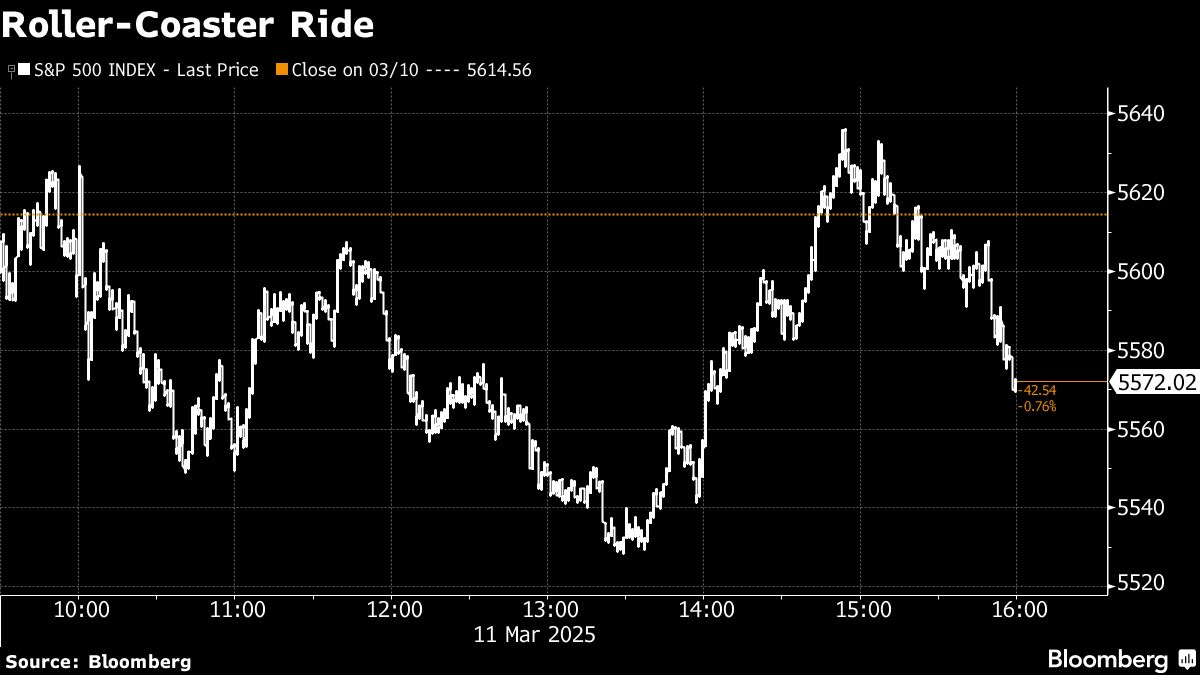
That all happened after stocks hit the lowest level since September, with the benchmark gauge ending 9.3% below its all-time high — after briefly crossing the threshold of a correction.
Wall Street is growing angsty as investors become increasingly unnerved by whipsawing tariff policy, sticky inflation and the unknown pace of the Federal Reserve's interest-rate easing. Market forecasters at banks including JPMorgan Chase & Co. and RBC Capital Markets have tempered bullish calls for 2025 as Trump's tariffs stoke fears of slowing economic growth.
“What Trump has been doing has not been helpful for US equity markets,” said Neil Dutta at Renaissance Macro Research. “For now, I don't see recession. We've never really had a recession from policy uncertainty itself. And, we don't yet know how markets would respond if Trump's escalation now results in de-escalation later.”
Just minutes after erasing a 1.5% slide on hopes for a Ukraine-Russia truce, the S&P 500 resumed its slide — finishing 0.8% lower. While a rebound in megacaps like Tesla Inc. and Nvidia Corp. drove the market away from session lows, the vast majority of shares retreated. The Nasdaq 100 slid 0.3%. The Dow Jones Industrial Average sank 1.1%.
The yield on 10-year Treasuries advanced six basis points to 4.28%. The Bloomberg Dollar Spot Index fell 0.4%.
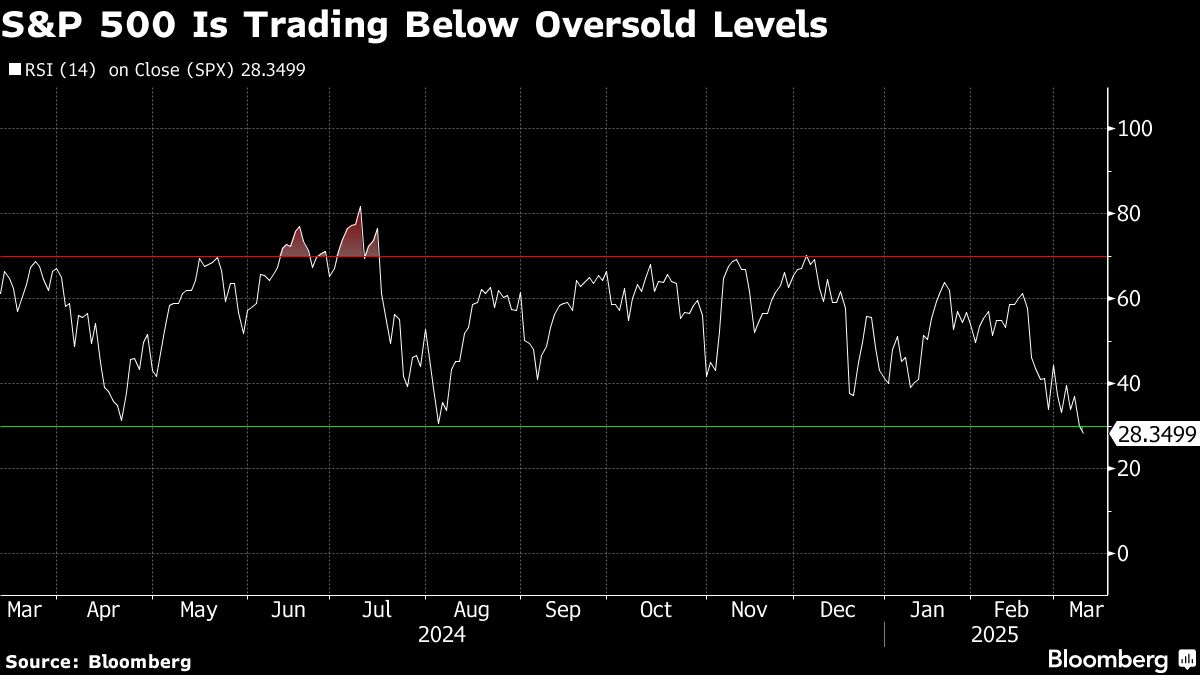
Aside from a compelling argument that the market was overdue for a downturn of this magnitude, 10% corrections usually don't become 20% bear markets unless they're accompanied by either an economic recession, an earnings recession, or a Fed hiking cycle, according to Daniel Skelly, head of Morgan Stanley's Wealth Management Market Research & Strategy Team.
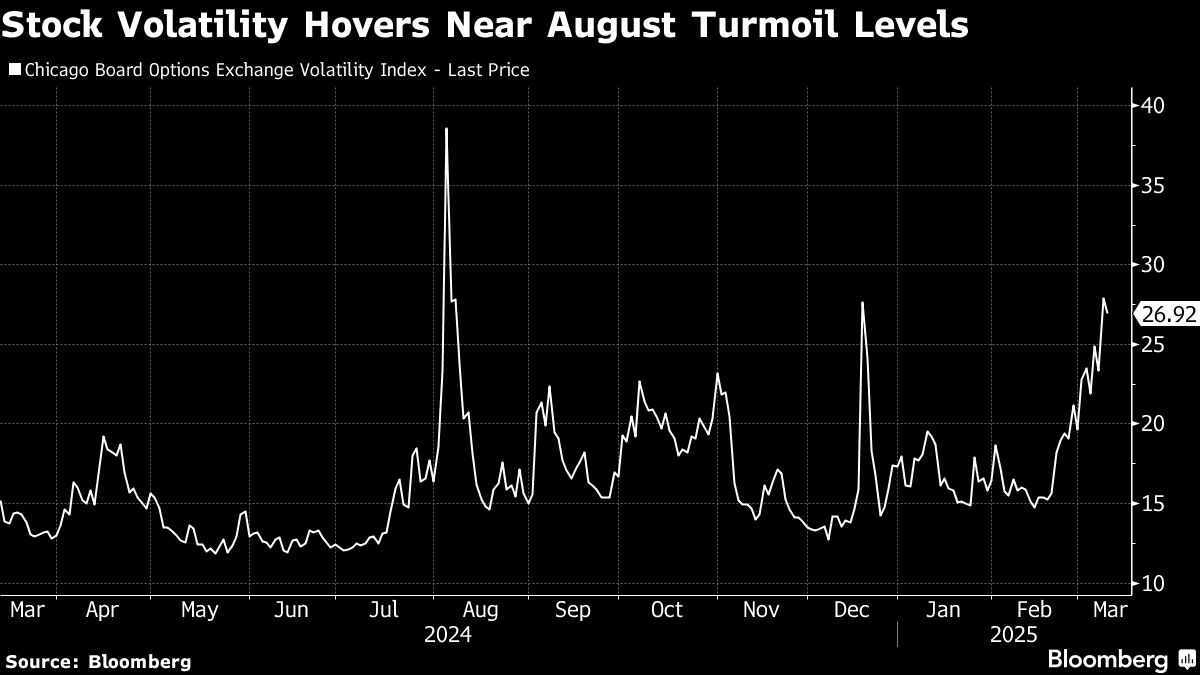
“We're not seeing any of those right now,” he noted. “That said, even if the majority of this drawdown is potentially behind us, volatility may not be, and there's a good chance the market could chop sideways for a while.”
Lauren Goodwin at New York Life Investments says markets need policy clarity to stabilize.
“In uncertain markets, a ‘wait and see' approach risks missing opportunities and building ballast against risks. Instead, investors should use volatility to their advantage and position for long-term themes.”
To Matt Maley at Miller tabak, US stocks are a long way from a “great” buying opportunity.
“A ‘great' buying opportunity comes after the stock market has fallen to a cheap level.” he said. “This does not mean that the stock market has to fall further. However, to call this a great buying opportunity is much is way too optimistic in our opinion.”
A chorus of Wall Street strategists is warning about risks for the stock market as Trump's tariffs stoke fears of slowing economic growth.
The latest call came from Citigroup Inc. strategists, who downgraded their view on US stocks to neutral from overweight.
That lukewarm view of US stocks is over the next three to six months, Citi strategists including Dirk Willer wrote in a note, adding that more negative US data prints are expected. Uncertainty over tariffs and government job cuts pushed the S&P 500 into one of its worst weeks this century relative to the rest of the world last week.
“US exceptionalism is at least pausing” for the coming few months, the strategists wrote. “The news flow from the US economy is likely to undershoot the rest of the world in coming months,” they added.
US consumer prices probably rose in February at a pace that illustrates plodding progress on inflation for Federal Reserve officials. They may be content to remain on the sidelines to assess a policy whirlwind from the Trump administration.
Bureau of Labor Statistics figures on Wednesday are projected to show that the consumer price index minus food and energy climbed 0.3%, based on the median estimate of economists surveyed by Bloomberg. While less than January's 0.4% gain in January, the magnitude of the increase leaves annual price growth elevated.
The so-called core CPI probably rose 3.2% from February last year. The data will inform the Fed's preferred price gauge, which isn't due until after the March 18-19 policy meeting. Interest-rate setters — now in a blackout period ahead of that gathering — have an inflation goal of 2%.
“Concerns persist over the inflationary impact of President Trump's tariff policies,” said Judith Raneri, senior portfolio manager of the Gabelli U.S. Treasury Money Market Fund. “However, the Fed views tariffs as temporary price shocks rather than sustained inflationary drivers. If this perspective holds, the central bank may look past short-term tariff-related price increases and remain positioned to cut rates later this year.”
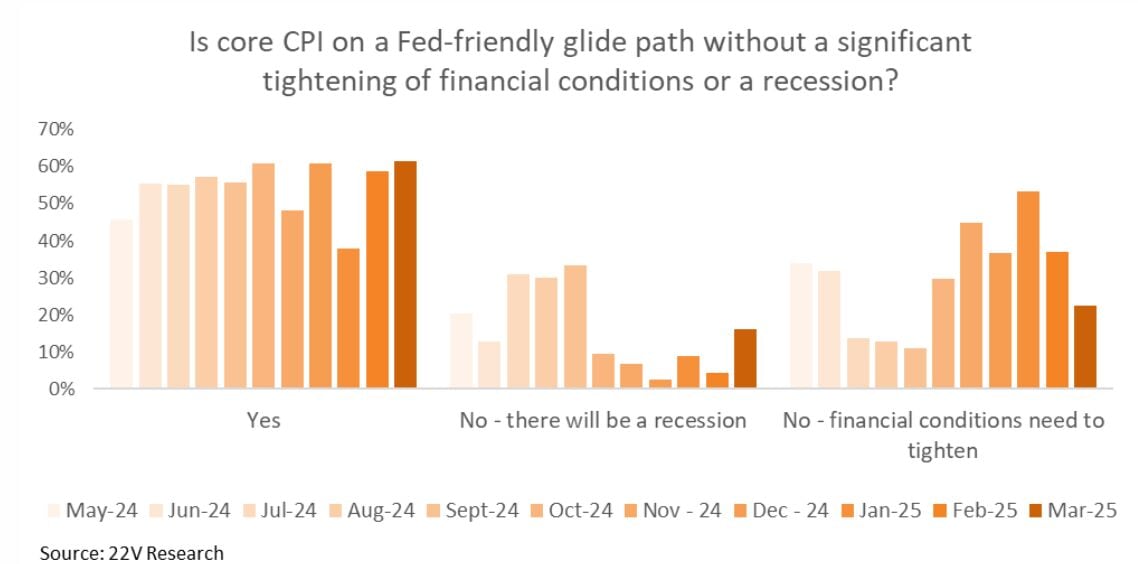
“When we asked investors how closely they are watching tomorrow's CPI, the median response was slightly more than normal,” said Dennis DeBusschere, founder of 22V Research.
Some 41% of investors surveyed expect the market reaction to the data to be “mixed/negligible,” 28% said “risk-on” and 31%, “risk-off.”
“61% believe that core CPI is on a Fed friendly glide path without a significant tightening of financial conditions,” DeBusschere noted.
Key events this week:
Canada rate decision, Wednesday
US CPI, Wednesday
Eurozone industrial production, Thursday
US PPI, initial jobless claims, Thursday
US University of Michigan consumer sentiment, Friday
Some of the main moves in markets:
Stocks
The S&P 500 fell 0.8% as of 4 p.m. New York time
The Nasdaq 100 fell 0.3%
The Dow Jones Industrial Average fell 1.1%
The MSCI World Index fell 0.8%
Currencies
The Bloomberg Dollar Spot Index fell 0.4%
The euro rose 0.8% to $1.0916
The British pound rose 0.5% to $1.2949
The Japanese yen fell 0.4% to 147.84 per dollar
Cryptocurrencies
Bitcoin rose 4.7% to $82,986.37
Ether rose 4.5% to $1,951.95
Bonds
The yield on 10-year Treasuries advanced seven basis points to 4.28%
Germany's 10-year yield advanced six basis points to 2.90%
Britain's 10-year yield advanced three basis points to 4.67%
Commodities
West Texas Intermediate crude rose 0.8% to $66.57 a barrel
Spot gold rose 1% to $2,916.53 an ounce

-
Navigating Energy Crossroads: S Jaishankar's Call For Diversified Supply Chains At G20 Ministerial Meeting

As geopolitical fault lines continue to test maritime trade routes and commodity flows, Jaishankar's message remains pertinent: true economic resilience requires open markets, protected transit lines, and a genuine commitment to multilateral cooperation rather than coercion.
-
Indians Are Travelling, But Not Every Journey Is A Holiday | The Week In Whys
Pilgrims, patients and working women are the real travellers, and the system hasn't quite caught up with them.
-
Getting To Work Costs Women More | The Reason Why
It is not just about women paying more than men. It is about women paying much more in cities than in villages.
-
AI Bias In Investing Cannot Be Eliminated, But It Can Be Governed
Framing is a particularly important example as identical financial information presented in terms of gains rather than losses can lead an LLM to reach a different assessment.
-
Joining The Dots | Dark Skies, Steady Diya: Why Hope Holds This Diwali
With war, a weak rupee and foreign outflows weighing on sentiment, policymakers at the NDTV World Summit and market veterans at NDTV Profit Ignite: Diwali Edition offered the same advice: stay invested and filter out the noise.
-
The Curious Case of Equitas Small Finance Bank And A CEO Who Quit For Stock
PN Vasudevan believes persistent investor concerns over a perceived conflict of interest had become a governance overhang on Equitas Small Finance Bank's stock, even as the lender improved profitability and asset quality.
-
Talking Points This Week: AI Cash Burn, A Tiger Comeback And An India That Still Finds Its Own Path
India is not immune to higher oil or tighter global liquidity, yet its earnings base is broader, its domestic policy levers are still available.
-
Foreign Investors Own Half Of HDFC Bank and ICICI Bank. An LTCG Cut Could Matter Most Here
Foreign portfolio investors have US$115 billion parked in HDFC Bank, ICICI Bank. If the government cuts long-term capital gains tax, Jefferies says returning foreign money could land here first.
-
'Never Seen This Level Of Negativity': Sandeep Tandon Says The Next Rally May Be Closer Than You Think
Veteran investor Sandeep Tandon says foreign selling is easing, large-caps are due a comeback and mid-caps are crowded, while he turns positive on gold, power and pharma this Diwali.
-
Indians Stay With Family, Not In Hotels | The Reason Why
India still lacks enough clean, reliable and affordable hotels for budget-conscious travellers.










