S&P 500 Tumbles 3.5% After US-China Feud Heats Up: Markets Wrap
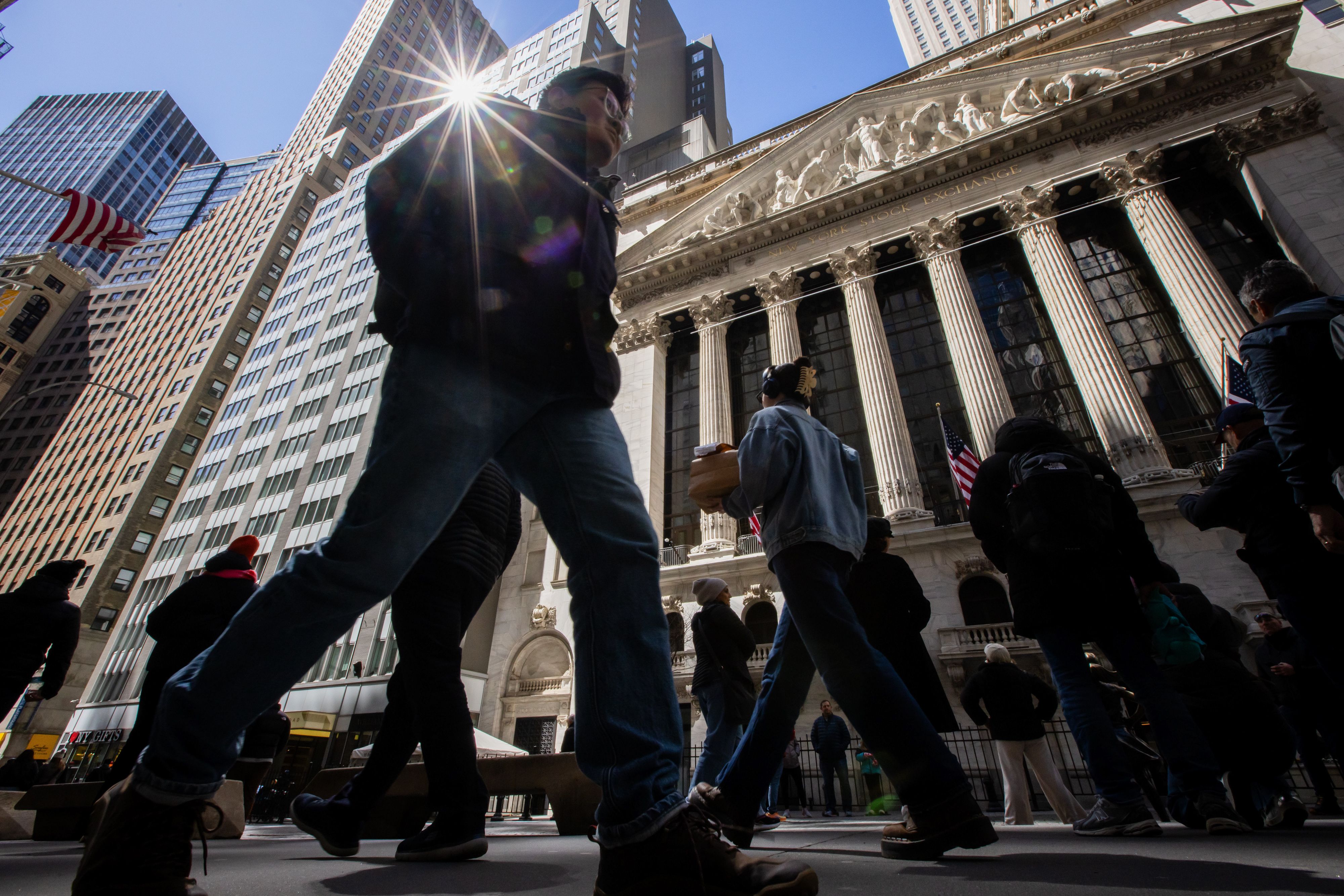
Economic angst enveloped every corner of Wall Street as US-China trade tensions escalate, sparking a slide in stocks, the dollar and oil, with liquidations in US assets pointing to disorder in the financial system.
A day after the biggest stock-buying wave in years, assets tied to the economic cycle are sinking again, with President Donald Trump's mollifying message on trade talks providing little relief. Investors are rushing to game out how the effective freezing of Chinese trade will impact companies and growth. The S&P 500 fell 3.5%. The dollar saw its worst day since 2022. A solid US sale of 30-year Treasuries failed to ignite a rally, but signaled appetite for bonds.
Market euphoria flipped back to unease despite Trump's signals that he's close to a first deal on tariffs — without naming the country. Concern grew that an escalation of the trade war between the two biggest economies will bring lasting damage to global growth after the White House said US tariffs on China rose to 145%.
“Investors are sobering up and realizing that the US-China ‘food fight' will probably get worse before it gets better,” said Michael Bailey at FBB Capital Partners.
Just a day after financial markets cheered Trump's decision to delay some of his tariff plans, the selloff in riskier corners of the market suggests growing skepticism that trade talks will be wrapped up in a timely manner, despite White House National Economic Council Director Kevin Hassett saying the US is “well advanced” in its discussions with economic partners.
The first signs of a slowdown in global trade are already emerging as companies around the world hit their own pause button on orders and he continues to escalate his trade war with China. If anything, Trump is extending the uncertainty that has already begun to drag on business and consumer sentiment.
“We still believe the anxiety around tariffs are alive and well. Volatility works in both directions — down and up. The path forward likely includes more market swings as we do not have a conclusion. In fact, we have the opposite, a likely extension of the tariff negotiation process,” said Nathan Thooft at Manulife Investment Management.

US-listed shares of Chinese companies fell on a report that the Trump administration is considering a push to delist the stocks of Chinese public companies that trade on American exchanges, citing unnamed sources. United States Steel Corp. sank after Trump reiterated his long-held position that he doesn't want to see the steelmaker owned by a Japanese company. CarMax Inc. backed away from the timing of its financial goals amid trade war uncertainty.
The staggering US tariffs on China have triggered a tit-for-tat trade war that has unnerved global financial markets.
“The Trump administration's stance has evolved from an all-out trade war against everyone, to a concentrated trade war against China,” said Nicolas Oudin of Gavekal Research. “Most investors believe that China shot itself in the foot by retaliating. The view from Beijing is different. Many in China read the ‘Trump fold' as a sign of US weakness, and therefore as a validation of China's decision to escalate.”
Bridgewater Associates' billionaire founder Ray Dalio said investors have been left with “an element of trauma or shock or fear” after all the global markets turmoil this week.
“It dramatically affected psychology and attitude about the United States' reliability,” he said in an interview with Bloomberg Television. “It could have been handled better.”

“Tariff-driven inflation is still coming as a result of the trade war, even if the immediacy of the impact has been lessened,” said Vail Hartman at BMO Capital Markets. “The extent of the flow-through of higher tariffs into realized inflation remains an open question – one that isn't likely to be resolved until well beyond the 90-day pause window.”
While data Thursday showed US inflation cooled broadly in March, the data was calculated prior to widespread levies that risk contributing to price pressures. That may change in coming months as Trump's higher levies filter through the economy. And price declines for services like hotel stays and airfares may be a warning sign that some consumers are cutting back on discretionary spending
“Healthy drop in inflation or big drop in demand?” said Brent Kenwell at eToro. “At the end of the day, we do need to see lower inflation to justify lower rates from the Fed and ease the burden on consumers. However, getting lower inflation due to a material drop in economic activity — and thereby jeopardizing the economy — isn't the best route to take.”
Meantime, a growing chorus of Federal Reserve officials have raised concerns that aggressive trade policies could lead to a more lasting increase in inflation. US central bankers have signaled they're not in a hurry to lower borrowing costs further, instead preferring to wait and see how changing government policies impact the economy before adjusting rates.
Some of the main moves in markets:
Stocks
The S&P 500 fell 3.5% as of 4 p.m. New York time
The Nasdaq 100 fell 4.2%
The Dow Jones Industrial Average fell 2.5%
The MSCI World Index fell 1.2%
Bloomberg Magnificent 7 Total Return Index fell 5%
The Russell 2000 Index fell 4.3%
Currencies
The Bloomberg Dollar Spot Index fell 1.5%
The euro rose 2.3% to $1.1200
The British pound rose 1.1% to $1.2966
The Japanese yen rose 2.1% to 144.67 per dollar
Cryptocurrencies
Bitcoin fell 4.3% to $79,592.45
Ether fell 9.5% to $1,514.5
Bonds
The yield on 10-year Treasuries advanced seven basis points to 4.40%
Germany's 10-year yield declined one basis point to 2.58%
Britain's 10-year yield declined 14 basis points to 4.64%
Commodities
West Texas Intermediate crude fell 3.3% to $60.31 a barrel
Spot gold rose 2.9% to $3,172.81 an ounce

-
Navigating Energy Crossroads: S Jaishankar's Call For Diversified Supply Chains At G20 Ministerial Meeting

As geopolitical fault lines continue to test maritime trade routes and commodity flows, Jaishankar's message remains pertinent: true economic resilience requires open markets, protected transit lines, and a genuine commitment to multilateral cooperation rather than coercion.
-
Indians Are Travelling, But Not Every Journey Is A Holiday | The Week In Whys
Pilgrims, patients and working women are the real travellers, and the system hasn't quite caught up with them.
-
Getting To Work Costs Women More | The Reason Why
It is not just about women paying more than men. It is about women paying much more in cities than in villages.
-
AI Bias In Investing Cannot Be Eliminated, But It Can Be Governed
Framing is a particularly important example as identical financial information presented in terms of gains rather than losses can lead an LLM to reach a different assessment.
-
Joining The Dots | Dark Skies, Steady Diya: Why Hope Holds This Diwali
With war, a weak rupee and foreign outflows weighing on sentiment, policymakers at the NDTV World Summit and market veterans at NDTV Profit Ignite: Diwali Edition offered the same advice: stay invested and filter out the noise.
-
The Curious Case of Equitas Small Finance Bank And A CEO Who Quit For Stock
PN Vasudevan believes persistent investor concerns over a perceived conflict of interest had become a governance overhang on Equitas Small Finance Bank's stock, even as the lender improved profitability and asset quality.
-
Talking Points This Week: AI Cash Burn, A Tiger Comeback And An India That Still Finds Its Own Path
India is not immune to higher oil or tighter global liquidity, yet its earnings base is broader, its domestic policy levers are still available.
-
Foreign Investors Own Half Of HDFC Bank and ICICI Bank. An LTCG Cut Could Matter Most Here
Foreign portfolio investors have US$115 billion parked in HDFC Bank, ICICI Bank. If the government cuts long-term capital gains tax, Jefferies says returning foreign money could land here first.
-
'Never Seen This Level Of Negativity': Sandeep Tandon Says The Next Rally May Be Closer Than You Think
Veteran investor Sandeep Tandon says foreign selling is easing, large-caps are due a comeback and mid-caps are crowded, while he turns positive on gold, power and pharma this Diwali.
-
Indians Stay With Family, Not In Hotels | The Reason Why
India still lacks enough clean, reliable and affordable hotels for budget-conscious travellers.










