Stocks Jump, Bonds Ease Slide On Treasury Auction: Markets Wrap

Stocks climbed and bonds traded well off session lows as a solid $39 billion sale of benchmark Treasuries eased fears of financial turmoil after another chaotic day on Wall Street.
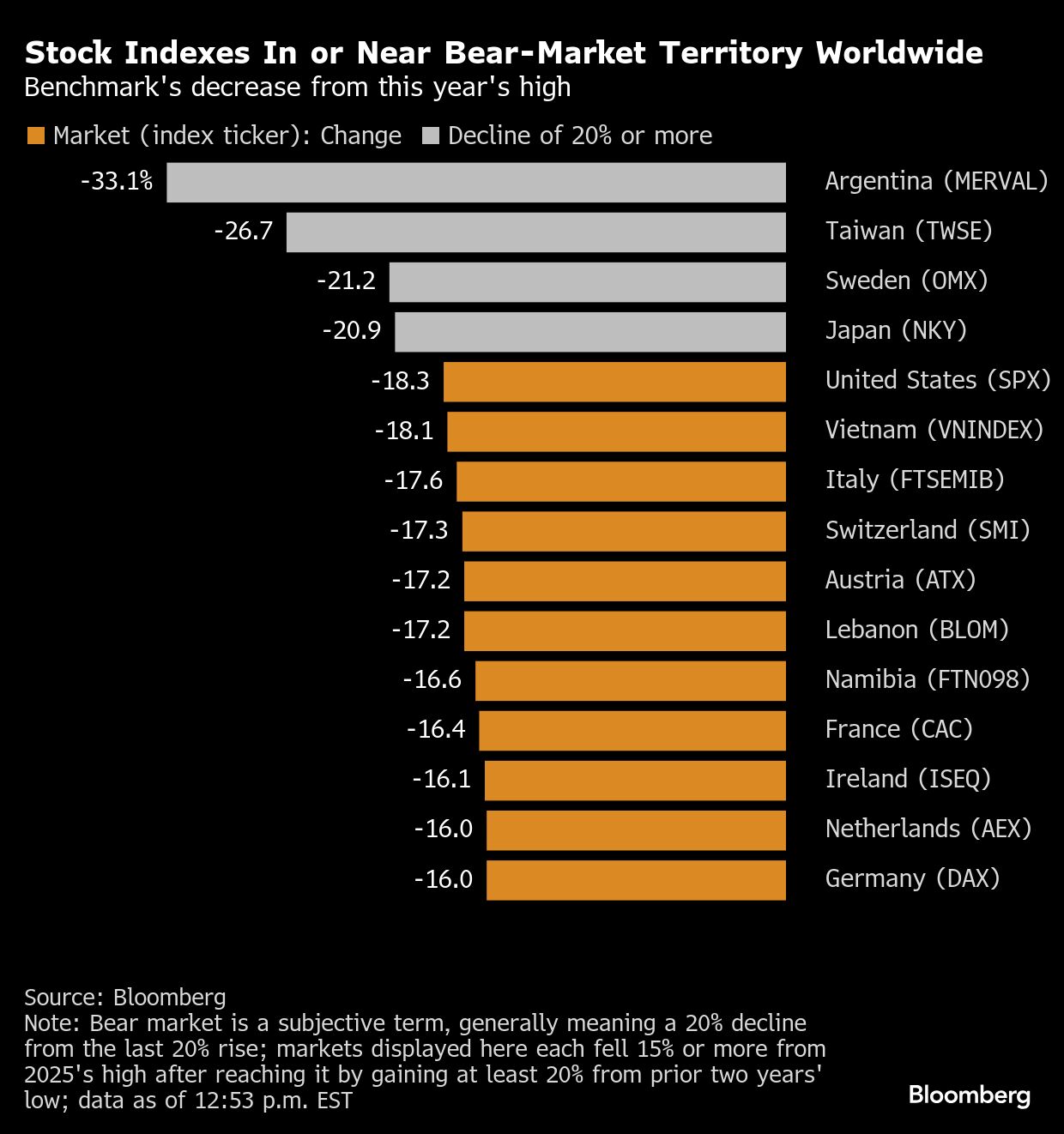
With traders glued to screens awaiting fresh news on tariffs, volatility once again engulfed assets across the globe. Equities pushed away from their bear-market threshold, with the S&P 500 up about 1%. Treasury 10-year yields pared an advance that earlier topped 20 basis points amid a bond a selloff that raised concern about the US status as a safe spot. The dollar slid against most major currencies while the Japanese yen and Swiss franc climbed. Oil plunged.
The minute-by-minute watch of new tariff headlines is making the trading landscape challenging even for market pros.
What was earlier shaping up to be a big down day for equities after China's retaliation quickly reversed into a gains as Treasury Secretary Scott Bessent said he envisions trade agreements with US allies. Trump urged Americans to remain calm and continue investing — an indication the White House is closely monitoring the reaction to the levies.
“In the fog of war, extreme rallies are no healthier than extreme declines, as they are all emotion driven,” said Mark Hackett at Nationwide. “That is why markets rarely have a V-shaped bottom – it takes some churning and clarity to have a sustained recovery.”
Investors are fearing an oncoming breakage in the financial system, with a gauge of fear across the market for investment-grade credit spiking to the highest since 2023. And the prospect of tariff-induced inflation — just as Treasuries misfire as a hedge — complicates the Federal Reserve's policy response.
The escalating conflict in international commerce has now spurred Wall Street to ramp up recession warnings, with JPMorgan Chase & Co. Chief Executive Officer Jamie Dimon saying it's a “likely scenario.” Ray Dalio, the billionaire founder of Bridgewater Associates, added to the chorus of warnings, citing the risk of “once-in-a-lifetime” breakdown in the monetary and geopolitical order.
There's a growing discussion on Wall Street that the Fed may need to step in to stabilize the Treasury market if the rout that briefly propelled long-term US borrowing costs above 5% continues.
“If recent disruption in the US Treasury market continues, we see no other option for the Fed but to step in with emergency purchases of US Treasuries to stabilize the bond market,” said George Saravelos at Deutsche Bank.
“It feels like we've gone from shock, to panic, via a mini relief rally, to now worrying that the speed of recent market moves might've broken something under the surface,” said Michael Brown at Pepperstone.
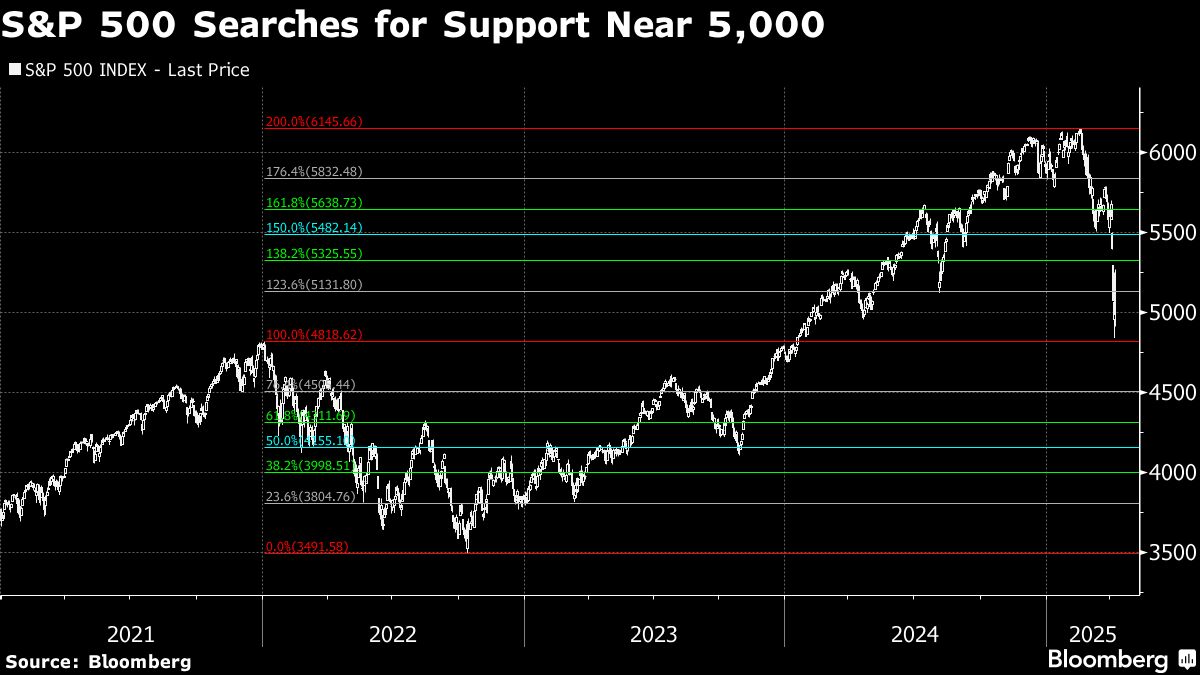
There are signs of support for the S&P 500 around 5,000. Goldman Sachs Group Inc. partner John Flood said this is a level where long-term investors are starting to buy the dip. “From my conversations with longer-duration investors, it feels like they will start scale buying the S&P 500 at 5,000 and get more aggressive in the mid-4,000s,” Flood wrote in a note to clients.
“It's hard to trust any rally,” according to Mark Newton, head of technical strategy at Fundstrat Global Advisors. “Stocks are getting close to bottoming after being massively oversold, but we still haven't seen the final low, and there's still room to fall even further. No one knows what's happening with tariffs.”
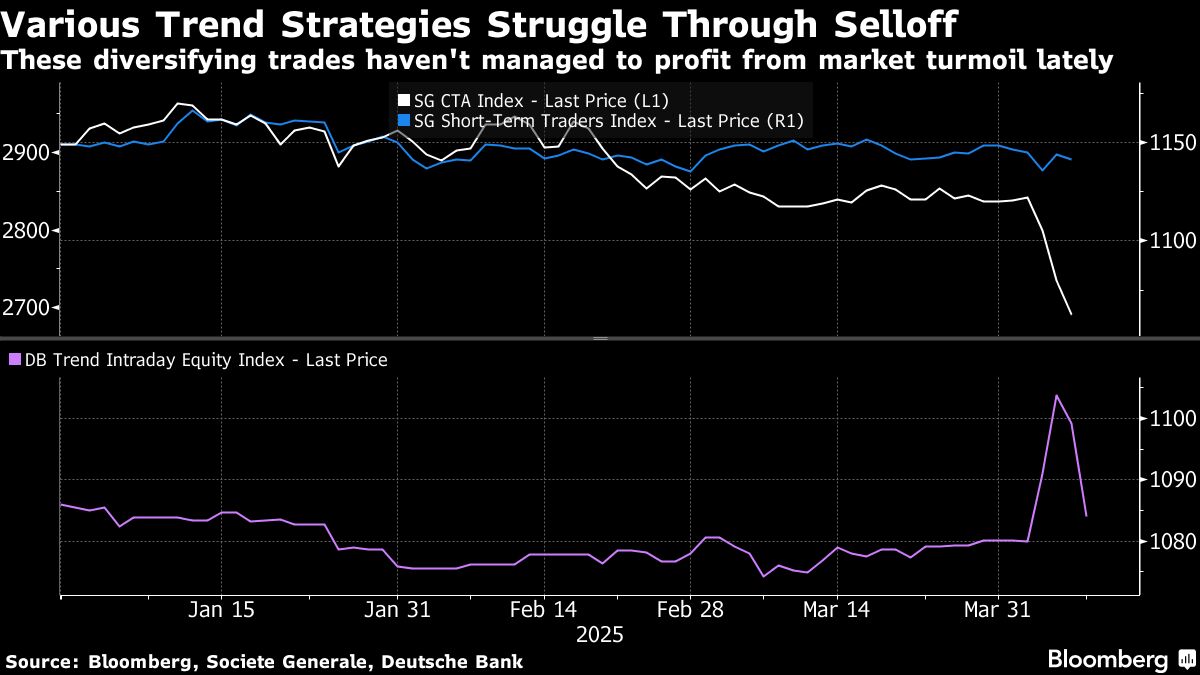
A slew of supposedly diversifying investment strategies are also failing to live up to their defensive billing.
Trend followers — a breed of quantitative fund who tout “crisis alpha,” or outperformance at times of market stress — have extended their worst losses in two years. A strategy that goes long steady stocks and short volatile ones is down on the week. Hedge funds, whose defensive pitch is right in their name, also appear to be struggling.
In short, the protective approaches often relied on by institutional investors have been faltering just when they're needed most. These could all be signs traders are dashing for the exits or being forced to offload more of their holdings. That's derailed all the usual market relationships from which defensive strategies try to profit.
Corporate Highlights:
Delta Air Lines Inc. withdrew its full-year financial guidance due to uncertainty surrounding global trade, a stark sign of the turmoil rippling across corporate America from President Donald Trump's tariffs.
As tariff-spooked shoppers begin pulling back on spending, Walmart Inc. is prepping for a worsening economy by using its massive footprint to keep prices low and hunt for ways to take market share.
Amazon.com Inc. has canceled orders for multiple products made in China and other Asian countries, according to a document reviewed by Bloomberg and people familiar with the matter, suggesting the company is reducing its exposure to tariffs imposed by President Donald Trump.
Morgan Stanley is no longer involved in providing financing for KKR & Co.'s purchase of Swedish consumer-health company Karo Healthcare, according to people familiar with the matter.
Peabody Energy Corp. said it's reviewing a deal worth up to $3.78 billion to buy Anglo American Plc's steel-making coal business after a fire at an Australian mine.
Airbus SE delivered 136 commercial aircraft in the first quarter, enough to edge out Boeing Co. after stepping up its pace of handovers in March
ThyssenKrupp AG is exploring exit options for its materials trading unit that could be valued at as much as €2 billion ($2.2 billion) in a deal, people familiar with the matter said, as the sprawling industrial conglomerate looks to streamline operations.
Key Events This Week:
US CPI, jobless claims, Thursday
Fed's Michelle Bowman's nomination hearing in Senate for the position of vice chair for supervision, Thursday
Fed's Austan Goolsbee, Patrick Harker, Lorie Logan, Jeff Schmid speak, Thursday
US PPI, University of Michigan consumer sentiment, Friday
Major banks reporting earnings include JPMorgan, Bank of New York Mellon, Morgan Stanley, Wells Fargo, Friday
Fed's John Williams and Alberto Musalem speak, Friday

-
Opinion | India at 38: From Innovation Overperformer to Innovation Powerhouse

India now has 453 VC-backed deep science startups, 18 of them late-stage, after 117 percent growth since 2020. Laurus Labs, at USD 9.3 billion, is the most valuable deep science company in any middle-income economy outside China.
-
Navigating Energy Crossroads: S Jaishankar's Call For Diversified Supply Chains At G20 Ministerial Meeting
As geopolitical fault lines continue to test maritime trade routes and commodity flows, Jaishankar's message remains pertinent: true economic resilience requires open markets, protected transit lines, and a genuine commitment to multilateral cooperation rather than coercion.
-
Indians Are Travelling, But Not Every Journey Is A Holiday | The Week In Whys
Pilgrims, patients and working women are the real travellers, and the system hasn't quite caught up with them.
-
Getting To Work Costs Women More | The Reason Why
It is not just about women paying more than men. It is about women paying much more in cities than in villages.
-
AI Bias In Investing Cannot Be Eliminated, But It Can Be Governed
Framing is a particularly important example as identical financial information presented in terms of gains rather than losses can lead an LLM to reach a different assessment.
-
Joining The Dots | Dark Skies, Steady Diya: Why Hope Holds This Diwali
With war, a weak rupee and foreign outflows weighing on sentiment, policymakers at the NDTV World Summit and market veterans at NDTV Profit Ignite: Diwali Edition offered the same advice: stay invested and filter out the noise.
-
The Curious Case of Equitas Small Finance Bank And A CEO Who Quit For Stock
PN Vasudevan believes persistent investor concerns over a perceived conflict of interest had become a governance overhang on Equitas Small Finance Bank's stock, even as the lender improved profitability and asset quality.
-
Talking Points This Week: AI Cash Burn, A Tiger Comeback And An India That Still Finds Its Own Path
India is not immune to higher oil or tighter global liquidity, yet its earnings base is broader, its domestic policy levers are still available.
-
Foreign Investors Own Half Of HDFC Bank and ICICI Bank. An LTCG Cut Could Matter Most Here
Foreign portfolio investors have US$115 billion parked in HDFC Bank, ICICI Bank. If the government cuts long-term capital gains tax, Jefferies says returning foreign money could land here first.










