Future Supply Chain IPO: Here’s All You Need To Know
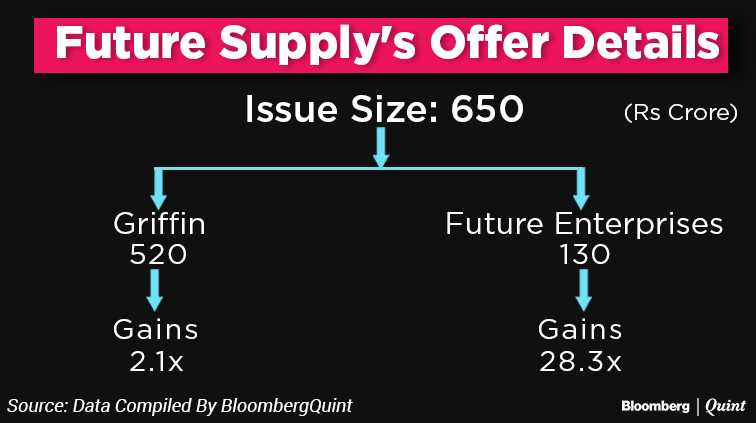
Future Supply Chain Solutions Ltd., the logistics arm of the Future Group, is looking to raise nearly Rs 650 crore through an initial public offer that opens today.
In the three-day offer, the company will issue up to 98 lakh equity shares at a price band of Rs 660-664 apiece. At the upper end, it will command a valuation of Rs 2,660 crore, according to BloombergQuint's calculations.
The IPO is an offer for sale through which promoter Future Enterprises Ltd. along with private equity investor Griffin Partners will offload shares.
Business
Future Supply Chain is one of India's largest third-party logistics solution provider, according to the Kishore Biyani-led company's red herring prospectus. It follows an asset light business model in which assets necessary for operations, such as vehicles and warehouses, are leased.
The company has presence in three business segments – contract, express and temperature controlled logistics.
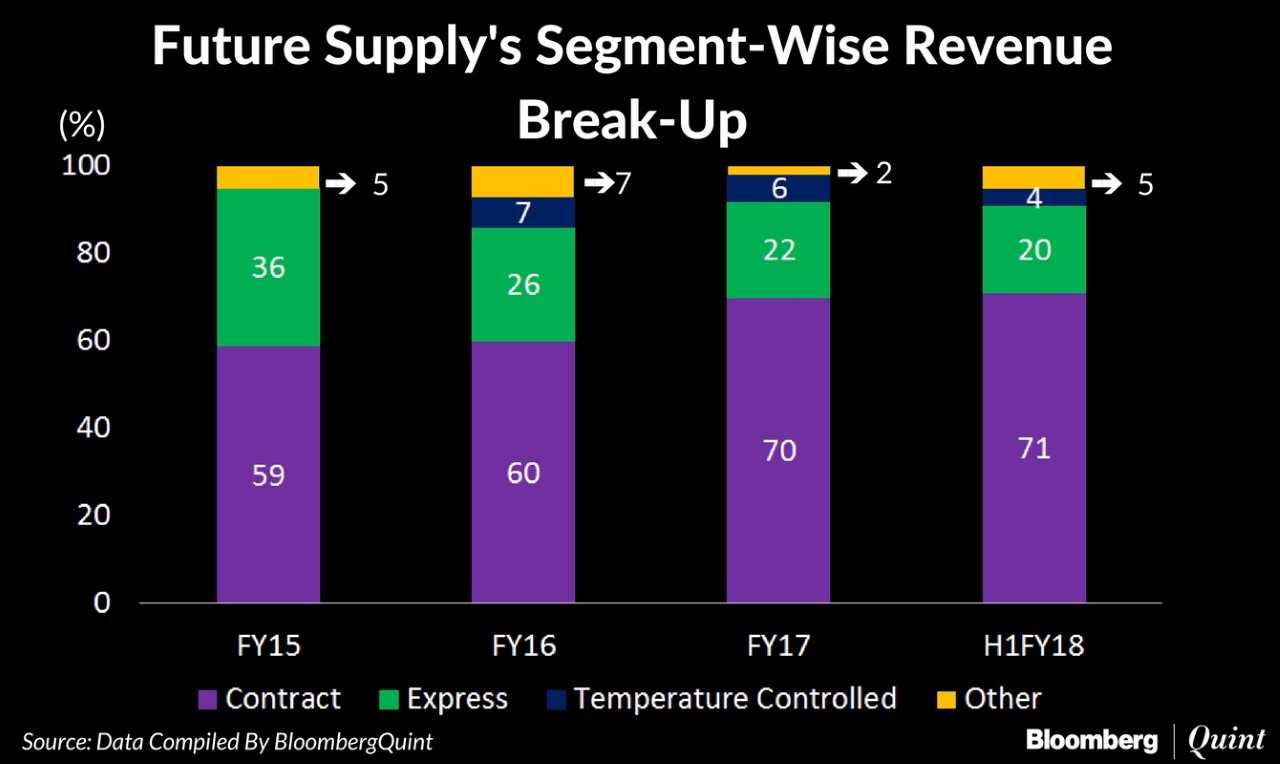
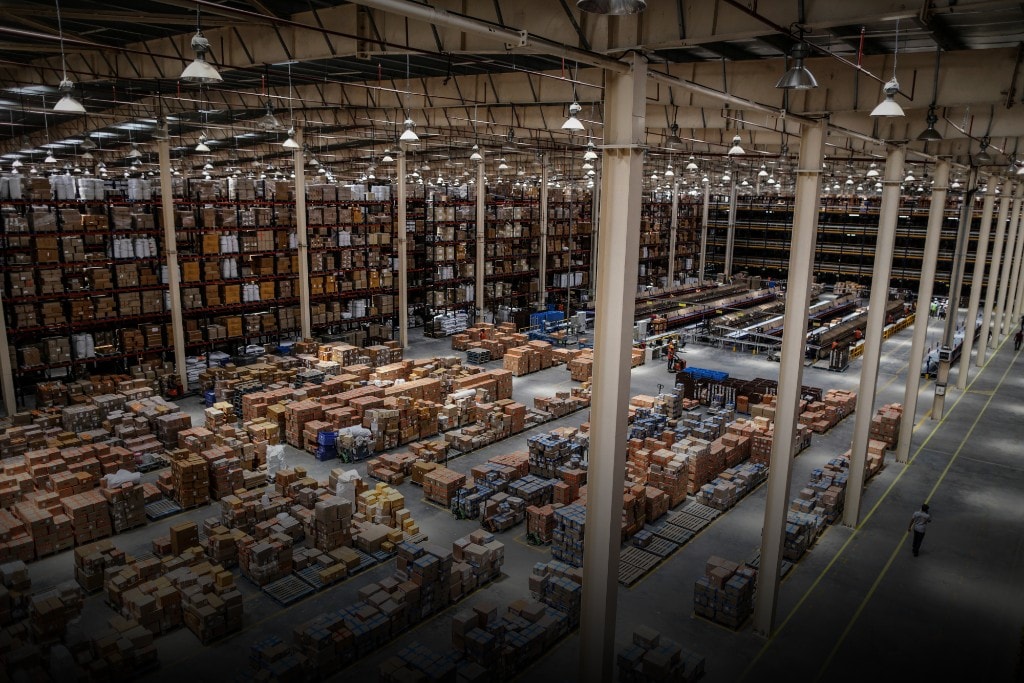
The bulk of its revenue comes from the contract logistics business which provides warehousing, distribution and other value-added services. Future Supply Chain has 42 distribution centres and 3.84 million square feet of warehouse space. It also operates 2 distribution centres and 0.37 million sq ft of warehouse space of its customers
Under express logistics, the company provides door-to-door delivery services. It has 14 hubs and 106 branches across India, covering 11,235 pin codes.
As part of the temperature controlled business, the company provides cold-chain warehousing, transportation solutions and distribution of perishable products. The segment was started in financial year 2015-16 and is yet to break even.
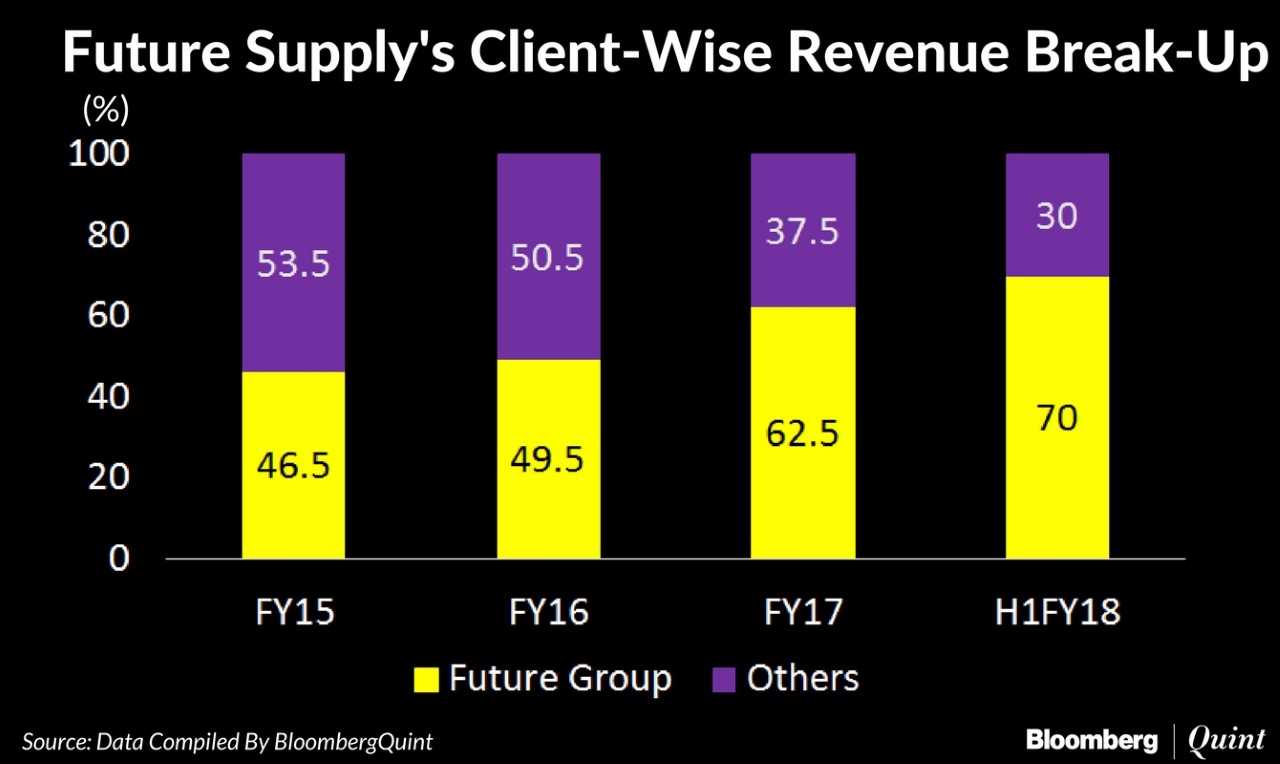
Almost 70 percent of Future Supply Chain's comes from group companies.
Financial Highlights
- Net worth stood at Rs 326 crore for the half-year ended September 2017 translating into a book value per share of Rs 81.
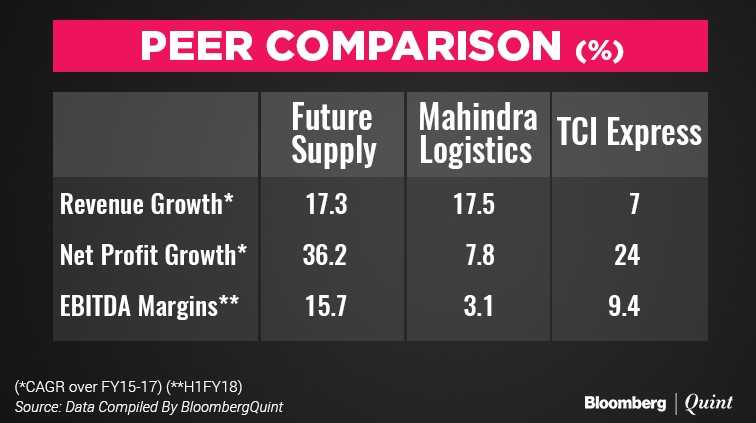
- Revenue grew at a compounded annual growth rate of 17 percent and net profit rose at 36 percent over FY15-17.
- Earnings before interest, tax and depreciation and amortisation margin has been ranged between 13-15 percent in the last three years.
- The company not declared any dividend during the last five financial years.
Peer Comparison
- The recently-listed Mahindra Logistics Ltd. has a similar business model and asset structure but generates nearly five times the revenue.
- Peer TCI Express Ltd. is a standalone express logistics company but follows an asset light business model.
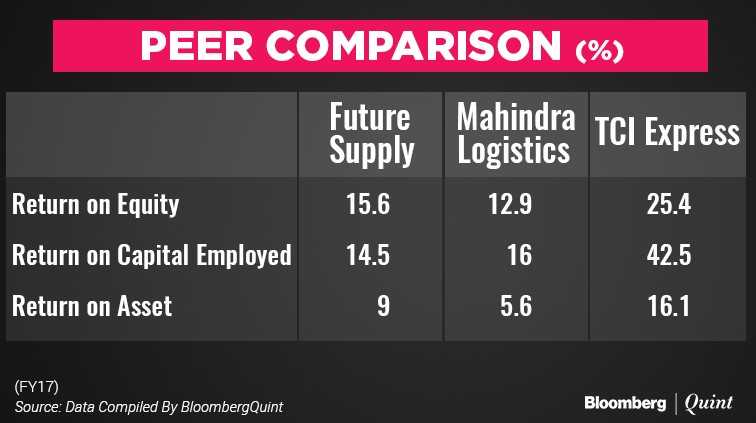
- Future Supply's return ratios are a mixed bag as the company outperforms on a few parameters but lags in others.
- Future Supply had a cash balance of more than Rs 80 crore as of Sept. 30 and negligible debt on its books.
.jpg)
Valuations
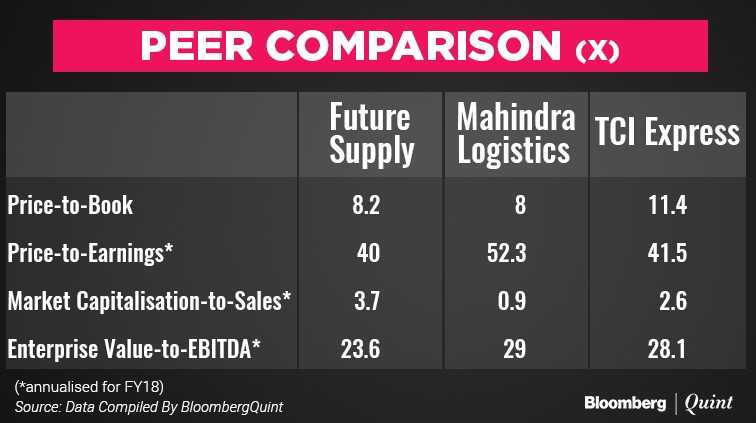
Earnings per share for the year to March comes to Rs 16.64 at the upper end of the price band. Its shares will trade at 40 times its earnings at that price, according to BloombergQuint's calculations. That's cheaper than its peers.
Shareholding Pattern
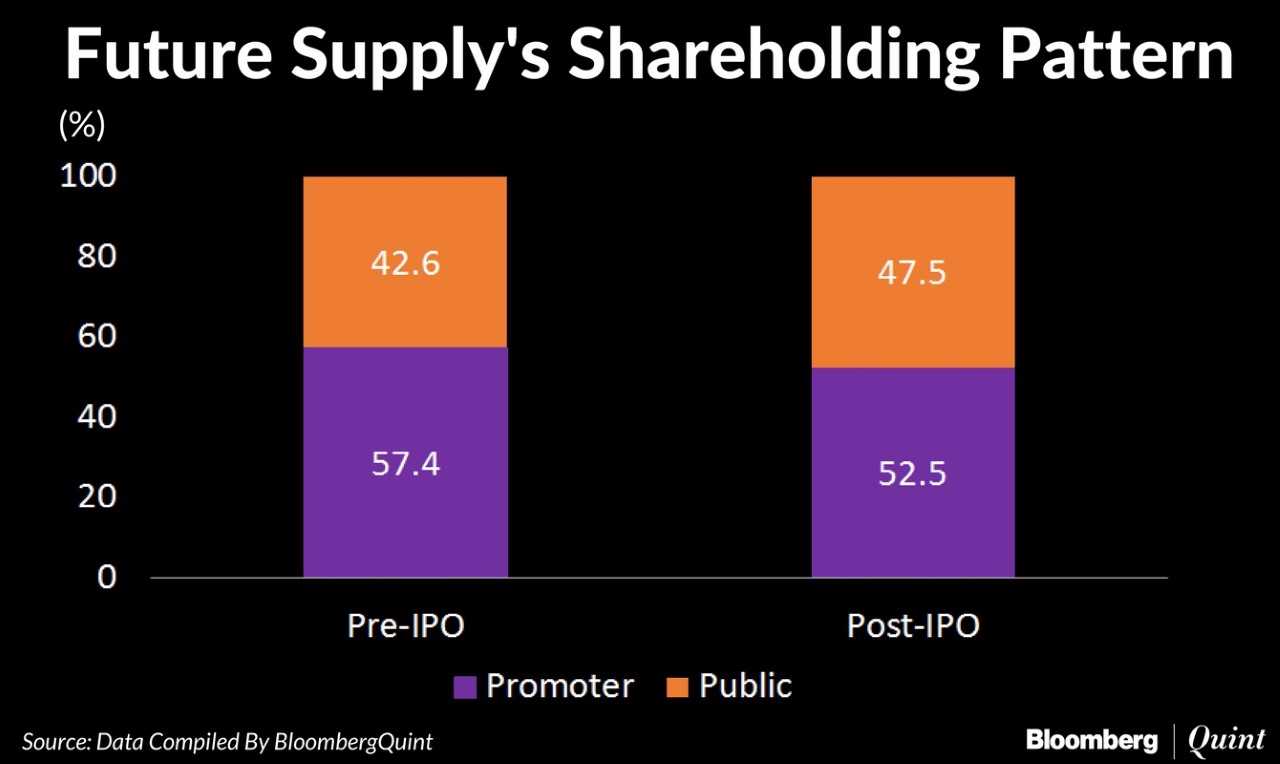
Promoter holding will come down to 52.5 percent, but Future Supply will continue to remain a subsidiary of Future Enterprises post listing.
Brokerage Take
Angel Broking: All positives are fully factored into current valuations, which does not provide any further upside for investors.
GEPL Capital: Future Supply Chain has a unique business model and strong growth metrics which makes the offer lucrative.
Choice: Future Supply Chain is available at cheaper valuations but at one-fifth of the size of its closest peer Mahindra Logistics. The issue is, therefore, aggressively priced leaving limited room for further upside.
Emkay Research: It is well positioned to capitalise on upcoming opportunities in the logistics sector. For investors with a 3-5 year time horizon, it will offer steady compounding returns.
Reliance Securities Research: It offers attractive growth opportunities in the medium to long term with the commensurate growth in 3PL logistics. It provides a healthy investment opportunity for long-term investors.

-
Navigating Friction And Energy Realities: An Analysis Of Marco Rubio's October Visit To India

Occurring at a critical juncture marked by stalled trade negotiations and escalating geopolitical pressures over global energy supplies, the visit offers a profound window into modern US-India relations.
-
India Exports Capital. Why Not Export Trusteeship?
The big question, then, is whether India can build an institution that global borrowers, investors, banks, and lawyers can trust, even without an Indian connection.
-
France's Economy & Politics Are In Crisis | The Reason Why
Let's look at how the French economy and politics evolved under Nicolas Sarkozy, Franois Hollande and Emmanuel Macron.
-
You May Inherit The Business. You Must Earn Its Credibility.
Succession tests the founder's ability to share authority as much as it tests the next generation's readiness to assume it.
-
Signing Deals Is One Thing; Making Them Work Is Another | The Week In Whys
Sometimes, things don't turn out as planned. Indian companies have lost some bids to rivals, some projects won't produce until 2030.
-
FOMC Wall, PERM Suspension, Hospital Stocks | Talking Points This Week
A PERM suspension would directly affect green-card sponsorship rather than H-1B visas, so the near-term earnings impact could remain relatively limited. The key question is whether this marks a new phase in US scrutiny of Indian IT.
-
Everything, Everywhere, All At Once: Dalal Street's Week To Forget | Joining The Dots
Visa curbs, a Starlink spat and cancer drug caps: what connects this week's shocks for Indian markets
-
India Is Going Abroad For Critical Minerals. But It May Take Years To Pay Off | The Reason Why
Although India's steps are in the right direction, they remain modest compared with India's growing dependence.
-
When Everyone Has AI, What Gives You An Edge?
India's young workforce is entering an uncertain world of work where powerful AI tools are becoming widely accessible. The advantage will belong to those who combine deep expertise with digital fluency, and the distinctly human capabilities that technology cannot manufacture.
-
Wrong Labels, High Pesticide Residues Holding Back Agri Exports | The Reason Why
India needs stronger domestic food-safety and labelling standards, with best practices becoming part of everyday business for farmers, traders and food companies.










