Foreigners Turn Sellers of India Bonds on Index Disappointment
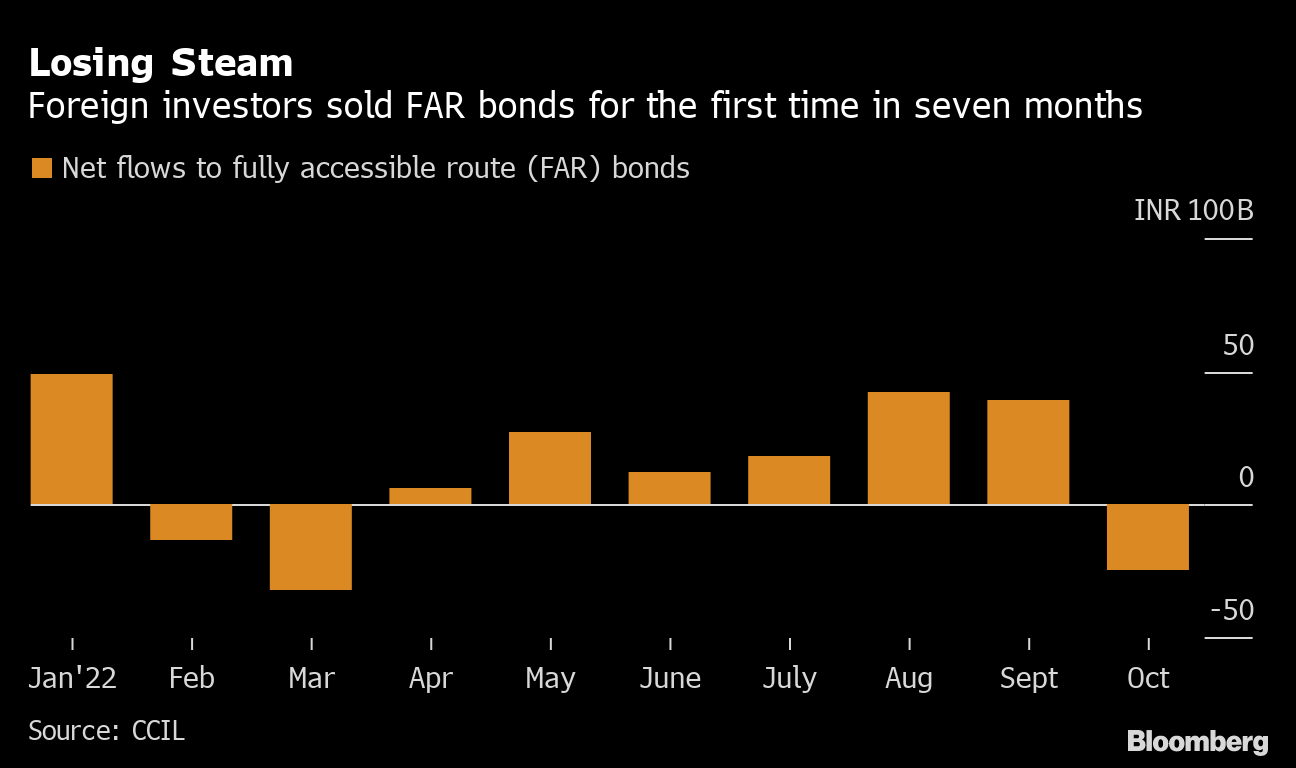
(Bloomberg) -- Global funds sold 24.4 billion rupees ($295 million) of index-eligible Indian sovereign bonds in October after JPMorgan Chase & Co. refrained from including the debt in its gauge.
The outflow from the so-called Fully Accessible Route, or FAR, securities marked the first such withdrawal in seven months. JPMorgan decided last month to keep rupee government notes off its emerging-market sovereign bond index, citing investment hurdles including a lengthy investor registration process.
The selling risks fueling further losses in Indian government securities after they rounded off a second month of declines amid a rout in global debt markets. Expectations for more rate hikes from the Reserve Bank of India may weigh on the market, with a Bloomberg survey of analysts predicting that 10-year yields could climb to 7.53% by year-end from around 7.42% now.
The disappointment over non-index inclusion, a falling rupee and better dollar-denominated returns elsewhere drove foreigners to exit Indian debt, said Naveen Singh, head of trading at ICICI Securities Primary Dealership Ltd.
JPMorgan's decision came on the heels of a similar move by FTSE Russell in September. Morgan Stanley had said Russia's exclusion could pave the way for India to be added to emerging market gauges, potentially drawing inflows of $30 billion.
--With assistance from .
More stories like this are available on bloomberg.com
©2022 Bloomberg L.P.

-
Opinion | India at 38: From Innovation Overperformer to Innovation Powerhouse

India now has 453 VC-backed deep science startups, 18 of them late-stage, after 117 percent growth since 2020. Laurus Labs, at USD 9.3 billion, is the most valuable deep science company in any middle-income economy outside China.
-
Navigating Energy Crossroads: S Jaishankar's Call For Diversified Supply Chains At G20 Ministerial Meeting
As geopolitical fault lines continue to test maritime trade routes and commodity flows, Jaishankar's message remains pertinent: true economic resilience requires open markets, protected transit lines, and a genuine commitment to multilateral cooperation rather than coercion.
-
Indians Are Travelling, But Not Every Journey Is A Holiday | The Week In Whys
Pilgrims, patients and working women are the real travellers, and the system hasn't quite caught up with them.
-
Getting To Work Costs Women More | The Reason Why
It is not just about women paying more than men. It is about women paying much more in cities than in villages.
-
AI Bias In Investing Cannot Be Eliminated, But It Can Be Governed
Framing is a particularly important example as identical financial information presented in terms of gains rather than losses can lead an LLM to reach a different assessment.
-
Joining The Dots | Dark Skies, Steady Diya: Why Hope Holds This Diwali
With war, a weak rupee and foreign outflows weighing on sentiment, policymakers at the NDTV World Summit and market veterans at NDTV Profit Ignite: Diwali Edition offered the same advice: stay invested and filter out the noise.
-
The Curious Case of Equitas Small Finance Bank And A CEO Who Quit For Stock
PN Vasudevan believes persistent investor concerns over a perceived conflict of interest had become a governance overhang on Equitas Small Finance Bank's stock, even as the lender improved profitability and asset quality.
-
Talking Points This Week: AI Cash Burn, A Tiger Comeback And An India That Still Finds Its Own Path
India is not immune to higher oil or tighter global liquidity, yet its earnings base is broader, its domestic policy levers are still available.
-
Foreign Investors Own Half Of HDFC Bank and ICICI Bank. An LTCG Cut Could Matter Most Here
Foreign portfolio investors have US$115 billion parked in HDFC Bank, ICICI Bank. If the government cuts long-term capital gains tax, Jefferies says returning foreign money could land here first.










