Emerging Markets Drop With Fed, China Widens Stock Trading Curbs

(Bloomberg) -- Emerging-markets assets started the week lower after Federal Reserve Chair Jerome Powell said over the weekend that the US may have to wait beyond March for the central bank to cut interest rates.
MSCI Inc.'s index for developing-nation currencies fell 0.3%, with declines across regions, led by the Thai baht. Chile's peso dropped to the lowest level since November 2022.
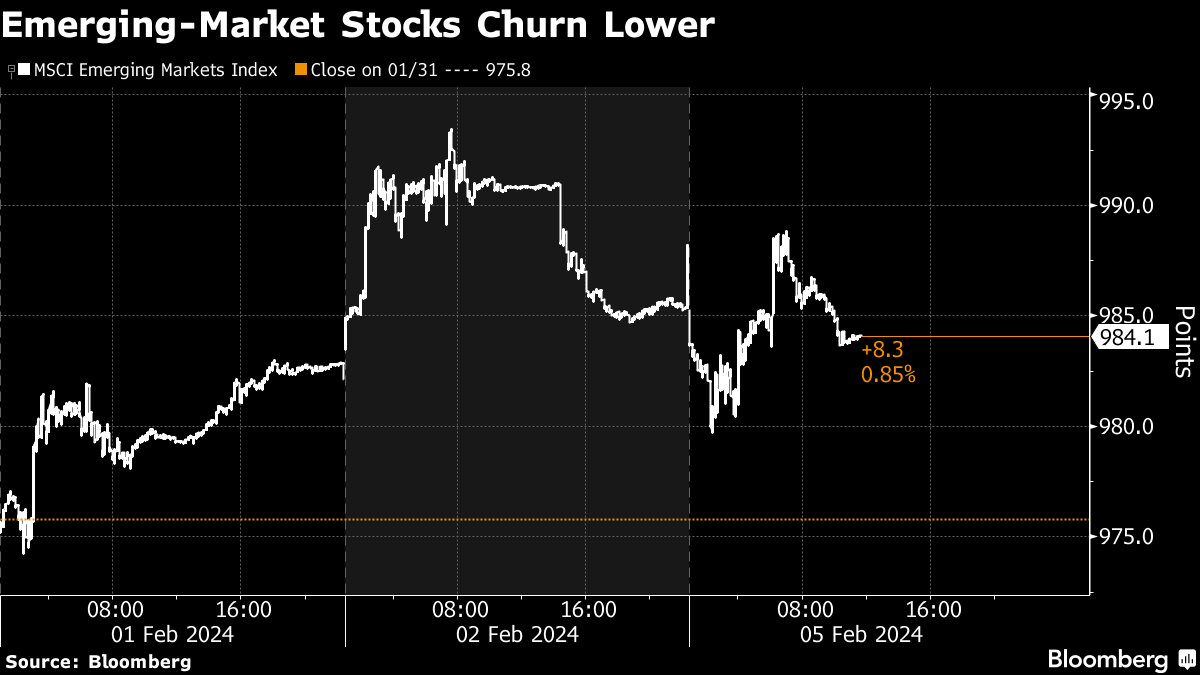
Stocks also declined, with the MSCI index down 0.5%. Equities in China, which account for a large share of global EM benchmarks, had another volatile session after last week's rout, as investors assessed pledges by policymakers to stabilize the market.
At the end of the session in Asia, authorities tightened trading restrictions on domestic institutional investors as well as some offshore units, according to people familiar with the matter.
Turkish assets took the surprise change of guard at the central bank largely in their stride, with the lira down 0.2% against the dollar. Turkish data on Monday showed monthly inflation jumped the most since August, an upswing that could test the central bank's resolve to quell price increases quickly after halting interest-rate increases last month.
Senegal's Spreads
Senegal's Eurobonds fell sharply after President Macky Sall postponed this month's presidential elections and as lawmakers gathered to consider extending his mandate until a successor takes power.
While it's premature to fully discard a positive trajectory, uncertainty has risen for the west African nation's markets, Barclays Plc economist Michael Kafe and strategist Andreas Kolbe wrote in a report Monday.
“We believe that, at least in the short-term, this will need to be reflected in additional political risk premia in Senegal spreads,” the Barclays report said.
In Nigeria, central Bank Governor Olayemi Cardoso said the country has almost cleared a backlog of foreign-exchange contracts that have weighed on the naira and repeated that the currency is undervalued, following a 38% slump last week.
More stories like this are available on bloomberg.com
©2024 Bloomberg L.P.

-
Ten Things I Learnt This Samvat

Patience can be a trap. Cheap stocks can stay cheap. Leverage can wipe you out. What did Samvat 2082 teach us? Niraj Shah writes on 10 lessons from the year gone by.
-
Talking Points This Week: Tech Nerves, FII Buying, And A Faraway Banking Shock
The global markets are not shining this Diwali. The exception in the large markets is, India.
-
Midterm Rally Lasted A Day. The Hard Reality Of A Divided US May Last Two Years | Opinion
Between a contested AI boom, a debt ceiling that arrives in 2027 and a president with every incentive to act alone, the next two years may prove more volatile than the first day's rally suggests.
-
Blue Wave Will Derail the AI Trade but Won't Dismantle the AI Era | Unhedged Position
The Democrats' sweep of the US Congress will see politics collide with economic forces both over the long and short term.
-
It's Time To Take The GST Council's Bet On Trust Global
Payment records can prove India's services exports, and clear, proportionate rules can bring foreign digital sellers into the tax net.
-
Opinion | India at 38: From Innovation Overperformer to Innovation Powerhouse
India now has 453 VC-backed deep science startups, 18 of them late-stage, after 117 percent growth since 2020. Laurus Labs, at USD 9.3 billion, is the most valuable deep science company in any middle-income economy outside China.
-
Navigating Energy Crossroads: S Jaishankar's Call For Diversified Supply Chains At G20 Ministerial Meeting
As geopolitical fault lines continue to test maritime trade routes and commodity flows, Jaishankar's message remains pertinent: true economic resilience requires open markets, protected transit lines, and a genuine commitment to multilateral cooperation rather than coercion.
-
Indians Are Travelling, But Not Every Journey Is A Holiday | The Week In Whys
Pilgrims, patients and working women are the real travellers, and the system hasn't quite caught up with them.
-
Getting To Work Costs Women More | The Reason Why
It is not just about women paying more than men. It is about women paying much more in cities than in villages.









