Emerging Markets Assets Fall as US Treasury Rout Intensifies

(Bloomberg) -- Emerging markets began the fourth quarter on a cautious note as China sent conflicting signals on its manufacturing revival and investors awaited a data-packed week for clues on the outlook for growth and inflation.
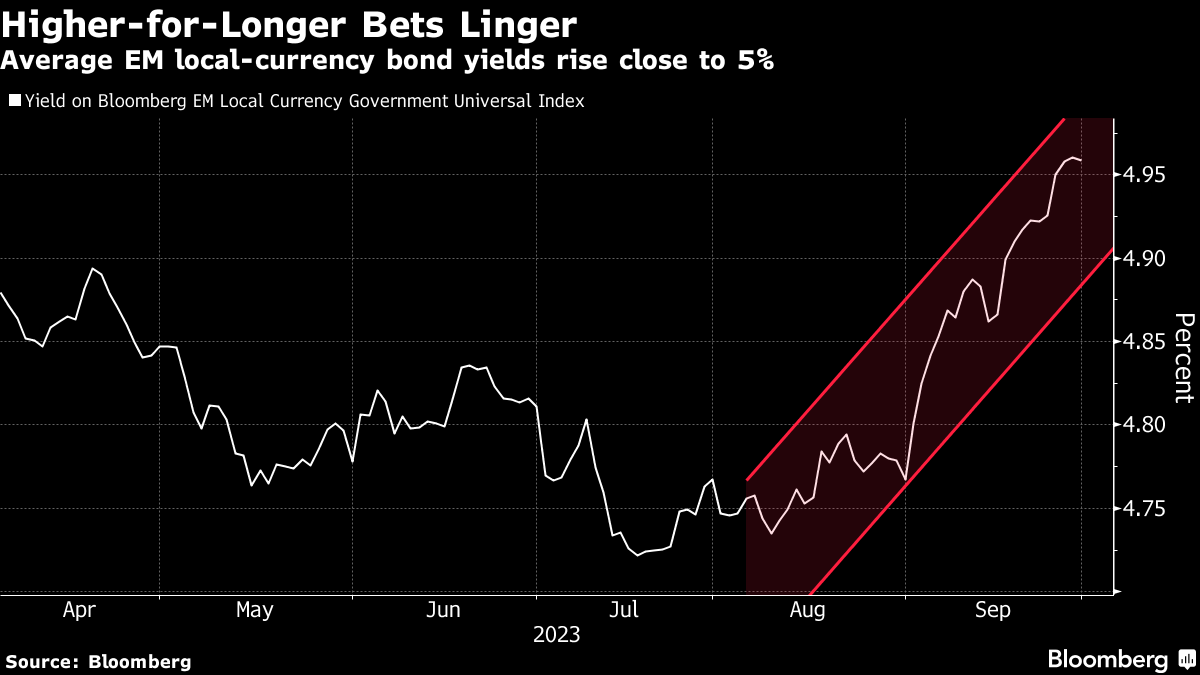
MSCI Inc.'s benchmark for developing-nation stocks and its counterpart index for currencies fell as treasury yields once again hit highs for the last 16 years. Fed Reserve Governor Michelle Bowman again said that multiple interest-rate hikes may be required to fully tame inflation. Sovereign-risk premiums widened amid higher US yields as the focus remained firmly on the higher-for-longer narrative for global interest rates.
China's official purchasing managers' index over the weekend brought encouraging signs of a bottom in the country's economic slump. The data showed a pickup in activity, with manufacturing returning to expansion. However, a popular private measure of the same data — the Caixin PMI — came in below forecasts, suggesting the economic recovery is still shaky.
Read more: China's Precarious Economic Recovery Signals More Support Needed
“This was supposed to be a quiet summer for emerging markets,” HSBC Holdings Plc researchers including Murat Ulgen wrote in a note. “However, the market mood saw a marked deterioration given the sharp spike in core bond yields, in the US in particular, as well as a stronger US dollar. Moreover, the underwhelming data out of mainland China didn't help with the investor mood.”
The data was followed by weak PMIs across Asia, sending currencies lower. The World Bank also cut its forecast for growth in East Asia and the Pacific, citing tighter financing conditions and a weak global environment. It reduced the projection for China's expansion to 4.4% next year, from the previous forecast of 4.8%.
Read more: World Bank Cuts Growth Estimates for East Asia as China Falters
Investors will assess whether the sluggishness seen in Asia is spreading to other emerging-market regions as South Africa, Saudi Arabia, Brazil and Mexico report their PMIs this week.
On the inflation front, Indonesia set the ball rolling by reporting a sharp deceleration in September, which boosted bets for a rate cut in the second half of 2024. But there was also a sobering note: Rice prices increased at a faster annual pace in September at 18.44%, showing the need to guard against inflation remains.
Turkey will report consumer-price trends on Tuesday, with the Philippines and Brazil following in the week. India will announce its interest-rate decision on Friday, where the reserve bank is expected to hold. Poland may slow down after its previous 75 basis-point cut spooked markets.
Amid all this, the flagship data release of the week will be the US nonfarm payrolls. There has been a resurgence in hiring over the past two months, adding to pressure on the Federal Reserve to keep rates high for longer, but economists project a gentle slowing of the labor market to have resumed in September.
Meanwhile, a survey by HSBC showed that investors remain optimistic for gains in emerging markets despite three quarters of losses. The results revealed the net share of respondents with a bullish view on prospects over the next three months came in at 17%, which was lower than the 22% in the previous survey, but still showed the positive bias toward emerging markets continues.
China's mainland markets are closed this entire week for a national holiday. Hong Kong and South Korea are also shut Monday.
--With assistance from Giovanna Bellotti Azevedo.
(Updates pricing, adds context on Powell roundtable in second paragraph)
More stories like this are available on bloomberg.com
©2023 Bloomberg L.P.

-
Ten Things I Learnt This Samvat

Patience can be a trap. Cheap stocks can stay cheap. Leverage can wipe you out. What did Samvat 2082 teach us? Niraj Shah writes on 10 lessons from the year gone by.
-
Talking Points This Week: Tech Nerves, FII Buying, And A Faraway Banking Shock
The global markets are not shining this Diwali. The exception in the large markets is, India.
-
Midterm Rally Lasted A Day. The Hard Reality Of A Divided US May Last Two Years | Opinion
Between a contested AI boom, a debt ceiling that arrives in 2027 and a president with every incentive to act alone, the next two years may prove more volatile than the first day's rally suggests.
-
Blue Wave Will Derail the AI Trade but Won't Dismantle the AI Era | Unhedged Position
The Democrats' sweep of the US Congress will see politics collide with economic forces both over the long and short term.
-
It's Time To Take The GST Council's Bet On Trust Global
Payment records can prove India's services exports, and clear, proportionate rules can bring foreign digital sellers into the tax net.
-
Opinion | India at 38: From Innovation Overperformer to Innovation Powerhouse
India now has 453 VC-backed deep science startups, 18 of them late-stage, after 117 percent growth since 2020. Laurus Labs, at USD 9.3 billion, is the most valuable deep science company in any middle-income economy outside China.
-
Navigating Energy Crossroads: S Jaishankar's Call For Diversified Supply Chains At G20 Ministerial Meeting
As geopolitical fault lines continue to test maritime trade routes and commodity flows, Jaishankar's message remains pertinent: true economic resilience requires open markets, protected transit lines, and a genuine commitment to multilateral cooperation rather than coercion.
-
Indians Are Travelling, But Not Every Journey Is A Holiday | The Week In Whys
Pilgrims, patients and working women are the real travellers, and the system hasn't quite caught up with them.
-
Getting To Work Costs Women More | The Reason Why
It is not just about women paying more than men. It is about women paying much more in cities than in villages.









