Dollar’s Link To US Treasury Yields Weakens As Confidence Cracks
The traditional relationship between the dollar and Treasury yields is the weakest in three years as investors rethink the safety of US assets in times of stress.
The dollar's rapid decline has been caused by investors pulling out of US assets as the Trump administration's trade war risks sending the economy into a recession. Meanwhile, yields on US long-term debt remain near 17-month highs.
Usually, higher bond yields are supportive of the US currency. But in this case, the two have diverged as more investors question the dollar's haven status and central role in the global financial system. Options positioning shows show that traders expect more losses for the dollar.
“The dislocation between the dollar, yields, and traditional risk proxies is striking, and increasingly reminiscent of past stress episodes,” Danske Bank A/S analysts including Jens Naervig Pedersen wrote in a note.
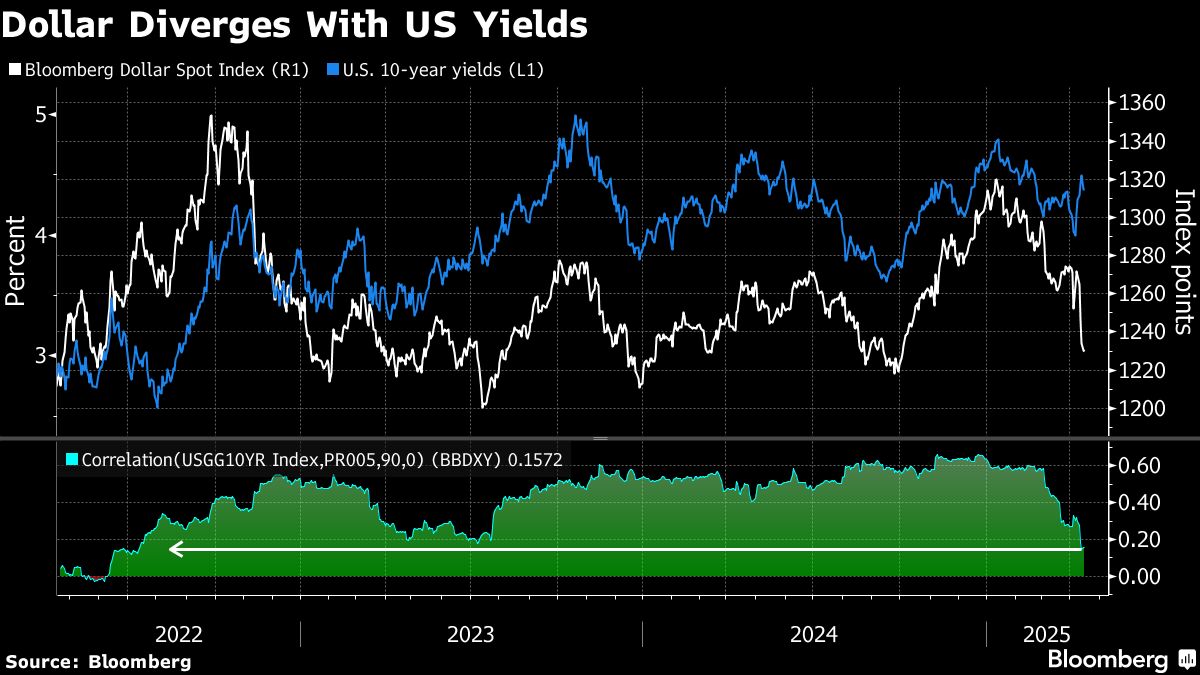
The Bloomberg Dollar Spot Index fell last week by the most since November 2022 and extended declines on Monday. Roughly two-thirds of options traded in the past week targeted a weaker dollar against the euro, yen, and Swiss franc, Depository Trust & Clearing Corp. data show.
Last week was only the third time in more than 50 years that the dollar declined more than 2.5% while the 10-year Treasury yield rose by at least 25 basis points, Pedersen said. The other occasions were in July 1985, during the so-called Plaza Accord aimed at devaluing the dollar, and in May 2009. Both of those episodes “were followed by sustained dollar weakness,” he said.
The options market suggests traders are positioning for such a development. So-called risk reversals, a barometer of investor sentiment that measures the premium on options to sell the greenback over those to buy it, show traders wagering on a weaker dollar over many time spans, from the next week to the next year. It's the first time since early 2020 that all tenors of risk reversals have shown that trend.
“There has been a lot of focus over the past week on the pressure on Treasuries and the shifting correlations to the dollar,” said Alvaro Vivanco, head of strategy at TJM FX. “Selling away from US assets but without consistent panic could be the right framework over the next few weeks to months.”
The dollar-yields correlation is at the lowest since the aftermath of Russia's invasion of Ukraine, when haven flows supported the greenback even as it decoupled from Treasury moves. Today, it's the opposite: the dollar is no longer benefiting from its haven status, and the dislocation reflects an accelerating exodus from U.S. assets.
“The sustainability of the greenback as a reserve currency is slowly put under question,” said Alberto Gallo, chief investment office at Andromeda Capital Management. “There is damage to the US brand and the ability of investors to keep duration in the long end.”

-
Talking Points This Week: Tech Nerves, FII Buying, And A Faraway Banking Shock

The global markets are not shining this Diwali. The exception in the large markets is, India.
-
Midterm Rally Lasted A Day. The Hard Reality Of A Divided US May Last Two Years | Opinion
Between a contested AI boom, a debt ceiling that arrives in 2027 and a president with every incentive to act alone, the next two years may prove more volatile than the first day's rally suggests.
-
Blue Wave Will Derail the AI Trade but Won't Dismantle the AI Era | Unhedged Position
The Democrats' sweep of the US Congress will see politics collide with economic forces both over the long and short term.
-
It's Time To Take The GST Council's Bet On Trust Global
Payment records can prove India's services exports, and clear, proportionate rules can bring foreign digital sellers into the tax net.
-
Opinion | India at 38: From Innovation Overperformer to Innovation Powerhouse
India now has 453 VC-backed deep science startups, 18 of them late-stage, after 117 percent growth since 2020. Laurus Labs, at USD 9.3 billion, is the most valuable deep science company in any middle-income economy outside China.
-
Navigating Energy Crossroads: S Jaishankar's Call For Diversified Supply Chains At G20 Ministerial Meeting
As geopolitical fault lines continue to test maritime trade routes and commodity flows, Jaishankar's message remains pertinent: true economic resilience requires open markets, protected transit lines, and a genuine commitment to multilateral cooperation rather than coercion.
-
Indians Are Travelling, But Not Every Journey Is A Holiday | The Week In Whys
Pilgrims, patients and working women are the real travellers, and the system hasn't quite caught up with them.
-
Getting To Work Costs Women More | The Reason Why
It is not just about women paying more than men. It is about women paying much more in cities than in villages.
-
AI Bias In Investing Cannot Be Eliminated, But It Can Be Governed
Framing is a particularly important example as identical financial information presented in terms of gains rather than losses can lead an LLM to reach a different assessment.