Wall Street Is Getting More Worried About the Debt Ceiling. These Charts Show How Much
(Bloomberg) -- Investors and politicians are zeroing in on whether or not the US government can avoid crashing into its statutory debt ceiling and a potentially catastrophic technical default that could follow. From Washington to Wall Street, here's what to watch to gauge how worried observers should be and when they should be concerned.

X-Date Predictions
Underpinning all these market moves are varying estimates about when the government might exhaust its options to fund itself — commonly referred to as the X-date. The administration itself has provided guidance that it might fall short as soon as June, as has the non-partisan Congressional Budget Office. Meanwhile, prognosticators across Wall Street have also been busy running the numbers based on government cash flows and expectations around tax and spending, with some strategists pulling forward align with forecasts out of Washington. Others are staying with their late-summer estimate, but acknowledge that the Treasury's finances will be thin.
Related story on Yellen's warning to Congress about hitting the limit

The Bills Curve
Investors have historically demanded higher yields on securities that are due to be repaid shortly after the US is seen as running out of borrowing capacity. That puts a lot of focus on the yield curve for bills — the shortest-dated Treasury securities --and potential dislocations that show up. Noticeable upward distortions in particular parts of the curve tend to suggest increased concern among investors that that's the time Uncle Sam might be at risk of default and right now that's most prominent around early June. The government this week sold $50 billion of four-week securities — that are scheduled to mature on June 6 — at a record 5.84%. That's the highest for Treasury bill auction since 2000.
Related story on the one-month bill auction this week that investors shunned

The Cash Balance
The US government's ability to pay its debts and meet its spending obligations ultimately comes down to whether it has the cash to do it, so the amount sitting in its checking account is crucial. That figure ebbs and flows from day to day depending on spending, tax receipts, debt repayments and the proceeds of new borrowing. And if it gets too close to zero for the Treasury department's comfort that could be a problem.
Related newsletter on how Biden and McCarthy are vying for leverage on the ceiling

Congress
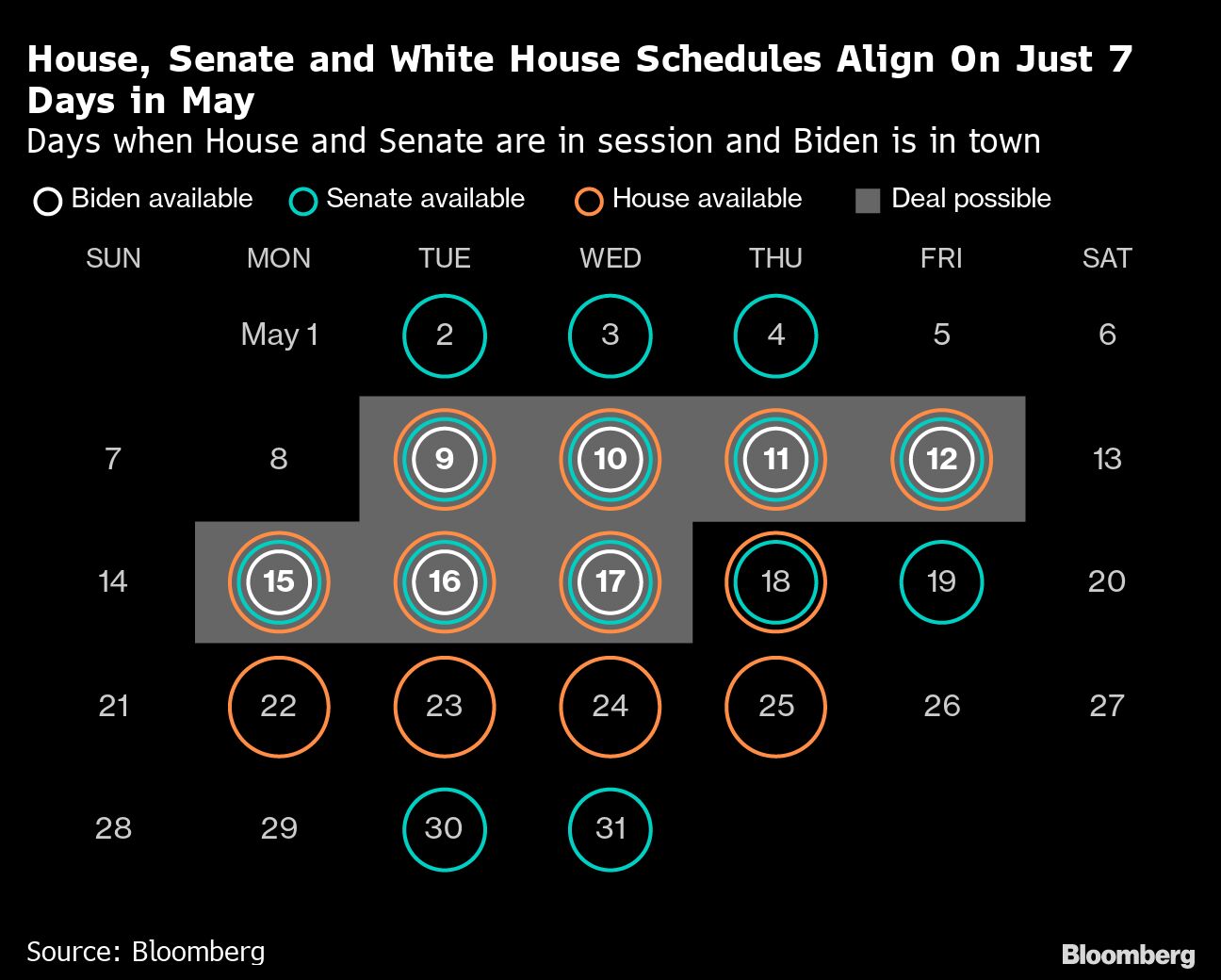
Ultimately, some of the most important numbers in this whole saga relate to the amount of votes that can be secured in Washington to get a deal done. That will be driven, in large part, by the willingness of key government leaders to hammer out an agreement. Following is a glance at just how small the window might be for them to bridge the gap and come to an agreement.
Related story on how the short deadline raises the odds of a stopgap fix

More stories like this are available on bloomberg.com
©2023 Bloomberg L.P.

-
Ten Things I Learnt This Samvat

Patience can be a trap. Cheap stocks can stay cheap. Leverage can wipe you out. What did Samvat 2082 teach us? Niraj Shah writes on 10 lessons from the year gone by.
-
Talking Points This Week: Tech Nerves, FII Buying, And A Faraway Banking Shock
The global markets are not shining this Diwali. The exception in the large markets is, India.
-
Midterm Rally Lasted A Day. The Hard Reality Of A Divided US May Last Two Years | Opinion
Between a contested AI boom, a debt ceiling that arrives in 2027 and a president with every incentive to act alone, the next two years may prove more volatile than the first day's rally suggests.
-
Blue Wave Will Derail the AI Trade but Won't Dismantle the AI Era | Unhedged Position
The Democrats' sweep of the US Congress will see politics collide with economic forces both over the long and short term.
-
It's Time To Take The GST Council's Bet On Trust Global
Payment records can prove India's services exports, and clear, proportionate rules can bring foreign digital sellers into the tax net.
-
Opinion | India at 38: From Innovation Overperformer to Innovation Powerhouse
India now has 453 VC-backed deep science startups, 18 of them late-stage, after 117 percent growth since 2020. Laurus Labs, at USD 9.3 billion, is the most valuable deep science company in any middle-income economy outside China.
-
Navigating Energy Crossroads: S Jaishankar's Call For Diversified Supply Chains At G20 Ministerial Meeting
As geopolitical fault lines continue to test maritime trade routes and commodity flows, Jaishankar's message remains pertinent: true economic resilience requires open markets, protected transit lines, and a genuine commitment to multilateral cooperation rather than coercion.
-
Indians Are Travelling, But Not Every Journey Is A Holiday | The Week In Whys
Pilgrims, patients and working women are the real travellers, and the system hasn't quite caught up with them.
-
Getting To Work Costs Women More | The Reason Why
It is not just about women paying more than men. It is about women paying much more in cities than in villages.









