Credit Suisse Risk Gauge At Record High, Shares Hit New Low
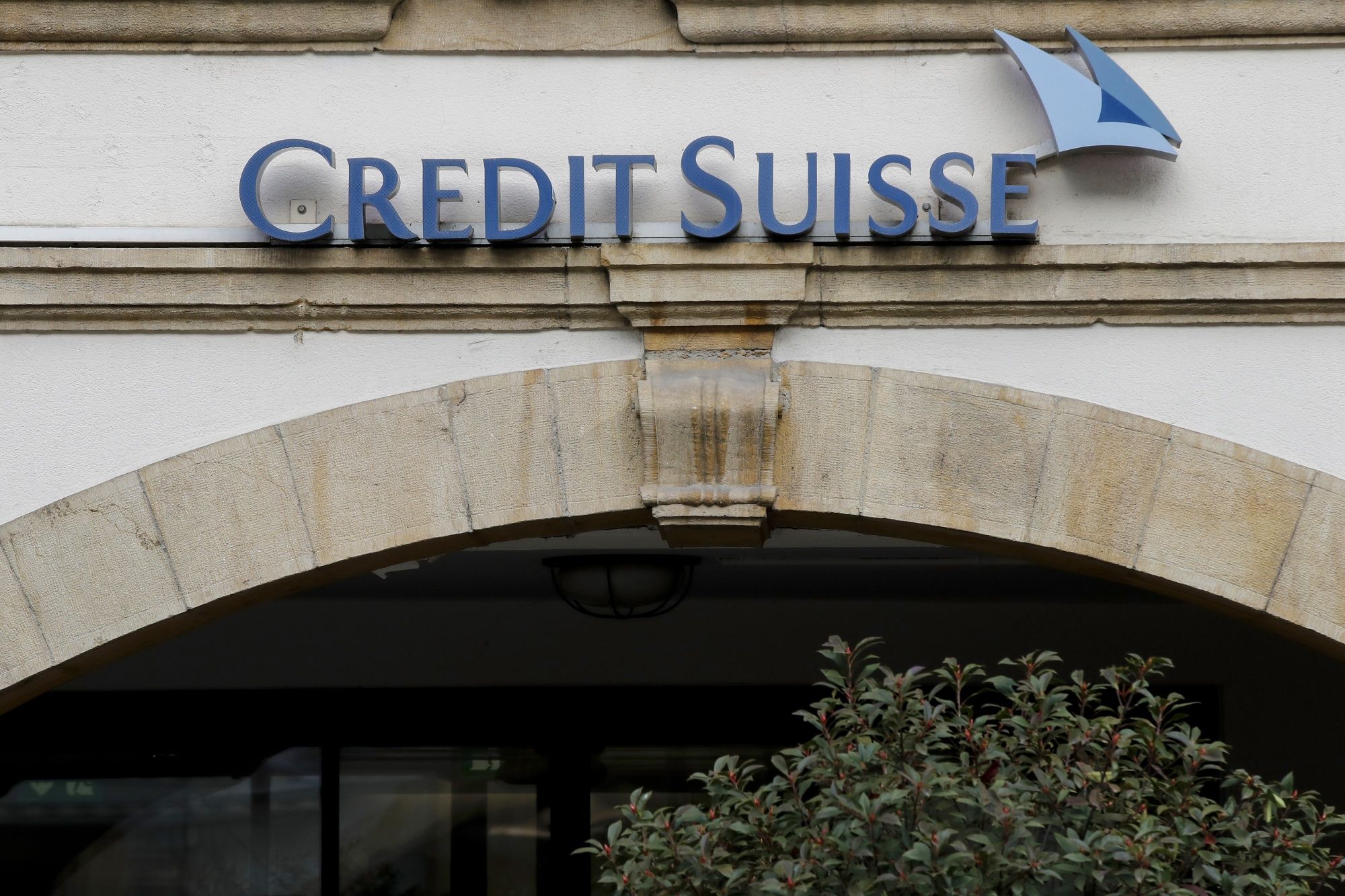
(Bloomberg) -- Credit Suisse Group AG's gauge of credit risk rose to a record high while its stock hit a fresh low, adding to the turmoil after the bank's attempts to reassure markets on its financial stability backfired.
The five-year credit default swaps price of about 293 basis points is up from about 55 basis points at the start of the year and at the highest ever, according to ICE Data Services. At the same time, the shares dropped as much as 12% in Zurich on Monday and have lost about 60% just this year alone, on track for the biggest annual drop in Credit Suisse's history.
Chief Executive Officer Ulrich Koerner had sought to calm employees and the markets over the weekend only to see his carefully-worded memo have the opposite effect. While touting the bank's capital levels and liquidity, he acknowledged that the firm was facing a “critical moment” as it worked towards its latest overhaul.

He also told employees that he will be sending them a regular update until the firm announces the new strategic plan on Oct. 27. At the same time, Credit Suisse again sent around talking points to executives dealing with clients who brought up the credit default swaps, according to people with knowledge of the matter.
While the credit default swap levels are still far from distressed and are part of a broad market selloff, they signify deteriorating perceptions of creditworthiness for the scandal-hit bank in the current environment. There is now a roughly 23% chance the bank defaults on its bonds within 5 years.
Some clients have used the rise in the CDS this year to ask questions, negotiate prices or use competitors, the people said, asking to remain anonymous discussing confidential conversations.
Credit Suisse declined to comment via a company spokesman.
Some prominent figures took to Twitter over the weekend to dismiss some of the rumors prompted by the widened CDS spread as “scaremongering.” Saba Capital Management's Boaz Weinstein tweeted “take a deep breath” and compared the situation to when Morgan Stanley's CDS was twice as wide in 2011 and 2012.
Koerner, named CEO in late July, has had to deal with market speculation, banker exits and capital doubts as he seeks to set a path forward. The lender is currently finalizing plans that will likely see sweeping changes to its investment bank and may include cutting thousands of jobs over a number of years, Bloomberg has reported.
Koerner's memo was the second straight Friday missive as speculation over the beleaguered bank's future increases. Analysts at KBW estimated that the firm may need to raise 4 billion Swiss francs ($4 billion) of capital even after selling some assets to fund any restructuring, growth efforts and any unknowns.
Credit Suisse's market capitalization has dropped to around 9.5 billion Swiss francs, meaning any share sale would be highly dilutive to longtime holders. The market value was above 30 billion francs as recently as March 2021.
Bank executives have noted that the firm's 13.5% CET1 capital ratio at June 30 was in the middle of the planned range of 13% to 14% for 2022. The firm's 2021 annual report said that its international regulatory minimum ratio was 8%, while Swiss authorities required a higher level of about 10%.

The KBW analysts were the latest to draw comparisons to the crisis of confidence that shook Deutsche Bank AG six years ago. Then, the German lender was facing broad questions about its strategy as well as near-term concerns about the cost of a settlement to end a US probe related to mortgage-backed securities. Deutsche Bank saw its credit-default swaps climb, its debt rating downgraded and some clients step back from working with it.
The stress eased over several months as the German firm settled for a lower figure than many feared, raised about 8 billion euros ($7.8 billion) of new capital and announced a strategy revamp. Still, what the bank called a “vicious circle” of declining revenue and rising funding costs took years to reverse.
There are differences between the two situations. Credit Suisse doesn't face any one issue on the scale of Deutsche Bank's $7.2 billion settlement, and its key capital ratio of 13.5% is higher than the 10.8% that the German firm had six years ago.
The stress Deutsche Bank faced in 2016 resulted in the unusual dynamic where the cost of insuring against losses on the lender's debt for one year surpassed that of protection for five years. Credit Suisse's one-year swaps are still significantly cheaper than five-year ones.
Credit Suisse Group CDS Widens 42 Bps: 12 Signals Since Sept. 16
Last week, Credit Suisse said it's working on possible asset and business sales as part of its strategic plan which will be unveiled at the end of October. The bank is exploring deals to sell its securitized products trading unit, is weighing the sale of its Latin American wealth management operations excluding Brazil, and is considering reviving the First Boston brand name, Bloomberg has reported.
More stories like this are available on bloomberg.com
©2022 Bloomberg L.P.

-
Love, Sex Aur Dhokha: The Audacious Plot To Spy On Jensen Huang

A Taipei dinner, a Singapore chip buyer and a suspected Chinese asset: inside the alleged spy operation that got close to NVIDIA's Jensen Huang.
-
Ten Things I Learnt This Samvat
Patience can be a trap. Cheap stocks can stay cheap. Leverage can wipe you out. What did Samvat 2082 teach us? Niraj Shah writes on 10 lessons from the year gone by.
-
Talking Points This Week: Tech Nerves, FII Buying, And A Faraway Banking Shock
The global markets are not shining this Diwali. The exception in the large markets is, India.
-
Midterm Rally Lasted A Day. The Hard Reality Of A Divided US May Last Two Years | Opinion
Between a contested AI boom, a debt ceiling that arrives in 2027 and a president with every incentive to act alone, the next two years may prove more volatile than the first day's rally suggests.
-
Blue Wave Will Derail the AI Trade but Won't Dismantle the AI Era | Unhedged Position
The Democrats' sweep of the US Congress will see politics collide with economic forces both over the long and short term.
-
It's Time To Take The GST Council's Bet On Trust Global
Payment records can prove India's services exports, and clear, proportionate rules can bring foreign digital sellers into the tax net.
-
Opinion | India at 38: From Innovation Overperformer to Innovation Powerhouse
India now has 453 VC-backed deep science startups, 18 of them late-stage, after 117 percent growth since 2020. Laurus Labs, at USD 9.3 billion, is the most valuable deep science company in any middle-income economy outside China.
-
Navigating Energy Crossroads: S Jaishankar's Call For Diversified Supply Chains At G20 Ministerial Meeting
As geopolitical fault lines continue to test maritime trade routes and commodity flows, Jaishankar's message remains pertinent: true economic resilience requires open markets, protected transit lines, and a genuine commitment to multilateral cooperation rather than coercion.
-
Indians Are Travelling, But Not Every Journey Is A Holiday | The Week In Whys
Pilgrims, patients and working women are the real travellers, and the system hasn't quite caught up with them.









