Commodities In 2017: The Year Of Bitcoin

It was a mix of a pick-up in demand and supply-side consolidation that paved the way for a bull market in commodities in 2017.
Central banks, on their part, ensured easy liquidity through the year, tightening in baby steps at best. While the oil cartel got bigger with non-OPEC countries led by Russia joining in, China's crusade against polluting industries sent the prices of several commodities to multi-year highs. To top it all, bitcoin invoked the memories of Tulip Mania, setting records on the way up and smashing them on the way down.
Also Read: The Economy In 2017: A Year Of Shifting Sands
Dollar Sinks
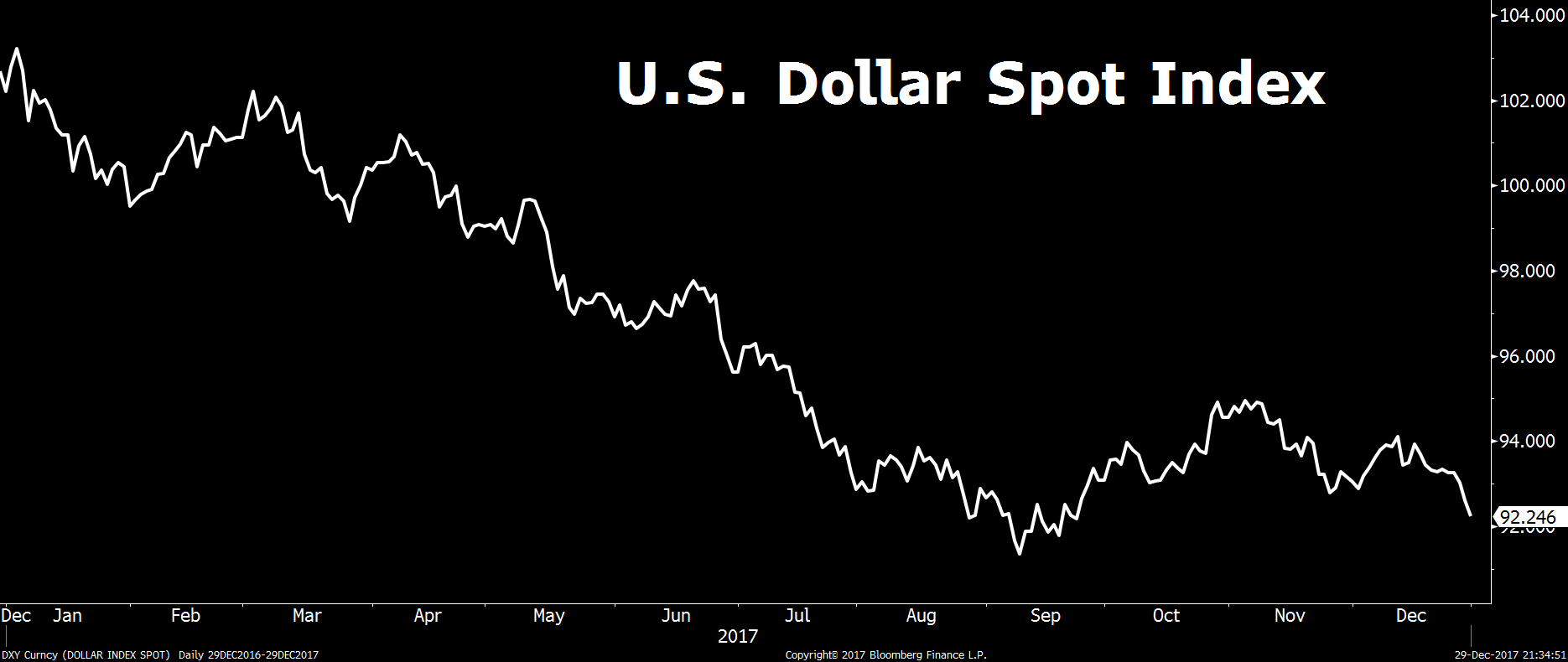
Nothing helps commodities like a falling dollar and 2017 was the worst year for the greenback in more than a decade. Since prices are quoted in the dollar, the falling U.S. currency helps all commodities appreciate. Global markets entered 2017 with bullish to ultra-bullish outlook on the greenback. President-elect Trump was tweeting overtime and markets were factoring in a steep tax cut, several incentives to revive manufacturing in the U.S. and much more. Traders had also started factoring in faster and sharper rate hikes during the year.
But the dollar peaked in the very first week of January. As markets realised that it was not easy for Trump to get the Congress to pass the key healthcare and tax reforms or clear $1-trillion investments in infrastructure, the currency started weakening. The euro gained strength as growth returned in the Euro Area. The U.S. dollar index that gauges the value of the greenback against major global currencies topped at around 104 to fall by around 12 percent in the next nine months. Although tax reforms finally got cleared before year end, that has failed to revive the American currency yet. Some believe that Trump is in favour of a weak dollar as it helps U.S. producers compete in global markets.
A Roaring Bull Market In Metals
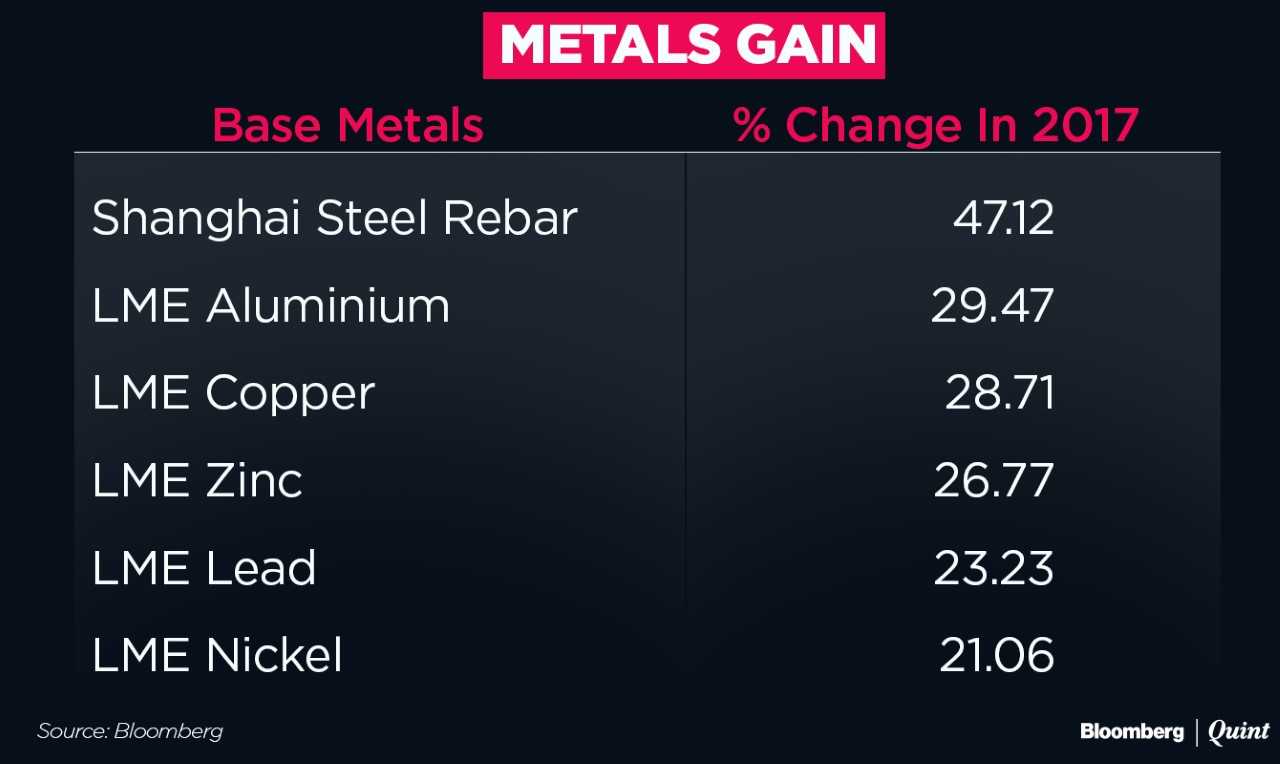
2016 saw base metal prices bottoming out after a five-year downturn. In 2017, several commodities hit multi-year highs. Zinc scaled the highest level in a decade due to supply constraints. Lead followed with a six-year high, aluminum had the best year in five, copper hit a three-year record and Nickel hit a two-year high as well.
As the year comes to an end, there is some uncertainty about Chinese demand. China's GDP growth is likely to slow from 6.8 percent in 2017 to 6 percent in 2018. Markets are pricing in a gradual shutdown and not a hard landing—that would be a key risk.
Chinese Purge
China's industrialised province of Shandong plans to eliminate 10.23 million tonnes of coal capacity. In December itself, the country's top two copper smelters halted production on government's order aimed at reducing pollution levels in winter. The pollution control plan that was announced in March this year targets 28 cities in and around Beijing-Tianjin-Hebei regions. It included up to 50 percent cut in steel capacities in major cities and around 28 percent cut in aluminum and alumina capacities. According to a report from Macquarie Research, illegal aluminum smelters capacity has been cut by 3.2 million tonnes against the announced target of 4.5 million tonnes. In steel, China has cut 115 million tonnes out of the 140 million tonne target by 2020.
These measures have contributed in a big way to the rising commodity prices world over. It has had some positive fallouts for Indian companies in metals and chemicals as their revenues jumped, earnings multiplied in some cases and stocks surged in last 12 months.
On Dec. 19, China announced a programme for coal users like power plants, cement industry and producers of aluminum and other metals to buy carbon credits. The system would also include iron and steel, chemicals, building materials and paper production.
The Big Oil Squeeze
OPEC and non-OPEC countries came together on Dec. 10, 2016 to tighten the crude supply. However, the first half of 2017 saw frequent breach of production ceilings by OPEC nations, that scenario changed completely after June. Led by Saudi Arabia and Venezuela, OPEC cut down the supply in the second half. Russia and Mexico were the biggest contributors among non-OPEC producers.
Saudi prince Mohammad-Bin-Salman tightened his grip on power by arresting several members of the royal family on the pretext of an anti-corruption drive. The new crown prince and his government strongly support high oil prices in run-up to the Aramco divestment. The public issue of Saudi state-owned oil company will likely be the most important IPO of 2018. U.S. President Donald Trump has gone public with his appeal to the Saudi government to list the company on an American bourse.
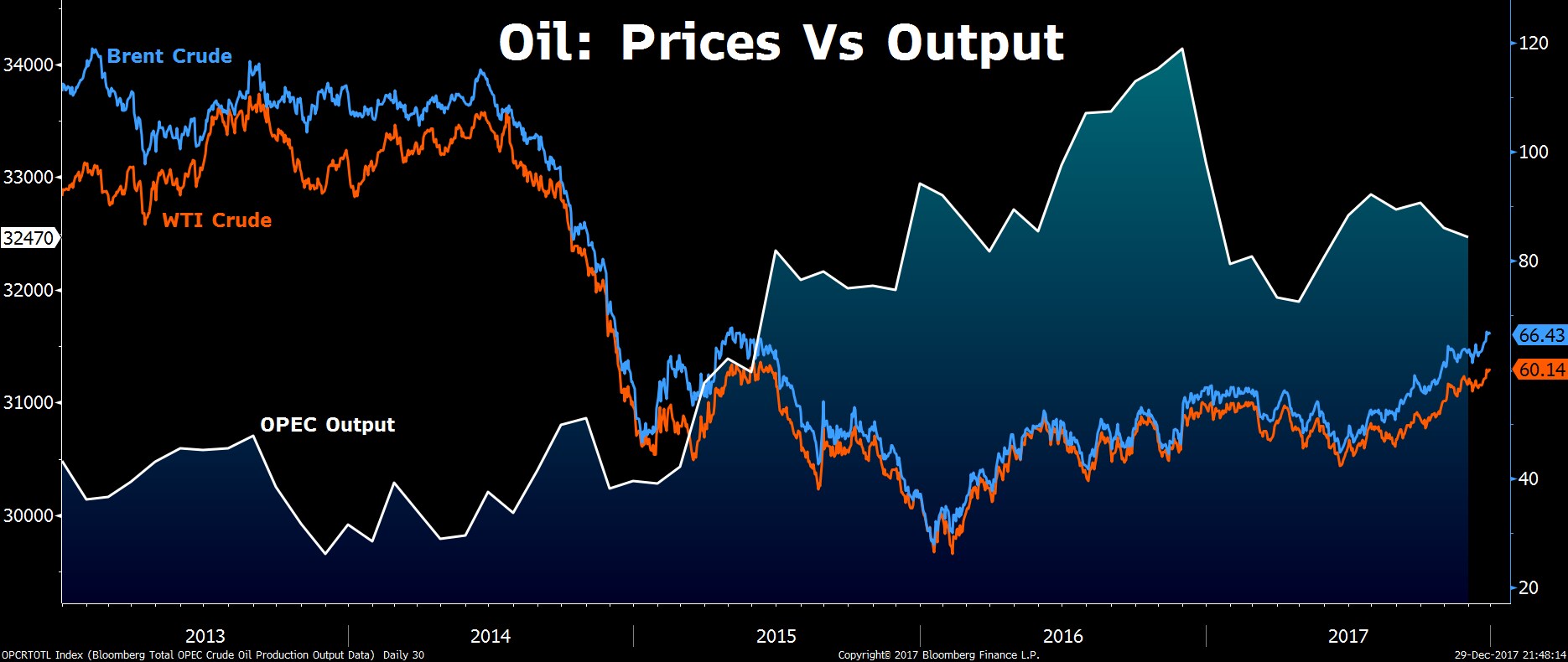
In November, the oil producers agreed to extend the production cuts till December 2018, with a mid-year review likely in June. Meanwhile, the U.S. emerged as the third-largest producer of liquid fuel, pumping out more oil than it ever did since 1970. With the U.S. producing nearly 10 million barrels a day, it's just behind the big two—Saudi and Russia. While supply outlook remains balanced, favourable diplomatic equations are likely to sustain oil prices at higher levels, at least until the big-bang public issue gets listed.
The Crypto Mania
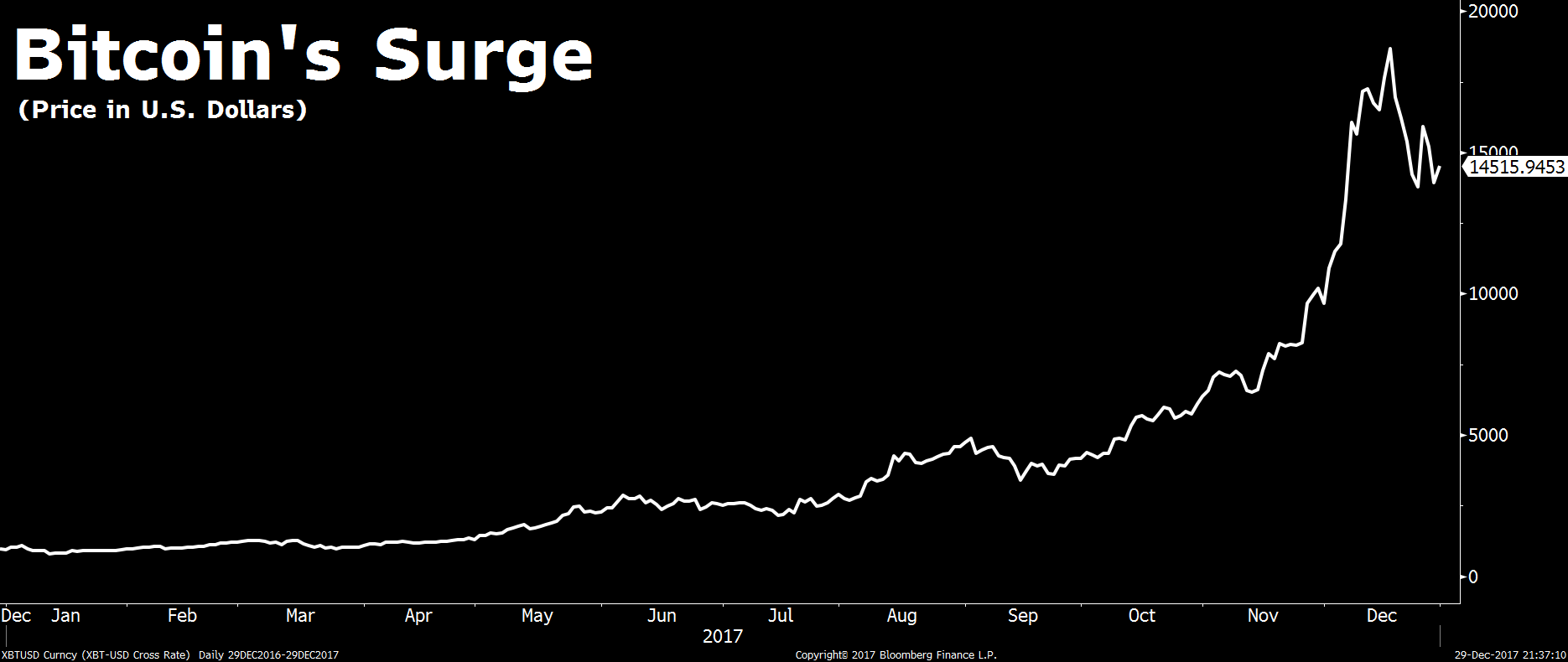
On Jan. 2, Bitcoin hit the $1,000 mark for the first time but that was just the beginning. By mid-May, the cryptocurrency had doubled. The real bull run started in September—in the first two weeks of the month, Bitcoin fell 30 percent from the record $5,000 to around $3,400. Within the next 45 days, it had hit $10,000, just to cross $15,000 within a week's time. Then came the turning point, CBOE started trading Bitcoin futures on Dec. 10. The rival bourse CME started it on Dec. 18, the day Bitcoin prices peaked to an all-time high of around 19,500. The return journey was as swift. It took just five sessions to fall 45 percent to below $11,000.
Also Read: Banning Bitcoin Won't Help, Says Former RBI Deputy Governor Gandhi
The wild swings were not confined to the price movement alone. The best brains of Wall Street suffered similar mood swings when it came to their views on the cryptocurrency. In October when Bitcoin was quoting around $5,000, JPMorgan Chase & Co. Chief Executive Officer Jamie Dimon threatened to fire any trader who bought bitcoin. Within six weeks as bitcoin doubled to around $10,000, JP Morgan was getting ready to facilitate clients' participation in bitcoin futures. For now, exuberance has peaked with the futures getting listed on exchanges. Will they provide a much-needed legitimacy to the cryptocurrency, turning it into a new asset class or mark the end of it is anybody's guess?
Also Read: Indian Politics In 2017: Modi Grows Stronger, Rahul Gets A Makeover
Indians Got An Option
Back home, 2017 saw a long-awaited development with market regulator allowing commodity exchanges to start trading options contracts. On Oct. 17, the country's largest commodity trading platform, Multi Commodity Exchange, launched the first gold options contract for December and January expiries. Although it's still early days for commodity options in India, it's potential can be understood by the fact that on a given trading day, equity options record a turnover that is around five times that of the futures on the NSE. With MCX taking the lead, its rival is set to follow. Come Jan. 14, on the auspicious occasion of Makar Sankranti, the National Commodity and Derivatives Exchange will roll out the ‘guar seed options' contract, the first agri-commodity option to trade on any Indian exchange.

-
High US Salaries, No Green Card Certainty: The Financial Calculation Facing Indian H-1B Families

The suspension of PERM processing at eight technology employers does not cancel existing H-1B visas. What it does is force a question many Indian families have been avoiding: is the US salary worth tying your career and family plans to one employer?
-
Swiggy vs Eternal: Food Delivery's Two Rivals Are No Longer In The Same Race
Eternal is building a private AI assistant, dark.ai. Swiggy is still working out how to make Instamart pay, with an operating loss of Rs 895 crore in the July-September quarter while Blinkit stayed profitable.
-
Where You Live Shapes How You Get To Work | The Reason Why
Two-wheelers are the most popular way to get to work in India, accounting for nearly 43% of workplace commutes.
-
Unhedged Position: Can India See An Indonesia-Style Time Correction?
The Nifty is trading below levels it first clocked in 2024. Is there, then, as I have suggested in the headline, potential that the current time correction drags on painfully for the next three-five, even ten years?
-
Navigating Friction And Energy Realities: An Analysis Of Marco Rubio's October Visit To India
Occurring at a critical juncture marked by stalled trade negotiations and escalating geopolitical pressures over global energy supplies, the visit offers a profound window into modern US-India relations.
-
India Exports Capital. Why Not Export Trusteeship?
The big question, then, is whether India can build an institution that global borrowers, investors, banks, and lawyers can trust, even without an Indian connection.
-
France's Economy & Politics Are In Crisis | The Reason Why
Let's look at how the French economy and politics evolved under Nicolas Sarkozy, Franois Hollande and Emmanuel Macron.
-
You May Inherit The Business. You Must Earn Its Credibility.
Succession tests the founder's ability to share authority as much as it tests the next generation's readiness to assume it.
-
Signing Deals Is One Thing; Making Them Work Is Another | The Week In Whys
Sometimes, things don't turn out as planned. Indian companies have lost some bids to rivals, some projects won't produce until 2030.
-
FOMC Wall, PERM Suspension, Hospital Stocks | Talking Points This Week
A PERM suspension would directly affect green-card sponsorship rather than H-1B visas, so the near-term earnings impact could remain relatively limited. The key question is whether this marks a new phase in US scrutiny of Indian IT.









