Bitcoin ETF Record Gets Broken Yet Again on $612 Million Inflow

(Bloomberg) -- Another day, another record across the booming world of Bitcoin ETFs – fueled by fear of missing out on the latest crypto rally.
BlackRock Inc.'s iShares Bitcoin Trust (ticker IBIT) netted $612 million Wednesday in its biggest one-session haul, breaking a record set just a day prior, data compiled by Bloomberg show. Altogether, the 10 new exchange-traded funds investing directly in the world's biggest cryptocurrency took in a net $673 million, even with the outflows seen by Grayscale Bitcoin Trust (GBTC). The cash pouring into the funds handily beat their launch day record of $655 million set on Jan. 11.
As Bitcoin surges past $60,000 and on toward new highs, the rush of money into the ETFs, particularly BlackRock's IBIT, helps explain the digital asset's remarkable run this year. At the crux of the rally is basic economics: supply and demand. Ever since the spot Bitcoin ETFs were launched last month, demand for the token has outstripped the amount of the cryptocurrency that long-time holders are willing to sell.
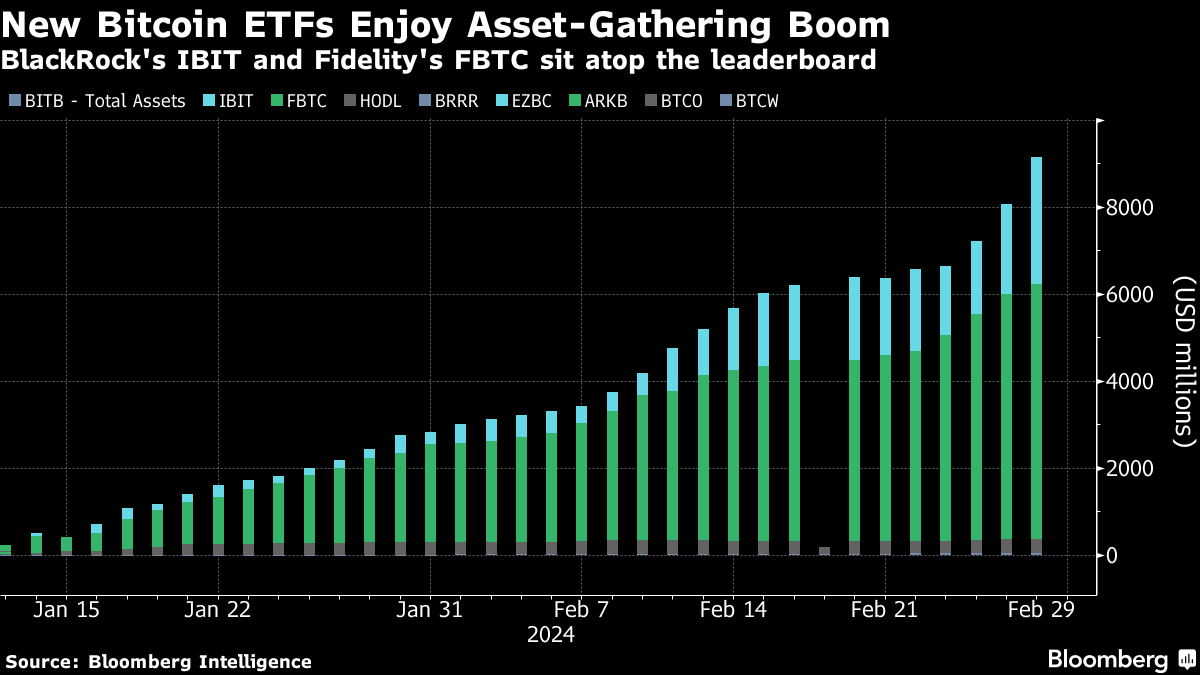
Bitcoin has already surged more than 40% this year, driven in part by the successful launch of the ETFs, and making it a top performer across all asset types. Just as proponents of the spot ETFs predicted would occur, last month's arrival of the new products has kicked open the door to fresh investment, giving the institutional and retail traders a new and easier avenue for sinking capital across the asset class. The interest is evident from the traded value within the group — excluding Grayscale's fund — as it doubled to over $6 billion with IBIT comprising more than half.
“A sharp correction around about now would be healthy to shake out some of the froth,” said Noelle Acheson, author of the newsletter. “It's way too soon in the cycle for the market to be really frothy.”
Buying a share of a spot Bitcoin ETF does not directly impact the cryptocurrency's price in real time. But the new Bitcoin issuers eventually need to purchase physical Bitcoin in order to hold enough tokens to back the shares they issue. The term “spot” after all implies that issuers have to hold physical Bitcoin rather than a derivative tied to the token.
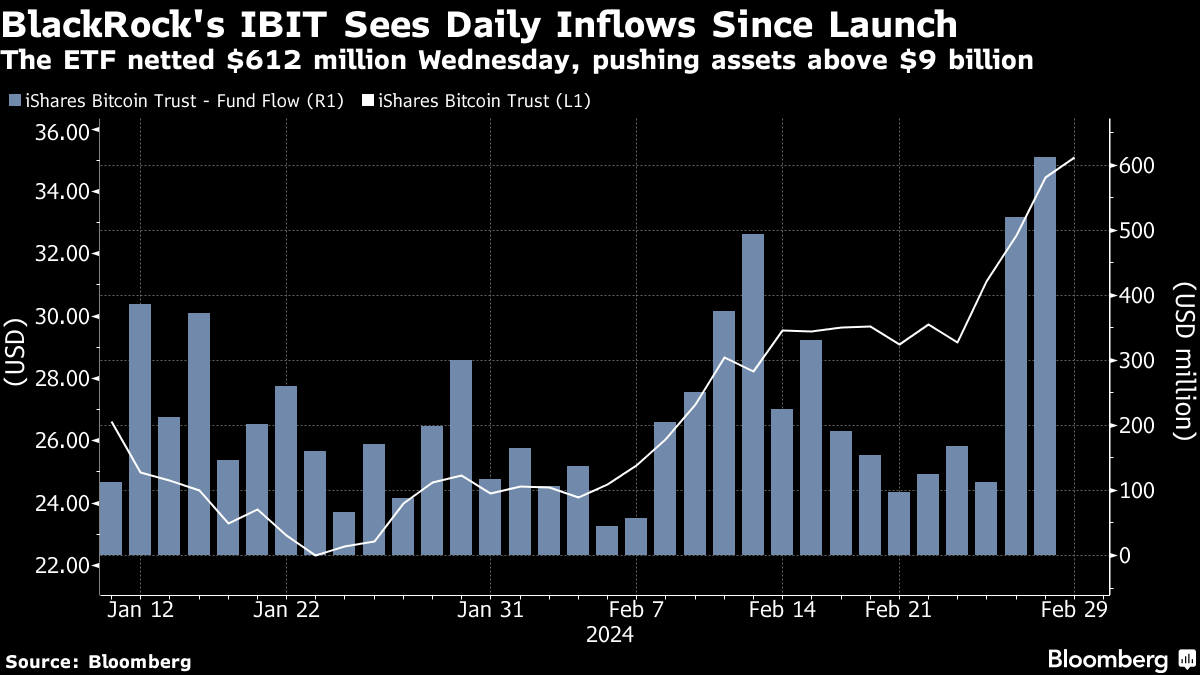
Further underscoring the demand, IBIT is at the cusp of hitting the $10 billion asset mark in just seven weeks — the fastest an ETF has ever hit such a milestone — according to Bloomberg Intelligence. For context, the $54 billion SPDR Gold Shares (GLD) launched in 2004, which Bitcoin funds are often compared to, took over two years to hit that level.
Despite ETFs being widely available to the masses, there are still some hold-outs. A few large, traditional firms have said they still need to be convinced that the ETFs are worthy additions to their massive trading platforms while others, including Vanguard Group Inc., have flat out to refused to offer the new ETFs on their platforms.
Others though have capitulated. Bank of America Corp.'s Merrill arm and Wells Fargo & Co.'s brokerage unit are offering access to Bitcoin ETFs to some clients upon request, Bloomberg reported.
“There is growing appreciation for the fact that access to the new nine has yet to be fully built out,” wrote Stephane Ouellette, chief executive of FRNT Financial, an institutional platform focused on digital assets. Digital asset investors are speculating on just how broad demand will be once the Bitcoin ETFs are more widely available, he added.
More stories like this are available on bloomberg.com
©2024 Bloomberg L.P.

-
Love, Sex Aur Dhokha: The Audacious Plot To Spy On Jensen Huang

A Taipei dinner, a Singapore chip buyer and a suspected Chinese asset: inside the alleged spy operation that got close to NVIDIA's Jensen Huang.
-
Ten Things I Learnt This Samvat
Patience can be a trap. Cheap stocks can stay cheap. Leverage can wipe you out. What did Samvat 2082 teach us? Niraj Shah writes on 10 lessons from the year gone by.
-
Talking Points This Week: Tech Nerves, FII Buying, And A Faraway Banking Shock
The global markets are not shining this Diwali. The exception in the large markets is, India.
-
Midterm Rally Lasted A Day. The Hard Reality Of A Divided US May Last Two Years | Opinion
Between a contested AI boom, a debt ceiling that arrives in 2027 and a president with every incentive to act alone, the next two years may prove more volatile than the first day's rally suggests.
-
Blue Wave Will Derail the AI Trade but Won't Dismantle the AI Era | Unhedged Position
The Democrats' sweep of the US Congress will see politics collide with economic forces both over the long and short term.
-
It's Time To Take The GST Council's Bet On Trust Global
Payment records can prove India's services exports, and clear, proportionate rules can bring foreign digital sellers into the tax net.
-
Opinion | India at 38: From Innovation Overperformer to Innovation Powerhouse
India now has 453 VC-backed deep science startups, 18 of them late-stage, after 117 percent growth since 2020. Laurus Labs, at USD 9.3 billion, is the most valuable deep science company in any middle-income economy outside China.
-
Navigating Energy Crossroads: S Jaishankar's Call For Diversified Supply Chains At G20 Ministerial Meeting
As geopolitical fault lines continue to test maritime trade routes and commodity flows, Jaishankar's message remains pertinent: true economic resilience requires open markets, protected transit lines, and a genuine commitment to multilateral cooperation rather than coercion.
-
Indians Are Travelling, But Not Every Journey Is A Holiday | The Week In Whys
Pilgrims, patients and working women are the real travellers, and the system hasn't quite caught up with them.









