Binance’s Market Share Is Stuck Near One-Year Low

(Bloomberg) -- Binance is reeling under the impact of increased regulatory scrutiny, with the exchange platform's market share languishing near a one-year low, according to data from research firm Kaiko.
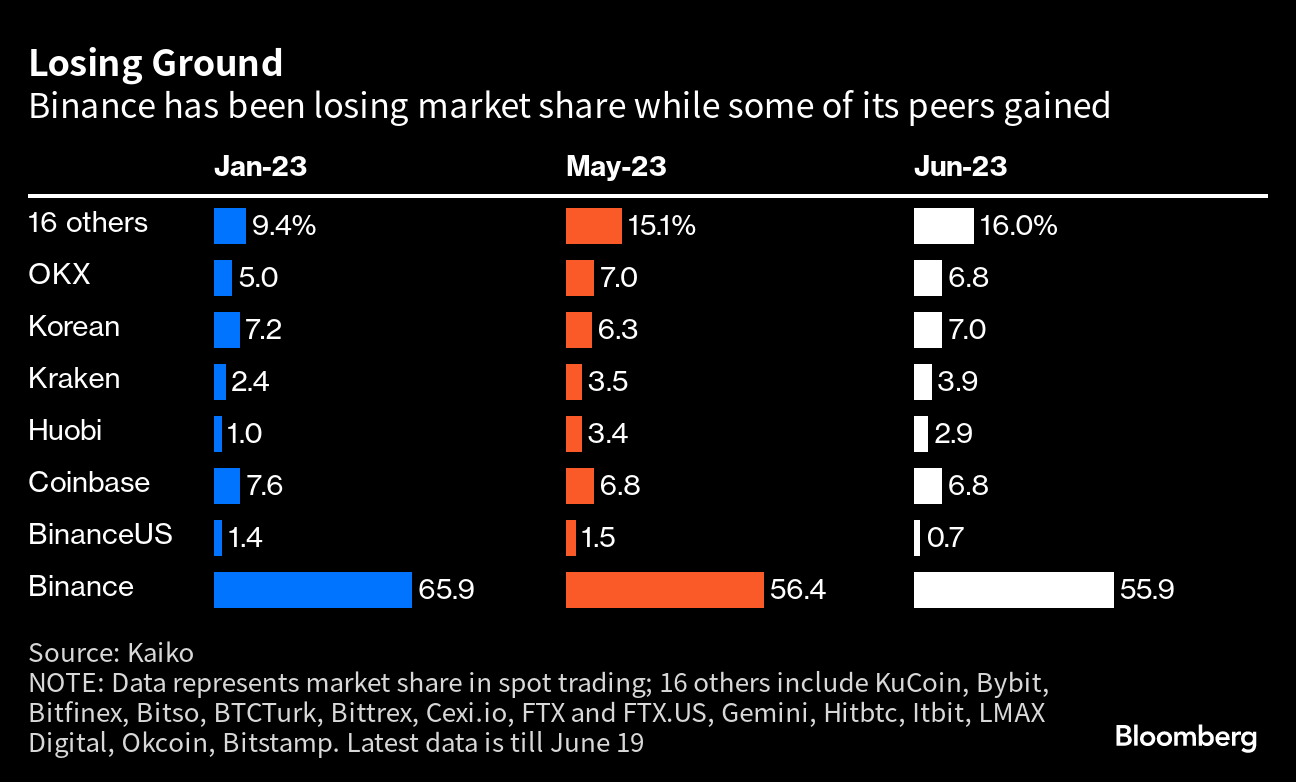
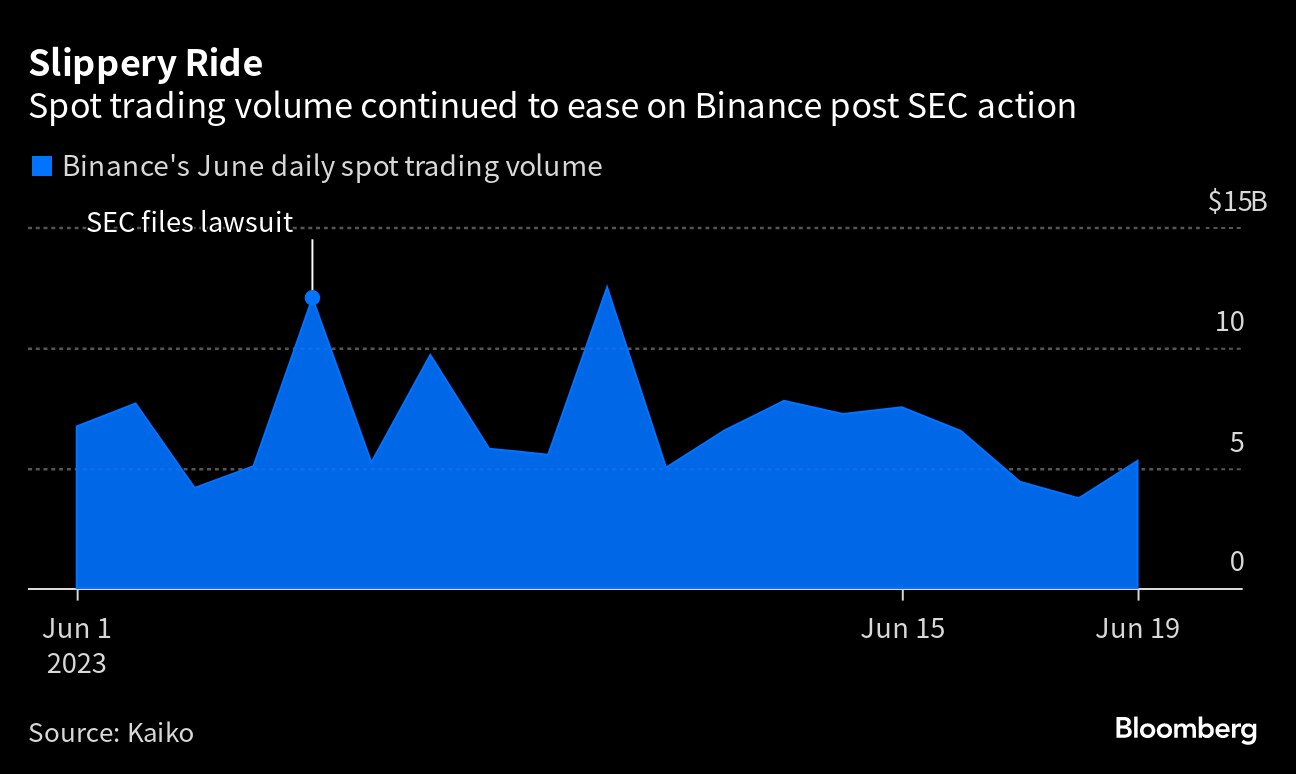
Binance's spot trading market share was little changed at 56% through June 19 from each of the two months prior, Kaiko data showed. That's the lowest since August, when it fell to 53.7%, Kaiko said. The world's largest cryptocurrency exchange suffered a blow after the US Securities and Exchange Commission filed a lawsuit against the firm and its founder Changpeng Zhao on June 5.
Its daily market share plunged to as low as 47% on on April 6, just after a separate lawsuit from the US Commodity Futures Trading Commission. The pressure on crypto exchanges like Binance has also increased after deep-pocketed traditional finance players like BlackRock Inc. applied for permission to start offering spot Bitcoin exchange-traded funds, seeking to lure investors looking for regulated institutions.
“Centralized exchanges will find themselves in a squeeze between decentralized exchanges and traditional-finance players entering the market,” said Alex Svanevik, chief executive officer of crypto intelligence firm Nansen.
Read more: Why Crypto Flinches When SEC Calls Coins Securities: QuickTake
US-based Coinbase, which is also being sued by the SEC, has seen its market share fall to 6.8% in June from 7.6% in January. Binance's US entity lost almost all its market share after the lawsuits from the CFTC and the SEC, according to Kaiko. Binance's share of trading in euro pairs has also tumbled, Kaiko data showed.
Binance's market share has also been hurt after it halted a popular zero-fee promotion in March. The exchange recently announced a new promotion for stablecoins, including True USD, BUSD, Tether's USDT and Circle's USDC, starting June 30.
A spokesperson for Binance said the company will “continue to maintain our strong financial performance. Our primary objective is to deliver for our users by maturing our products and services and continuing to invest in compliance processes for a new era of regulatory certainty.”
Binance is far from the only centralized exchange hurting. Overall global trading volume has shrunk across crypto exchanges as the regulatory onslaught dented investor sentiment.
“The regulatory risk applies to all centralized exchanges. Binance is bearing the brunt of regulatory actions,” said Cici Lu, founder of blockchain adviser Venn Link Partners. “It's going to be challenging times ahead for Binance to regain market share while meeting compliance requirements.”
Regulatory Woes
The onslaught of regulatory and banking hurdles has forced Binance to exit several countries. The company announced its exit from the Netherlands on June 16, citing a failed registration attempt. It was also probed by French authorities earlier this month, after it established the country as its European base. On June 23, Belgian authorities ordered Binance to cease operations there.
In April, the Australian Securities and Investments Commission canceled Binance's license for its derivatives business. Local banks and payment partners later halted their services to Binance Australia. And last month Binance said it was going to exit Canada after the country began rolling out new crypto regulations.
Size Advantage
Yet even after losing market share for most of 2023, Binance remains bigger than all other crypto exchanges combined. That gives Zhao's firm an added advantage of offering deeper market liquidity and trading.
Binance is also the biggest holder of customer tokens with reserves of $59.2 billion, according to crypto data provider DefiLlama.
“Without other sounder alternatives available currently, investors might still see Binance as the go-to exchange for transaction purposes, as it has the track record of providing the highest liquidity and market depth for trading which could limit the downside to their market share,” Lu of Venn Link Partners, said.
--With assistance from Sidhartha Shukla.
(Adds comment from Binance in seventh paragraph.)
More stories like this are available on bloomberg.com
©2023 Bloomberg L.P.

-
Navigating Friction And Energy Realities: An Analysis Of Marco Rubio's October Visit To India

Occurring at a critical juncture marked by stalled trade negotiations and escalating geopolitical pressures over global energy supplies, the visit offers a profound window into modern US-India relations.
-
India Exports Capital. Why Not Export Trusteeship?
The big question, then, is whether India can build an institution that global borrowers, investors, banks, and lawyers can trust, even without an Indian connection.
-
France's Economy & Politics Are In Crisis | The Reason Why
Let's look at how the French economy and politics evolved under Nicolas Sarkozy, Franois Hollande and Emmanuel Macron.
-
You May Inherit The Business. You Must Earn Its Credibility.
Succession tests the founder's ability to share authority as much as it tests the next generation's readiness to assume it.
-
Signing Deals Is One Thing; Making Them Work Is Another | The Week In Whys
Sometimes, things don't turn out as planned. Indian companies have lost some bids to rivals, some projects won't produce until 2030.
-
FOMC Wall, PERM Suspension, Hospital Stocks | Talking Points This Week
A PERM suspension would directly affect green-card sponsorship rather than H-1B visas, so the near-term earnings impact could remain relatively limited. The key question is whether this marks a new phase in US scrutiny of Indian IT.
-
Everything, Everywhere, All At Once: Dalal Street's Week To Forget | Joining The Dots
Visa curbs, a Starlink spat and cancer drug caps: what connects this week's shocks for Indian markets
-
India Is Going Abroad For Critical Minerals. But It May Take Years To Pay Off | The Reason Why
Although India's steps are in the right direction, they remain modest compared with India's growing dependence.
-
When Everyone Has AI, What Gives You An Edge?
India's young workforce is entering an uncertain world of work where powerful AI tools are becoming widely accessible. The advantage will belong to those who combine deep expertise with digital fluency, and the distinctly human capabilities that technology cannot manufacture.
-
Wrong Labels, High Pesticide Residues Holding Back Agri Exports | The Reason Why
India needs stronger domestic food-safety and labelling standards, with best practices becoming part of everyday business for farmers, traders and food companies.










