Asian Stocks Fluctuate After Downbeat US Session: Markets Wrap

Asian stocks traded in a tight range early Friday, after the Federal Reserve's hawkish pivot continued to weigh on US equities and bonds but lifted the dollar.
Shares slid in Australia and South Korea while Hong Kong equity futures dropped. Stocks in Japan edged higher after the yen weakened. US contracts slipped after the S&P 500 ended marginally lower Thursday, on pace for its worst week since September. The Nasdaq 100 dropped 0.5%.
Treasuries were little changed in Asia after selling pressure on Thursday lifted the 10-year yield to 4.57%, a level last seen in May. The policy-sensitive two-year yield fell, widening the gap between the two maturities to levels last seen two years ago. A Bloomberg dollar index compounded gains from earlier in the week to hover around 2022 highs. Australian and New Zealand yields rose early Friday.
The yen weakened against the dollar even as Japan's key inflation gauge strengthened for the first time in three months. That added to Thursday's decline after the Bank of Japan left borrowing costs unchanged and Governor Kazuo Ueda cast doubt on whether the bank could hike rates in January.
The mixed moves in Asia came after data released Thursday showed resilience in the US economy, weakening the need for imminent rate cuts.
The economy expanded at a faster clip in the third quarter than previously expected, according to the latest gross domestic product data. Consumer spending was marked up. Applications for US unemployment benefits fell and existing-home sales in the US topped a rate of 4 million in November for the first time in six months. One of the Fed's preferred gauges of inflation was revised up.
Given that Chair Jerome Powell said future easing would require fresh progress on inflation, markets will be closely watching the last noteworthy piece of data for the year — personal consumption expenditures for November — due Friday.
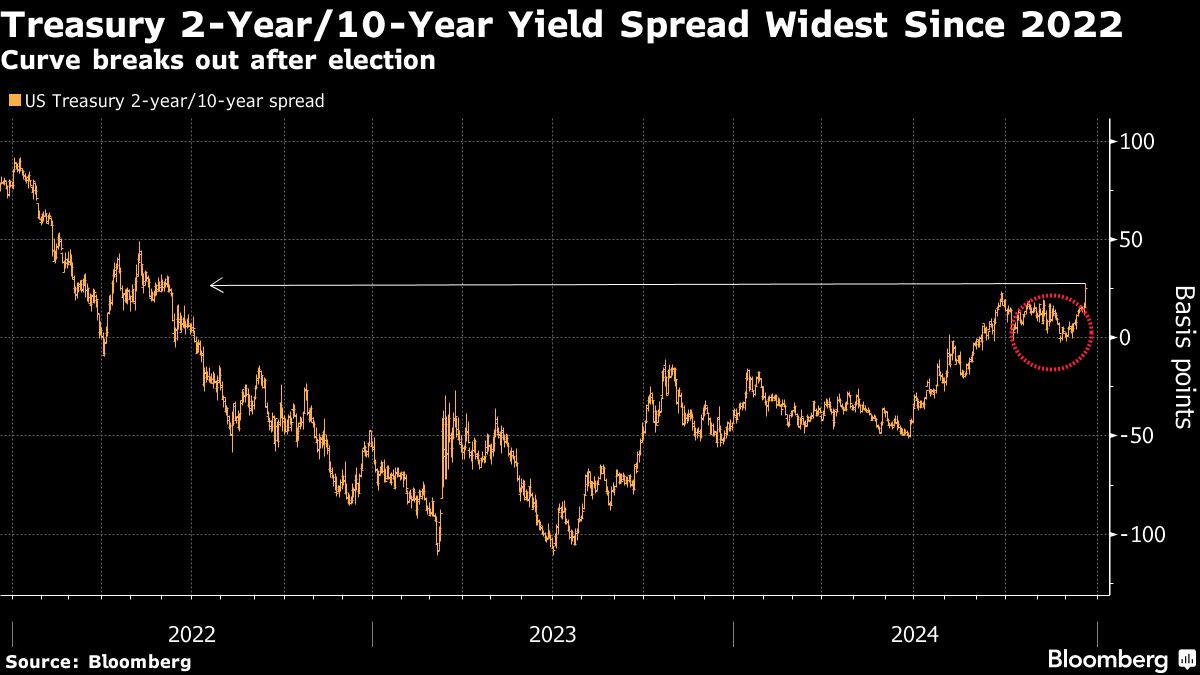
“Investors are being defensive today,” said Matt Maley, chief market strategist at Miller Tabak + Co. “They're not jumping back into the market with both feet. So, if we don't get some relief from the bond market soon, there might not be a Santa Claus rally this year.”
Elsewhere, President-elect Donald Trump and House Republicans struck a deal to avert a US government shutdown and suspend the federal debt limit for two years.
The cautious trading in the US on Thursday indicated investors are still digesting the Fed's scaled rate cut expectations for 2025. The so-called hawkish pivot was likely what the central bank had planned for next year before the meeting, according to Evercore ISI's Krishna Guha.
Powell said on Wednesday that some policymakers had begun to weave into their forecasts the potential impact of higher tariffs that Trump may implement.
“To a large degree the Fed decided to pad its forecast and pre-position for Trump – pulling forward much of what would otherwise have been a hawkish update in March,” Guha wrote in a note. That makes the Fed's pronouncement of a new phase of policy “hawkish absolutely, but not as hawkish as it looked,” Guha wrote. He's expecting the US central bank to skip an interest-rate cut in January unless cracks appear in the labor market.
The swaps market is now implying fewer than two quarter-point reductions for the entirety of 2025, even less than what was implied in the Fed's so-called dot plot on Wednesday.
The Bank of England kept borrowing costs unchanged Thursday at 4.75%. Still, money markets now see two quarter-point reductions and a strong chance of a third in 2025 after three of the nine-member policy committee called for a cut at Thursday's meeting. Swap traders had priced in less than two reductions next year prior to the announcement. The pound declined.
Mexico's peso shrugged off losses after the country's central bank delivered a fourth consecutive rate cut.
In Asia, data set for release Friday includes inflation for Malaysia and Hong Kong, and Taiwan export orders for November. China may release its one-year Medium-Term Lending Facility rate as early as today.
Elsewhere in Asia, Korea's won weakened to levels that can force the National Pension Service to sell up to almost $50 billion of foreign exchange to hedge against losses, according to people familiar with the matter.
In commodities, oil edged lower Thursday after the Fed's outlook for next year boosted the dollar. Gold was flat around $2,593 per ounce after stemming a two-day decline Thursday.
Key events this week:
Japan CPI, Friday
China loan prime rates, Friday
Eurozone consumer confidence, Friday
US personal income, spending & PCE inflation, Friday
Some of the main moves in markets:
Stocks
S&P 500 futures were little changed as of 8:08 a.m. Tokyo time
Nikkei 225 futures fell 0.2%
Hang Seng futures fell 0.3%
Australia's S&P/ASX 200 fell 0.4%
Currencies
The Bloomberg Dollar Spot Index rose 0.2%
The euro was little changed at $1.0362
The Japanese yen was little changed at 157.52 per dollar
The offshore yuan was little changed at 7.3105 per dollar
Cryptocurrencies
Bitcoin rose 0.4% to $97,753.26
Ether rose 0.5% to $3,434.63
Bonds
Australia's 10-year yield advanced six basis points to 4.47%
Commodities
West Texas Intermediate crude fell 0.2% to $69.22 a barrel
Spot gold was little changed
This story was produced with the assistance of Bloomberg Automation.

-
Blue Wave Will Derail the AI Trade but Won't Dismantle the AI Era | Unhedged Position

The Democrats' sweep of the US Congress will see politics collide with economic forces both over the long and short term.
-
It's Time To Take The GST Council's Bet On Trust Global
Payment records can prove India's services exports, and clear, proportionate rules can bring foreign digital sellers into the tax net.
-
Opinion | India at 38: From Innovation Overperformer to Innovation Powerhouse
India now has 453 VC-backed deep science startups, 18 of them late-stage, after 117 percent growth since 2020. Laurus Labs, at USD 9.3 billion, is the most valuable deep science company in any middle-income economy outside China.
-
Navigating Energy Crossroads: S Jaishankar's Call For Diversified Supply Chains At G20 Ministerial Meeting
As geopolitical fault lines continue to test maritime trade routes and commodity flows, Jaishankar's message remains pertinent: true economic resilience requires open markets, protected transit lines, and a genuine commitment to multilateral cooperation rather than coercion.
-
Indians Are Travelling, But Not Every Journey Is A Holiday | The Week In Whys
Pilgrims, patients and working women are the real travellers, and the system hasn't quite caught up with them.
-
Getting To Work Costs Women More | The Reason Why
It is not just about women paying more than men. It is about women paying much more in cities than in villages.
-
AI Bias In Investing Cannot Be Eliminated, But It Can Be Governed
Framing is a particularly important example as identical financial information presented in terms of gains rather than losses can lead an LLM to reach a different assessment.
-
Joining The Dots | Dark Skies, Steady Diya: Why Hope Holds This Diwali
With war, a weak rupee and foreign outflows weighing on sentiment, policymakers at the NDTV World Summit and market veterans at NDTV Profit Ignite: Diwali Edition offered the same advice: stay invested and filter out the noise.
-
The Curious Case of Equitas Small Finance Bank And A CEO Who Quit For Stock
PN Vasudevan believes persistent investor concerns over a perceived conflict of interest had become a governance overhang on Equitas Small Finance Bank's stock, even as the lender improved profitability and asset quality.









