Asia High-Yielders Pull Ahead In Carry Race As Policies Diverge
(Bloomberg) --
Asia's higher-yielding currencies are becoming more attractive to investors thanks to their improving carry compared with their Latin American peers.
The Indian rupee's implied returns adjusted for volatility are about 2.9 standard deviations above their 12 months average, while those for the Indonesian rupiah are about 1.71 above the same mean, according to Bloomberg estimates. The two currencies have performed better than all their developing-nation peers relative to recent averages.
Underpinning the appeal of the rupee, rupiah and other Asian currencies is that central banks in the region have largely kept interest rates unchanged, while their Latin American counterparts have been easing policy. The policy divergence has lured overseas funds into most Asian countries this year.
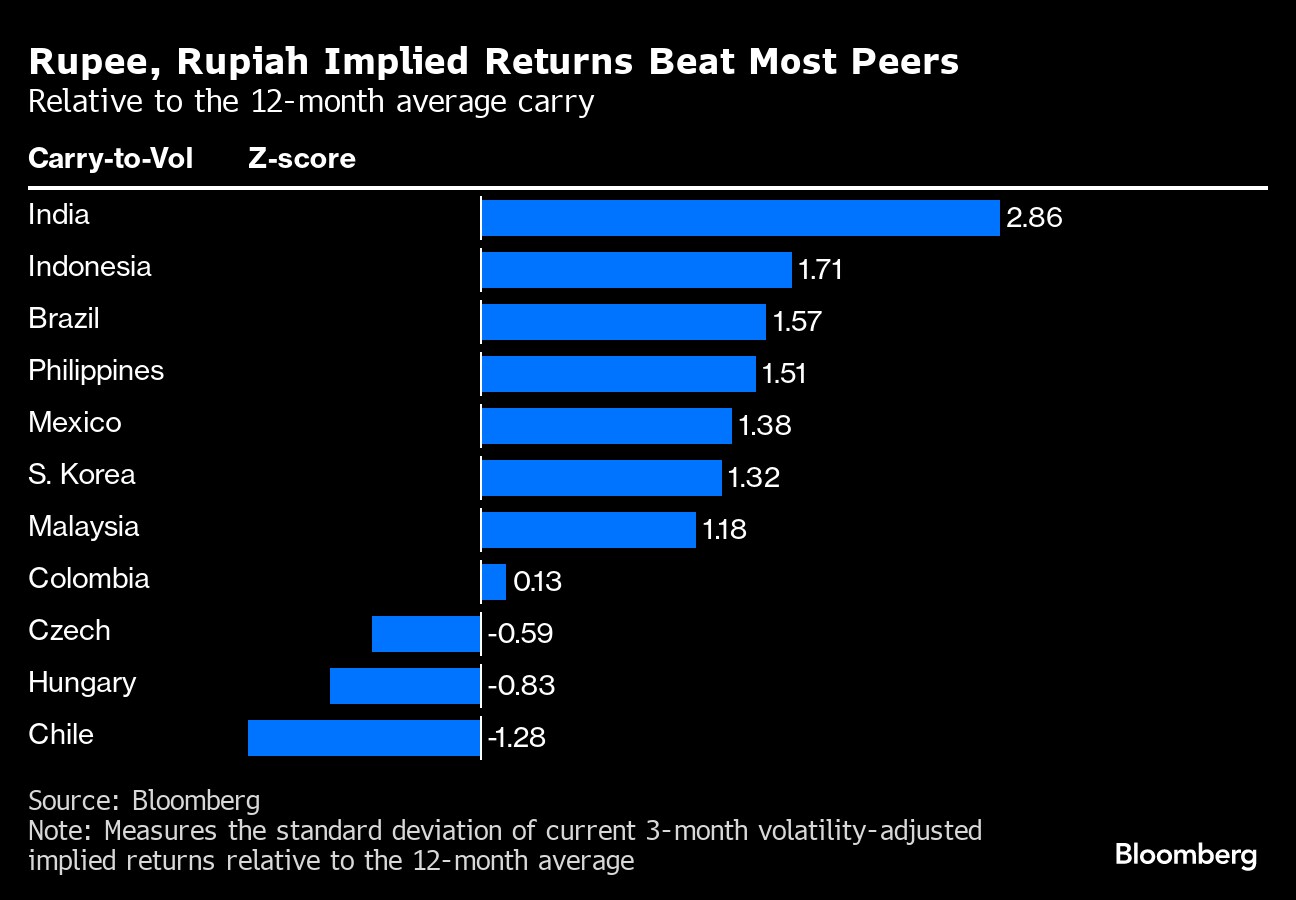
Asian high-yield currencies look more attractive than their Latin American peers from a carry, volatility and growth perspective, according to JPMorgan Chase & Co. Both India and Indonesia are set to outperform South America and central and eastern Europe in carry returns, BNY Mellon Capital Markets says.
Indonesia and India will sustain their position as the dominant carry trades for the next three-to-six months, said Bob Savage head of markets strategy and insights at BNY Mellon in New York. “Really big carry trades like Mexico and Brazil are going to be difficult, they've seen a slowdown in investment.”
Fragile Five
India and Indonesia were famously lumped together as part of Morgan Stanley's “Fragile Five” in 2013 but have become investor favorites a decade later following successful programs of reform and fiscal restraint.
The results of recent elections in the two nations has also removed an area of potential risk, according to Bank of America Corp.
Read more: Fragile-Five Days Long Gone as Funds Pile Into India, Indonesia
Latin American assets may face more volatility as delays in Federal Reserve interest-rate cuts could convince emerging markets to slow the pace of any further easing, according to T. Rowe Price Group Inc.
The Fed repricing, coupled with elevated political concerns heading into the US elections, is putting into question one of the fund's top calls on the Mexican peso, said Leonard Kwan, a portfolio manager at T. Rowe Price in Hong Kong. “Despite the positive predisposition to Mexico, that's something we're going to be more watchful over.”
More stories like this are available on bloomberg.com
©2024 Bloomberg L.P.

-
Ten Things I Learnt This Samvat

Patience can be a trap. Cheap stocks can stay cheap. Leverage can wipe you out. What did Samvat 2082 teach us? Niraj Shah writes on 10 lessons from the year gone by.
-
Talking Points This Week: Tech Nerves, FII Buying, And A Faraway Banking Shock
The global markets are not shining this Diwali. The exception in the large markets is, India.
-
Midterm Rally Lasted A Day. The Hard Reality Of A Divided US May Last Two Years | Opinion
Between a contested AI boom, a debt ceiling that arrives in 2027 and a president with every incentive to act alone, the next two years may prove more volatile than the first day's rally suggests.
-
Blue Wave Will Derail the AI Trade but Won't Dismantle the AI Era | Unhedged Position
The Democrats' sweep of the US Congress will see politics collide with economic forces both over the long and short term.
-
It's Time To Take The GST Council's Bet On Trust Global
Payment records can prove India's services exports, and clear, proportionate rules can bring foreign digital sellers into the tax net.
-
Opinion | India at 38: From Innovation Overperformer to Innovation Powerhouse
India now has 453 VC-backed deep science startups, 18 of them late-stage, after 117 percent growth since 2020. Laurus Labs, at USD 9.3 billion, is the most valuable deep science company in any middle-income economy outside China.
-
Navigating Energy Crossroads: S Jaishankar's Call For Diversified Supply Chains At G20 Ministerial Meeting
As geopolitical fault lines continue to test maritime trade routes and commodity flows, Jaishankar's message remains pertinent: true economic resilience requires open markets, protected transit lines, and a genuine commitment to multilateral cooperation rather than coercion.
-
Indians Are Travelling, But Not Every Journey Is A Holiday | The Week In Whys
Pilgrims, patients and working women are the real travellers, and the system hasn't quite caught up with them.
-
Getting To Work Costs Women More | The Reason Why
It is not just about women paying more than men. It is about women paying much more in cities than in villages.









