Apple’s Historic Selloff Has Bulls Balking From Tariff Risks
A sharp selloff in shares of Apple Inc. illustrates investor skepticism about its ability to navigate President Donald Trump's tariffs on China, Vietnam and India — countries all critical to the iPhone maker's supply chain.
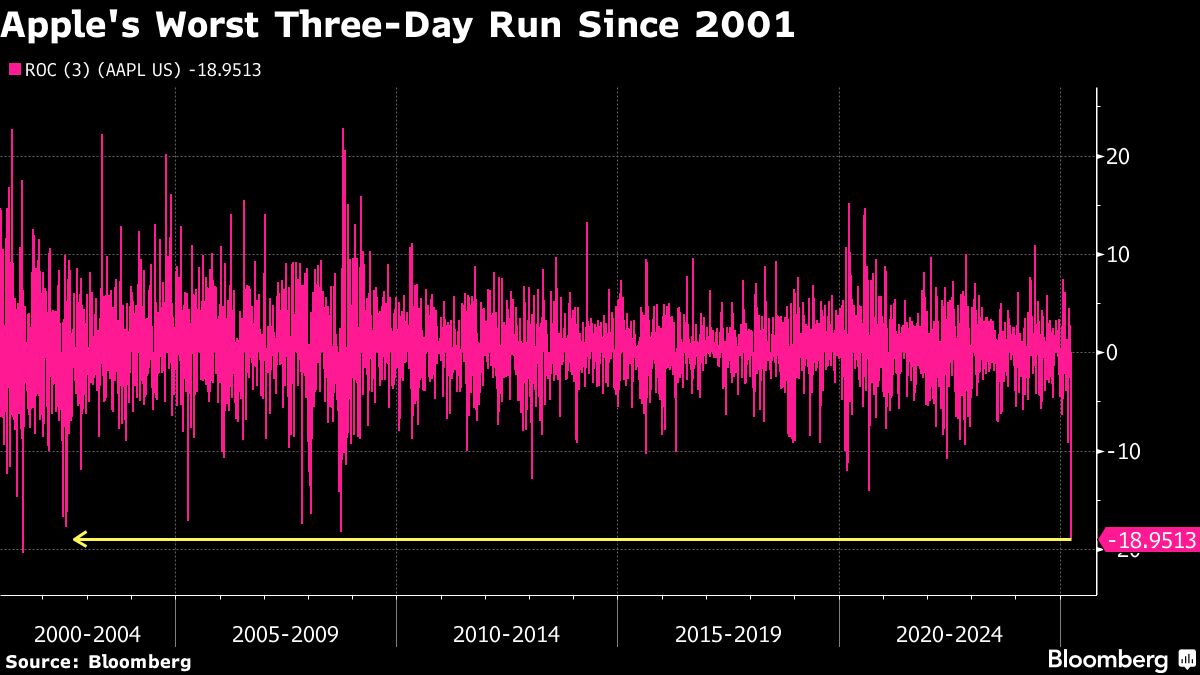
Its shares have shed 23% in the wake of last week's tariffs announcement, marking the worst four-day stretch for Apple since 2000. The rout erased more than $770 billion in market value from the tech giant and sent a proxy for the stock's volatility skyrocketing. The decline knocked Apple from the top spot by value in the S&P 500 Index, putting its market capitalization below that of Microsoft Corp.
“The tariff situation really complicates things for Apple. What is it going to do? Raise prices? That will hit demand. Absorb costs? That will hurt earnings and margins,” said Anthony Saglimbene, chief market strategist at Ameriprise Financial Services Inc. “It is very difficult to assess prospects from here, and that's why the market has reacted the way it has.”
The risk became more acute with Monday's threat of an additional 50% levy after China retaliated against previous tariffs with one of their own on US imports.
Wall Street analysts and investors alike are now trying to assess both how tariffs and a slowdown in one of Apple's major growth markets will impact margins, spending and the stock price.
“The way Apple goes will influence the whole market,” Saglimbene said. “Without a deal on tariffs, it is hard to make a near-term case for Apple moving higher.”
Apple has long been viewed as a relative haven given the company's strong free cash flow, balance sheet and robust buyback activity, all of which derive from the massive global user base for its products. However, the current uncertainty around tariffs is overwhelming. The CBOE Apple VIX, which tracks a market estimate of future volatility for the stock, has spiked to its highest since September 2020.
Still, many analysts remain positive on the company's prospects, especially in the wake of the historic selloff, which Bank of America said represented an “enhanced buying opportunity.” Based on the average analyst price target, they expect the stock to rise more than 40% over the coming 12 months, and the stock's 14-day relative strength index fell under 23 this week, among the lowest readings over the past decade, and under the 30 level that generally suggests oversold conditions.
In addition, shares are trading around 24 times estimated earnings for the next 12 months, near their lowest in more than two years, though still at a modest premium to their 10-year average.
“Now the froth is out and I think it looks attractive,” said Andrew Zamfotis, portfolio manager at Ami Asset Management Corp. “Yes there is a lot of uncertainty, but given how much this selloff prices in, I think it should be pretty stable from here.”
Of course, what happens with tariffs is the central question facing the stock. Should the company get an exemption, as it did during the first Trump term, it could see an enormous relief rally. The tariffs staying in place or being escalated, on the other hand, would represent “economic Armageddon,” according to Wedbush Securities analyst Daniel Ives, who recently cut his price target on the stock.
Given the uncertainty, and the possibility of an exemption, analysts have thus far held off on making dramatic changes to their estimates. The consensus for Apple's net 2025 earnings has dipped 0.7% over the past week or so, according to data compiled by Bloomberg, while the view for revenue is down less than that.
Should estimates get cut dramatically, that would have the effect of making the stock appear more expensive by shrinking the denominator in the price-to-earnings ratio.
The next major company catalyst that investors will be watching is Apple's quarterly earnings report, due May 1. According to Pat Burton, a portfolio manager at Winslow Capital Management, this will likely be a catalyst for estimates changing.
“Based on the magnitude of the moves out of these stocks, the market's anticipating a negative revision from basically every tech company,” he said. “People will cut their forward looking numbers for the June and September quarters. And in a sense, 2025 will be a washout loss year.”
Readers interested in markets can now subscribe to a new daily fixture called “Before the Bell,” a one-stop-shop of all you need to know before the open on Wall Street, including the biggest news breaking overnight, market insight and strategy, analyst actions, earnings previews and more. On the terminal, click here to subscribe.

-
Talking Points This Week: Tech Nerves, FII Buying, And A Faraway Banking Shock

The global markets are not shining this Diwali. The exception in the large markets is, India.
-
Midterm Rally Lasted A Day. The Hard Reality Of A Divided US May Last Two Years | Opinion
Between a contested AI boom, a debt ceiling that arrives in 2027 and a president with every incentive to act alone, the next two years may prove more volatile than the first day's rally suggests.
-
Blue Wave Will Derail the AI Trade but Won't Dismantle the AI Era | Unhedged Position
The Democrats' sweep of the US Congress will see politics collide with economic forces both over the long and short term.
-
It's Time To Take The GST Council's Bet On Trust Global
Payment records can prove India's services exports, and clear, proportionate rules can bring foreign digital sellers into the tax net.
-
Opinion | India at 38: From Innovation Overperformer to Innovation Powerhouse
India now has 453 VC-backed deep science startups, 18 of them late-stage, after 117 percent growth since 2020. Laurus Labs, at USD 9.3 billion, is the most valuable deep science company in any middle-income economy outside China.
-
Navigating Energy Crossroads: S Jaishankar's Call For Diversified Supply Chains At G20 Ministerial Meeting
As geopolitical fault lines continue to test maritime trade routes and commodity flows, Jaishankar's message remains pertinent: true economic resilience requires open markets, protected transit lines, and a genuine commitment to multilateral cooperation rather than coercion.
-
Indians Are Travelling, But Not Every Journey Is A Holiday | The Week In Whys
Pilgrims, patients and working women are the real travellers, and the system hasn't quite caught up with them.
-
Getting To Work Costs Women More | The Reason Why
It is not just about women paying more than men. It is about women paying much more in cities than in villages.
-
AI Bias In Investing Cannot Be Eliminated, But It Can Be Governed
Framing is a particularly important example as identical financial information presented in terms of gains rather than losses can lead an LLM to reach a different assessment.