Analysts’ Bullish Reviews Mask Weak Conviction In US Stock Rally

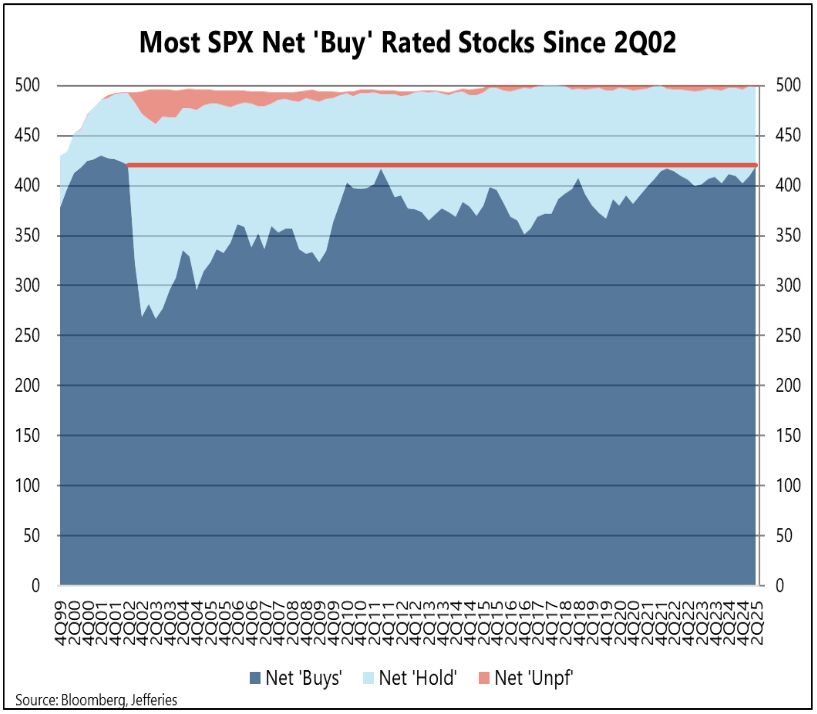
After a furious May rally, Wall Street analysts now have more buy ratings on individual companies in the S&P 500 Index than at any time in more than two decades, according to a Jefferies LLC analysis.
That's usually a sign of froth in a market poised for a pullback, but Jefferies' Andrew Greenebaum sees fewer reasons to worry once you look under the hood.
His argument goes like this: While more than four of the five stocks in the S&P 500 have buy recommendations, the price targets underlying those assessments imply just a gain of 10% over the next 12 months, based on the firm's analysis. That's near the average for the US benchmark historically, and should allay fears the current rebound has run its course, he said.
“Wall Street's been upgrading names, probably using the selloff to do it,” said Greenebaum, senior vice president of equity research product management at Jefferies, who compiled the data. “But I don't take that as overwhelming bullishness, because price targets are not that far away from where stocks currently sit.”
The S&P 500 has jumped nearly 20% from the depths of April's rout on a reprieve from President Donald Trump tariff blitz. Yet analysts and strategists alike have been struggling to map out the path forward, penciling in, then erasing forecasts against a backdrop of back-and-forth policy pronouncements from Trump and his administration on trade.
Greenebaum says analyst predictions on individual stocks are a better indicator of the market's direction than year-end S&P 500 targets since they more take into consideration individual companies' profits.
He calculated the aggregated S&P 500 target over the next 12 months and landed at 6,528, a level that implies a 10% advance from Friday's close.
If analyst ratings and price targets are any indicator of stock performance, things look like business as usual, he says. This hasn't stopped prognosticators from fretting.
“You can probably ignore strategy comments and focus on the fundamentals, because the analysts aren't seeing company fundamentals go down,” said Greenebaum.
Forecasts Shredded
Trump's on-the-fly tariff regime has forced wild swings in expectations from sell-side strategists. After furiously downgrading their US stock forecasts across April, some are starting to make U-turns on their calls once again. Ed Yardeni of Yardeni Research and David Kostin of Goldman Sachs Group Inc. are among soothsayers who lifted their forecasts after lowering them.
But economists are warning that although rhetoric around levies has calmed since Trump's April 2 rollout of steep levies, the damage on business and consumer confidence has already been done and could be reflected in economic data in the months ahead.
From one vantage point, the economy is already showing cracks. Gross domestic product decreased at a 0.2% annualized pace in the first quarter, the second estimate from the Bureau of Economic Analysis showed Thursday. That compared with an initially reported 0.3% decline. On the other hand, the labor market has so far remained intact with investors looking ahead to next week's payrolls report as the next hurdle.
“The analysts are not actually getting reachy with their price targets,” Greenebaum said. “When you look at that level, it's basically low, double-digit returns — it's kind of ho-hum boring.”

-
Talking Points This Week: Tech Nerves, FII Buying, And A Faraway Banking Shock

The global markets are not shining this Diwali. The exception in the large markets is, India.
-
Midterm Rally Lasted A Day. The Hard Reality Of A Divided US May Last Two Years | Opinion
Between a contested AI boom, a debt ceiling that arrives in 2027 and a president with every incentive to act alone, the next two years may prove more volatile than the first day's rally suggests.
-
Blue Wave Will Derail the AI Trade but Won't Dismantle the AI Era | Unhedged Position
The Democrats' sweep of the US Congress will see politics collide with economic forces both over the long and short term.
-
It's Time To Take The GST Council's Bet On Trust Global
Payment records can prove India's services exports, and clear, proportionate rules can bring foreign digital sellers into the tax net.
-
Opinion | India at 38: From Innovation Overperformer to Innovation Powerhouse
India now has 453 VC-backed deep science startups, 18 of them late-stage, after 117 percent growth since 2020. Laurus Labs, at USD 9.3 billion, is the most valuable deep science company in any middle-income economy outside China.
-
Navigating Energy Crossroads: S Jaishankar's Call For Diversified Supply Chains At G20 Ministerial Meeting
As geopolitical fault lines continue to test maritime trade routes and commodity flows, Jaishankar's message remains pertinent: true economic resilience requires open markets, protected transit lines, and a genuine commitment to multilateral cooperation rather than coercion.
-
Indians Are Travelling, But Not Every Journey Is A Holiday | The Week In Whys
Pilgrims, patients and working women are the real travellers, and the system hasn't quite caught up with them.
-
Getting To Work Costs Women More | The Reason Why
It is not just about women paying more than men. It is about women paying much more in cities than in villages.
-
AI Bias In Investing Cannot Be Eliminated, But It Can Be Governed
Framing is a particularly important example as identical financial information presented in terms of gains rather than losses can lead an LLM to reach a different assessment.









