Amazon Braces For Tougher Business Climate Amid Trump Trade War
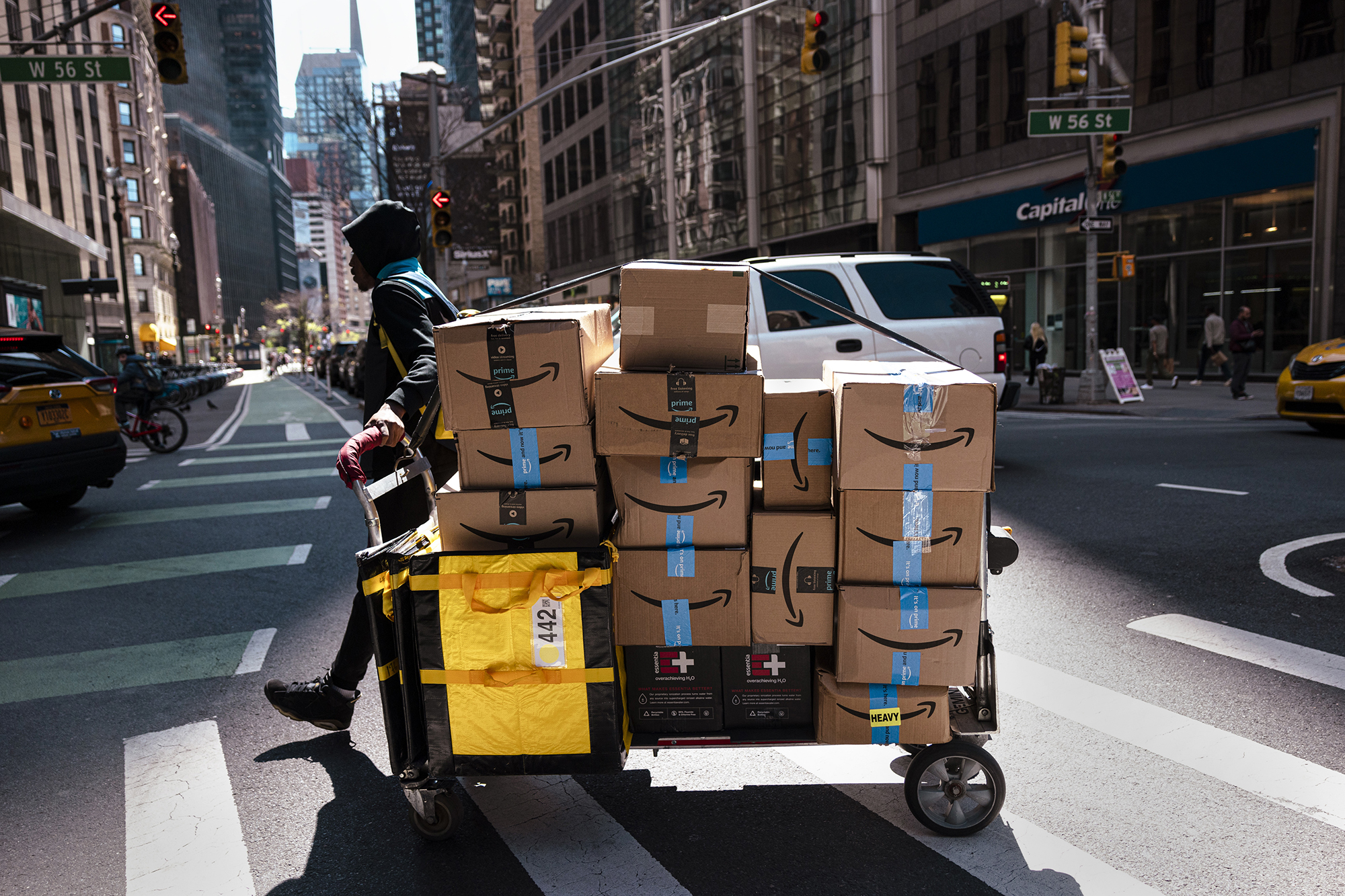
Amazon.com Inc. said it's bracing for a tougher business climate in the coming months, echoing concerns from a range of companies that tariffs and related economic turmoil could crimp consumer spending.
When it reported results Thursday, the world's largest online retailer posted a decent first quarter but said operating profit in the current period would be weaker than Wall Street anticipated.
Amazon projected operating profit of $13 billion to $17.5 billion, compared with an average estimate of $17.8 billion. Sales will be $159 billion to $164 billion in the period ending in June, the company said in a statement. Analysts, on average, expected $161.4 billion.
In issuing its forecast, Amazon said results may be “materially affected by many factors,” such as “tariff and trade policies,” currency fluctuations and “recessionary fears.” Amazon didn't mention tariffs in its first-quarter forecast in early February.
“Obviously, none of us knows exactly where tariffs will settle or when,” Chief Executive Officer Andy Jassy said on a conference call after the results were released. “We haven't seen any attenuation of demand yet. To some extent, we've seen some heightened buying in certain categories that may indicate stocking up in advance of any potential tariff impact.”
First-quarter sales increased 9% to $155.7 billion, compared with the average estimate of $155.2 billion. Operating income was $18.4 billion in the period ended March 31. Analysts projected $17.5 billion.
The company's reputation for competitive prices and a broad base of suppliers could insulate it if shoppers become more deal-focused. But a pullback by the independent Chinese sellers who help stock Amazon's warehouses could hit the logistics and high-margin advertising businesses.
There are already signs of a slowdown. Revenue from third-party seller services increased 6% to $36.5 billion in the first quarter, falling short of analysts' average estimate. Advertising, which has been the company's fastest-growing unit, gained 18% to $13.9 billion, in line with estimates.
“Amazon advertising remains vulnerable to cuts in spending from the many small and mid-sized sellers who will be most squeezed by tariffs on goods from China, and revenue growth from the third party marketplace has slowed significantly from the levels of just a few quarters ago,” said Sky Canaves, an analyst at Emarketer.
The shares declined about 3% in extended trading after closing at $190.20 in New York. The shares have fallen about 13% this year as Wall Street weighed the impact of President Donald Trump's tariffs on a retail operation that sources much of its goods from China.
Amazon Web Services, the largest seller of rented computing power, reported first-quarter sales gained 17% to $29.3 billion, in line with analysts' estimates. It was the unit's slowest growth in a year and contrasted with Microsoft Corp.

Amazon's biggest cloud rival posted a blowout quarter this week, reporting stronger-than-expected sales and profit, suggesting customer demand for cloud services has held steady despite the wave of tariffs and economic turbulence.
Gil Luria, an analyst with DA Davidson & Co., said Amazon investors “may be a little disappointed by margins and margin guidance, which could create a concern about Amazon absorbing tariff costs. While AWS grew almost as expected, that comes on the tail of Microsoft Azure well exceeding expectations and growing that business almost twice as fast.”
The White House lambasted Amazon earlier this week following a news report that the company was considering displaying the cost of tariffs to shoppers. Amazon said it was considering — and has no plans to implement — disclosing the cost of imports for Haul, its Temu-like storefront that features cheap goods shipped directly from Chinese sellers.
Chief Financial Officer Brian Olsavsky said Amazon is planning for “various outcomes” regarding trade and the overall economy.
“We've taken a number of actions to protect the customer experience,” Olsavsky said on the call. “We're doing everything we can to keep prices low for customers, in a way that makes economic sense.”

-
Unhedged Position: Can India See An Indonesia-Style Time Correction?

The Nifty is trading below levels it first clocked in 2024. Is there, then, as I have suggested in the headline, potential that the current time correction drags on painfully for the next three-five, even ten years?
-
Navigating Friction And Energy Realities: An Analysis Of Marco Rubio's October Visit To India
Occurring at a critical juncture marked by stalled trade negotiations and escalating geopolitical pressures over global energy supplies, the visit offers a profound window into modern US-India relations.
-
India Exports Capital. Why Not Export Trusteeship?
The big question, then, is whether India can build an institution that global borrowers, investors, banks, and lawyers can trust, even without an Indian connection.
-
France's Economy & Politics Are In Crisis | The Reason Why
Let's look at how the French economy and politics evolved under Nicolas Sarkozy, Franois Hollande and Emmanuel Macron.
-
You May Inherit The Business. You Must Earn Its Credibility.
Succession tests the founder's ability to share authority as much as it tests the next generation's readiness to assume it.
-
Signing Deals Is One Thing; Making Them Work Is Another | The Week In Whys
Sometimes, things don't turn out as planned. Indian companies have lost some bids to rivals, some projects won't produce until 2030.
-
FOMC Wall, PERM Suspension, Hospital Stocks | Talking Points This Week
A PERM suspension would directly affect green-card sponsorship rather than H-1B visas, so the near-term earnings impact could remain relatively limited. The key question is whether this marks a new phase in US scrutiny of Indian IT.
-
Everything, Everywhere, All At Once: Dalal Street's Week To Forget | Joining The Dots
Visa curbs, a Starlink spat and cancer drug caps: what connects this week's shocks for Indian markets
-
India Is Going Abroad For Critical Minerals. But It May Take Years To Pay Off | The Reason Why
Although India's steps are in the right direction, they remain modest compared with India's growing dependence.
-
When Everyone Has AI, What Gives You An Edge?
India's young workforce is entering an uncertain world of work where powerful AI tools are becoming widely accessible. The advantage will belong to those who combine deep expertise with digital fluency, and the distinctly human capabilities that technology cannot manufacture.









