Virat Kohli Tops ICC Test Ranking For Batsmen
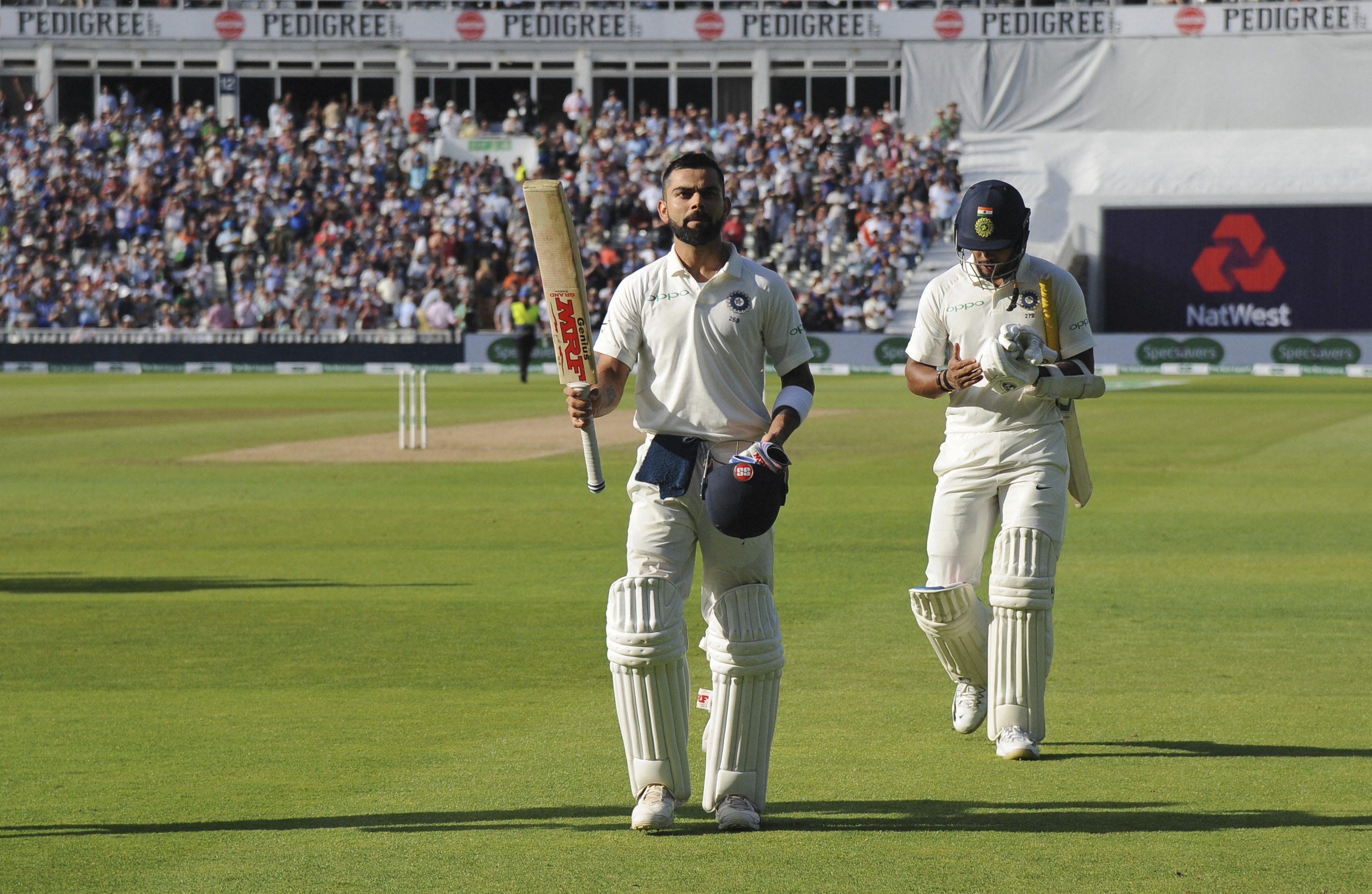
India skipper Virat Kohli today topped the ICC Player Rankings for Test Batsmen, riding on his brilliant century against England in the opening Test at Edgbaston.
Kohli became the seventh India batsman and first since Sachin Tendulkar (in June 2011) to be ranked the number one Test batsman in the latest ICC ranking released today.
Kohli scored 149 and 51 in India's 31-run defeat and has gone up by 31 points, which have helped him to end Steve Smith's 32-month reign as the top-ranked batsman and reach the top of the summit for the first time in his 67-test career.
Kohli now leads Smith by five points, but will have to maintain the form in the remaining four Tests to finish the series as the world's highest-ranked batsman.
Tendulkar had joined South Africa's Jacques Kallis in number-one position in January 2011, but had dropped to second spot following the Jamaica Test in June 2011 after he had missed the three-Test series against the West Indies.
Apart from Kohli and Tendulkar, Rahul Dravid, Gautam Gambhir, Sunil Gavaskar, Virender Sehwag and Dilip Vengsarkar are the other India batsmen to have achieved number-one rankings during their careers.
However, at 934 points, Kohli has become India's highest-ranked batsman, 14th overall, on the all-time tally of points.
Kohli had entered the Edgbaston Test on 903 points, 13 points behind Gavaskar, and is now ahead of the ICC Cricket Hall of Famer by 18 points.
If Kohli can deliver another strong performance in the second Test at Lord's, then he can break into the top-10 by leapfrogging Matthew Hayden, Kallis and AB de Villiers, whose highest points tally was 935 each.
Donald Bradman (961) and Steve Smith (947) are the two batsmen sitting on top of this exclusive list.
Kohli, who powered India to the ICC U19 Cricket World Cup title in 2008 and then won the prestigious Sir Garfield Sobers Trophy for ICC Cricketer of the Year in 2017, is the 76th player to top the Test batting rankings.
He is also the number-one ranked ODI batsman, but is ranked 12th in T20Is, 220 points behind number-one ranked Aaron Finch of Australia.
However, other Indian batsman lost ground after the first Test with Lokesh Rahul (19th) and Ajinkya Rahane (22nd) slipping one and three places, respectively.
Murali Vijay and Shikhar Dawan now share 25th position after slipping two and one spots, respectively.
England's wicketkeeper-batsman Jonny Bairstow improved his ranking as he now shares the 12th position with the West Indies' Kraigg Brathwaite after moving up four places.
But Alistair Cook, 17th (down by four places), and Ben Stokes, 33rd (down by five places), lost ground after the Edgbaston Test.
In the bowlers' table, India off-spinner Ravichandran Ashwin has gained 14 points following his four for 62 and three for 59, which means he now trails South Africa's fourth-ranked Vernon Philander by just one point.
Ishant Sharma has collected 19 points to move within 13 points of 25th-ranked team-mate Bhuvneshwar Kumar, while Mohammed Shami is in 19th spot after sliding two places.
England pacer Stuart Broad is now ranked 13th after falling one place, while James Anderson has retained his top position but his lead over Kagiso Rabada has been reduced to two points.
Stokes has compensated for his double failure with the bat by taking six wickets in the Test, including three of India's last four wickets. For this performance, he has been rewarded with a rise of four places, which has put him in 27th position.
England's 20-year-old Sam Curran is another fascinating story from what was a nerve-wracking 1000th England men's Test.
The left-handed all-rounder scored 24 and 63 with the bat, and claimed match figures of five for 92 with the ball, which not only earned him the player of the match award but significant gains in the latest rankings.
In the batting table, Curran has jumped from 152nd to 72nd, the bowling table has seen him rise 49 places to 62nd, while in the all-rounders' category, he now sits in 37th position after jumping 58 places.

-
A New Samvat Wishlist: Inclusive Prosperity And Human Development

India has strengthened its economic foundations through infrastructure, digital access and enterprise. Its next growth chapter must deepen productivity, create better livelihoods and widen participation in prosperity.
-
Love, Sex Aur Dhokha: The Audacious Plot To Spy On Jensen Huang
A Taipei dinner, a Singapore chip buyer and a suspected Chinese asset: inside the alleged spy operation that got close to NVIDIA's Jensen Huang.
-
Ten Things I Learnt This Samvat
Patience can be a trap. Cheap stocks can stay cheap. Leverage can wipe you out. What did Samvat 2082 teach us? Niraj Shah writes on 10 lessons from the year gone by.
-
Talking Points This Week: Tech Nerves, FII Buying, And A Faraway Banking Shock
The global markets are not shining this Diwali. The exception in the large markets is, India.
-
Midterm Rally Lasted A Day. The Hard Reality Of A Divided US May Last Two Years | Opinion
Between a contested AI boom, a debt ceiling that arrives in 2027 and a president with every incentive to act alone, the next two years may prove more volatile than the first day's rally suggests.
-
Blue Wave Will Derail the AI Trade but Won't Dismantle the AI Era | Unhedged Position
The Democrats' sweep of the US Congress will see politics collide with economic forces both over the long and short term.
-
It's Time To Take The GST Council's Bet On Trust Global
Payment records can prove India's services exports, and clear, proportionate rules can bring foreign digital sellers into the tax net.
-
Opinion | India at 38: From Innovation Overperformer to Innovation Powerhouse
India now has 453 VC-backed deep science startups, 18 of them late-stage, after 117 percent growth since 2020. Laurus Labs, at USD 9.3 billion, is the most valuable deep science company in any middle-income economy outside China.
-
Navigating Energy Crossroads: S Jaishankar's Call For Diversified Supply Chains At G20 Ministerial Meeting
As geopolitical fault lines continue to test maritime trade routes and commodity flows, Jaishankar's message remains pertinent: true economic resilience requires open markets, protected transit lines, and a genuine commitment to multilateral cooperation rather than coercion.









