Nana Chudasama: A Banner Life
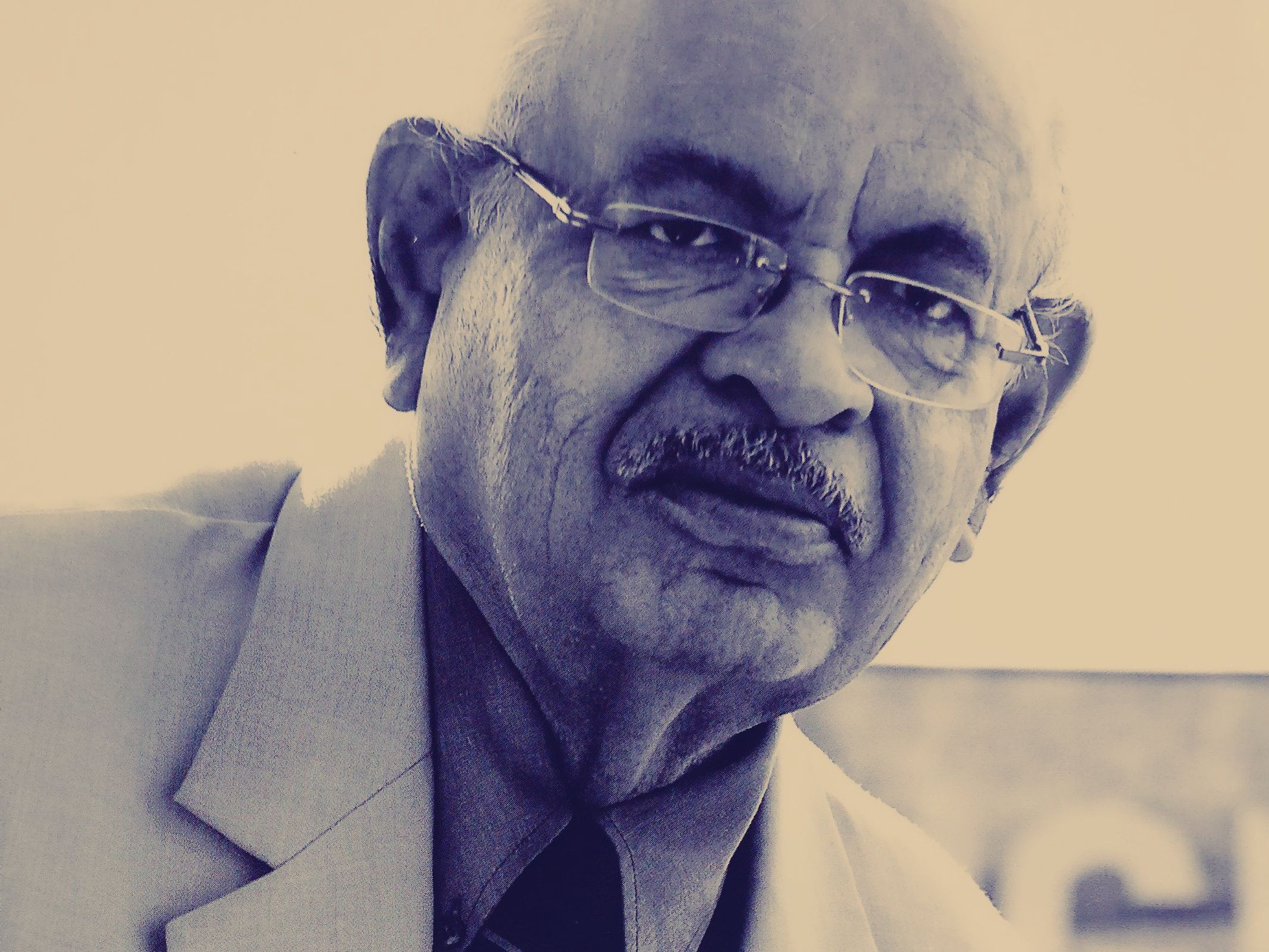
As a student, I remember craning my neck out of the window, as the bus or taxi approached the Churchgate traffic light, to read the banner. For the longest time I didn't know who the author was. And then only knew him as the ‘I Love Mumbai' man.

Once upon a time the city had a Sheriff. He wielded a banner. And used wit, sarcasm, often a good scold, to keep our conscience alive. Nana Chudasama, 86, died on Sunday, Dec. 23.
An activist, founder of GIANTS, city leader and Padma Shri. But more than anything else Mumbai will remember him for the landmark banner.
I spent Christmas afternoon leafing through a wonderfully compiled book, Nana Chudasama's History On A Banner, compiled by Neeru Nanda and loaned to me by Chudasama's son and noted lawyer Akshay. It catalogues the banner lines between 1975 and 2010.
The journey through time reinforced two beliefs – that, history repeats itself, you'll see that in Chudasama's commentary on Mrs Gandhi's time, and that the most powerful journalism needs few words.

These banner lines and explanations are reproduced from the book. Lightly edited.

During emergency...crime rate came down; trains ran on time; inflation fell and many industrialists were quoted as saying that strikes, boycotts and demonstrations, were a thing of the past.

President Fakhruddin Ali Ahmed died in office. It was he (under pressure from Mrs Gandhi) who had signed off India's democracy by proclaiming Emergency. Nana's sardonic comment reiterates the common man's opinion that the President would, in any case, be a puppet.

Nana Chudasama taunts the Janata government.

Morarji Desai appointed a Commission, headed by BP Mandal, to “identify the socially or educationally backward”.

Mrs Gandhi won the Chikmagalur seat.

Colour television arrived in India nearly 25 years after it did in the western world. But the programmes were hardly entertaining.

The Asian Games 1982 were held in Delhi. The event was surrounded by controversy and politics. Corruption was rampant...

Mrs Gandhi's autocratic control over the media in a seemingly democratic way was suffocating the nation.

The state of the opposition in the Rajiv Gandhi government was reduced to zero.

In April 1987, Swedish radio announced discrepancies in the $1.4 billion Bofors gun deal. The furore brought down the Rajiv Gandhi government.

As advertising came of age hoardings sprung up across Mumbai. Trees were being ruthlessly cut to make way for them.

After bold exposes by the Indian Express on discrepancies in the Ambani business and other scandals, notably Bofors, the premises of the paper were raided by orders from the Prime Minister's office.

The Supreme Court first allowed the Central Bureau of Investigation to continue its investigation in the Ambani-Wadia case and within half an hour changed its mind...

In February 1990, Kashmir was bitterly cold and the insurgency operation had gained ground. Chief Minister Farooq Abdullah had resigned and the new Governor Jagmohan had dismissed the Assembly.

The years of the Ram Janmabhoomi movement launched by the VHP resulted in the end of VP Singh's prime ministership in November 1990.

Manmohan Singh's budget. Nana Chudasama makes a strong comment about the Swatantra Party's endorsement of free enterprise thirty years earlier. Founded by Chakravarti Rajagopalachari, the Swatantra Party was Chudasama's too when he first stood for elections.

The Harshad Mehta scam.

After the Babri masjid demolition.

Coca-cola relaunches in India. 16 years earlier it was exiled by George Fernandes, then Industry Minister.

TN Seshan was the most visible and effective Chief Election Commissioner. On January 1, 1995 he issued a stern dictat that if no identification cards were issued to voters elections would not be held.

The month that Sonia Gandhi announced her decision to campaign for the Congress in the 1998 elections.

The world was rocked by the Bill Clinton-Monica Lewinsky scandal.

The Ketan Parekh scam.

In the aftermath of the Gujarat riots.

The BJP's election slogan. It lost the election soon after.

Elections were around the corner. Political bargaining was at its peak.
The Banner Lives On...
The records of banners after 2010 are somewhere in Chudasama's office and hopefully will make it to another riveting book someday. In the more recent years, about 18 months ago, Akshay has taken over from his father. The banner lives on.


All pictures and descriptions are courtesy the Nana Chudasama book and Akshay Chudasama. The descriptions have been lightly edited.

-
Midterm Rally Lasted A Day. The Hard Reality Of A Divided US May Last Two Years | Opinion

Between a contested AI boom, a debt ceiling that arrives in 2027 and a president with every incentive to act alone, the next two years may prove more volatile than the first day's rally suggests.
-
Blue Wave Will Derail the AI Trade but Won't Dismantle the AI Era | Unhedged Position
The Democrats' sweep of the US Congress will see politics collide with economic forces both over the long and short term.
-
It's Time To Take The GST Council's Bet On Trust Global
Payment records can prove India's services exports, and clear, proportionate rules can bring foreign digital sellers into the tax net.
-
Opinion | India at 38: From Innovation Overperformer to Innovation Powerhouse
India now has 453 VC-backed deep science startups, 18 of them late-stage, after 117 percent growth since 2020. Laurus Labs, at USD 9.3 billion, is the most valuable deep science company in any middle-income economy outside China.
-
Navigating Energy Crossroads: S Jaishankar's Call For Diversified Supply Chains At G20 Ministerial Meeting
As geopolitical fault lines continue to test maritime trade routes and commodity flows, Jaishankar's message remains pertinent: true economic resilience requires open markets, protected transit lines, and a genuine commitment to multilateral cooperation rather than coercion.
-
Indians Are Travelling, But Not Every Journey Is A Holiday | The Week In Whys
Pilgrims, patients and working women are the real travellers, and the system hasn't quite caught up with them.
-
Getting To Work Costs Women More | The Reason Why
It is not just about women paying more than men. It is about women paying much more in cities than in villages.
-
AI Bias In Investing Cannot Be Eliminated, But It Can Be Governed
Framing is a particularly important example as identical financial information presented in terms of gains rather than losses can lead an LLM to reach a different assessment.
-
Joining The Dots | Dark Skies, Steady Diya: Why Hope Holds This Diwali
With war, a weak rupee and foreign outflows weighing on sentiment, policymakers at the NDTV World Summit and market veterans at NDTV Profit Ignite: Diwali Edition offered the same advice: stay invested and filter out the noise.









