‘Moonlight’ Wins Best-Picture Oscar In Milestone For Black Film
(Bloomberg) -- In an upset made all the more shocking by its announcement, “Moonlight” won the Oscar for best picture, a crowning achievement for African-American filmmakers after two years of controversy over institutional racism in Hollywood.
Actor Warren Beatty mistakenly announced that “La La Land,” the favorite, had won the best picture award, and the winners had already taken the stage when he was corrected. Instead of the retro musical, a coming-of-age film about a black gay man, distributed by tiny A24, was Sunday night's big winner.
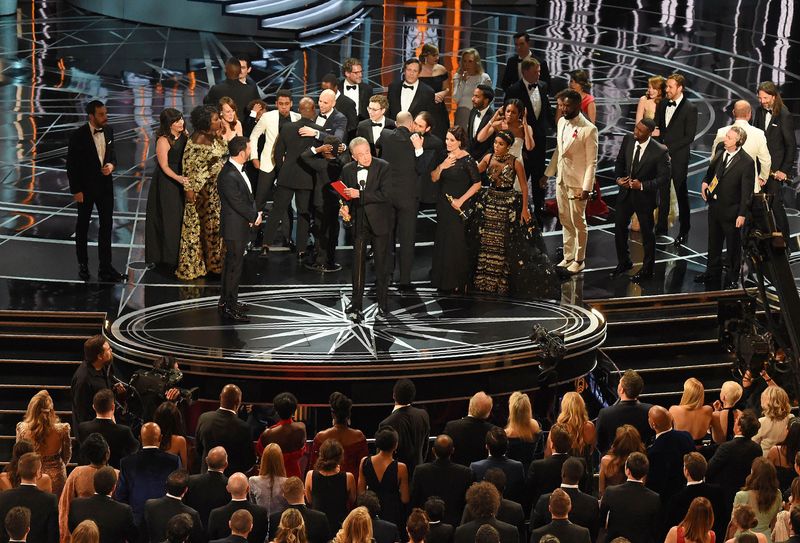
Oscar voters also honored black actors for both supporting-actor categories in a ceremony peppered with political barbs at President Donald Trump. “La La Land,” distributed by Lions Gate Entertainment Corp., won six of its 14 nominations, including best director for Damien Chazelle, who at 32 is the youngest to win the award, and best actress for Emma Stone. Casey Affleck won best actor for “Manchester by the Sea.”
Mahershala Ali's portrayal of a drug-dealing father figure in “Moonlight” and Viola Davis's embattled housewife in “Fences,” both supporting roles, were early winners in Sunday night's ceremony. Barry Jenkins and Tarell Alvin McCraney won for adapted screenplay for “Moonlight,” the first time multiple African-American writers have received an Oscar in the same year.
“This goes out to all those black and brown boys and girls and all those non-gender-conforming,” McCraney said. “This is to all of you.”
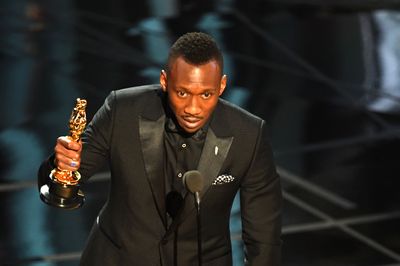
Ali and Davis were two of six black actors nominated for an Academy Award after two years when people of color were snubbed. In response to complaints about a lack of diversity, the Academy of Motion Picture Arts & Sciences last year brought in 683 new members, almost double the number added the previous year, to include a more diverse group of people.
The Academy Awards, hosted this year on ABC by Jimmy Kimmel, can boost the fortunes of small films and create new power brokers in Hollywood. More importantly, they're an important cultural touchstone, drawing more than 30 million viewers in the U.S. alone.
A lack of diversity remains an issue in front of and behind the camera, and the #OscarsSoWhite Twitter campaign of the last two years clearly bruised Hollywood, normally known as a bastion of liberalism. The election of Trump, a Republican, in November also gave this year's awards ceremony special significance, since actors such as Meryl Streep have directly drawn the president's ire for using their celebrity to make political statements.
“Thank you, President Trump,” Kimmel said in his opening monologue. “Remember last year when it seemed like the Oscars were racist? That's gone, thanks to him.”
That was one of several jokes at the president's expense, including several entreaties by Kimmel for Trump to tweet about the proceedings. As of the end of the ceremony, he hadn't obliged.
Few other presenters or winners made overt political statements. Ruth Negga, nominated for her role in “Loving,” and Lin-Manuel Miranda, creator of the musical “Hamilton,” were among actors wearing a blue ribbon Sunday night in support of the American Civil Liberties Union, which has battled Trump's immigration restrictions in court.
Director Ava DuVernay, whose film “13th” about mass incarceration was nominated for best documentary, posted a picture of herself on social media holding a sweater with the name Trayvon, in memory of Trayvon Martin, the teenager gunned down in 2012. Her film lost to “O.J.: Made in America,” which explores the racial themes behind the 1995 murder trial of the former football star O.J. Simpson.
This year the Oscars has been directly affected by President Trump's policies. Asghar Farhadi, the Iranian director of best foreign film winner “The Salesman,” said in a statement read at the ceremony that he boycotted the event in solidarity with those affected by “inhumane” travel restrictions Trump attempted to impose on Iran and other majority-Muslim countries.
“Dividing the world into the ‘us and enemies' categories creates fear,” said Farhadi. His film was distributed by Amazon.com Inc., whose Chief Executive Officer Jeff Bezos was in the audience.
Khaled Khateeb, the Syrian cinematographer of documentary short-feature winner “The White Helmets,” was barred entry to the U.S, according to the Associated Press. The film, distributed by Netflix Inc., is about volunteer rescue workers in war-torn Syria.
“The Salesman” and “The White Helmets” were the first Oscar wins for Amazon and Netflix and the first for streaming-video services, a reflection of how the technology industry infiltrating Hollywood. Amazon's “Manchester by the Sea” also garnered a best original screenplay award for Kenneth Lonergan.
Streep, nominated for best actress this year for “Florence Foster Jenkins,” drew Trump's attention after a speech at the Golden Globes criticizing the president and urging viewers to support a free press. Trump responded by tweeting that Streep, a 20-time Oscar nominee and three-time winner, is an overrated actress.
Kimmel led the Academy Awards audience in a standing ovation for Streep, saying she was due a “totally undeserved round of applause.”

-
A New Samvat Wishlist: Inclusive Prosperity And Human Development

India has strengthened its economic foundations through infrastructure, digital access and enterprise. Its next growth chapter must deepen productivity, create better livelihoods and widen participation in prosperity.
-
Love, Sex Aur Dhokha: The Audacious Plot To Spy On Jensen Huang
A Taipei dinner, a Singapore chip buyer and a suspected Chinese asset: inside the alleged spy operation that got close to NVIDIA's Jensen Huang.
-
Ten Things I Learnt This Samvat
Patience can be a trap. Cheap stocks can stay cheap. Leverage can wipe you out. What did Samvat 2082 teach us? Niraj Shah writes on 10 lessons from the year gone by.
-
Talking Points This Week: Tech Nerves, FII Buying, And A Faraway Banking Shock
The global markets are not shining this Diwali. The exception in the large markets is, India.
-
Midterm Rally Lasted A Day. The Hard Reality Of A Divided US May Last Two Years | Opinion
Between a contested AI boom, a debt ceiling that arrives in 2027 and a president with every incentive to act alone, the next two years may prove more volatile than the first day's rally suggests.
-
Blue Wave Will Derail the AI Trade but Won't Dismantle the AI Era | Unhedged Position
The Democrats' sweep of the US Congress will see politics collide with economic forces both over the long and short term.
-
It's Time To Take The GST Council's Bet On Trust Global
Payment records can prove India's services exports, and clear, proportionate rules can bring foreign digital sellers into the tax net.
-
Opinion | India at 38: From Innovation Overperformer to Innovation Powerhouse
India now has 453 VC-backed deep science startups, 18 of them late-stage, after 117 percent growth since 2020. Laurus Labs, at USD 9.3 billion, is the most valuable deep science company in any middle-income economy outside China.
-
Navigating Energy Crossroads: S Jaishankar's Call For Diversified Supply Chains At G20 Ministerial Meeting
As geopolitical fault lines continue to test maritime trade routes and commodity flows, Jaishankar's message remains pertinent: true economic resilience requires open markets, protected transit lines, and a genuine commitment to multilateral cooperation rather than coercion.









