Maruti Suzuki’s Plan To Become India’s No.1 Electric Car Maker Hinges On Exports
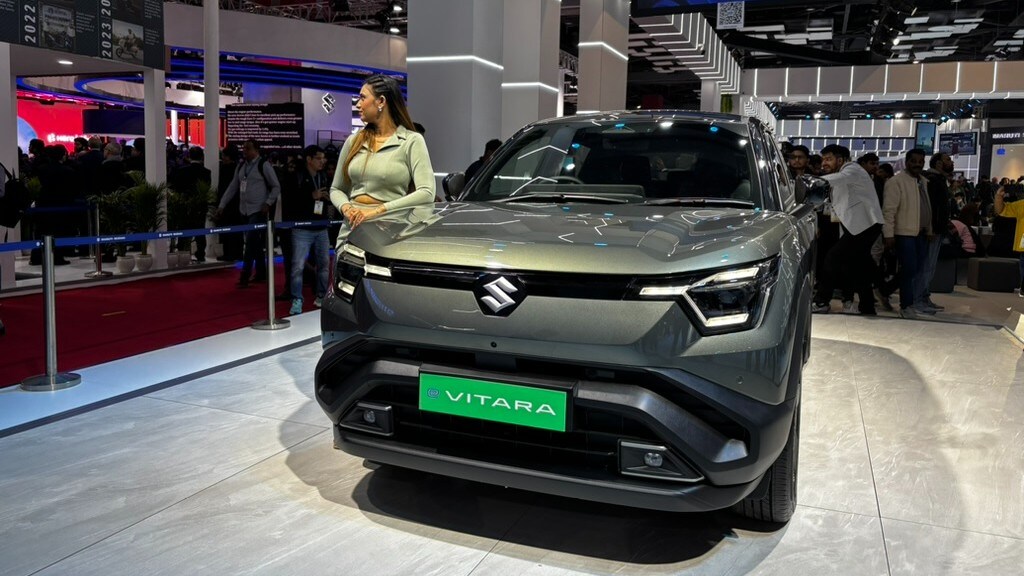
Maruti Suzuki India Ltd. aims to become India's largest electric car maker in the first year of production itself. That won't be possible without exports and sales to Toyota Motor Co.
“The one big advantage that helps us achieve this milestone will be the combined volume of exports to about 100 countries—including Japan and Europe—and sales to other OEMs (original equipment manufacturers),” Rahul Bharti, executive director (corporate affairs) at Maruti Suzuki, told NDTV Profit during a post-earnings interaction on Thursday.
The eVitara will also be rebadged as a Toyota globally, as part of the Toyota-Suzuki alliance that was formed in 2017 to collaborate on the production of electric vehicles.
Maruti Suzuki in India is the only subsidiary of Suzuki Motor Corp. that is manufacturing the eVitara for the world. Production of the company's first electric car will start at Suzuki Motor Gujarat in February. The midsize electric SUV is expected to go on sale in Europe, Japan and India in June.
“This was always our strategy to concentrate manufacturing at one location and leverage the economies of scale and manufacturing might that India has to offer,” Bharti said.
It's a good thing, then, that Maruti's exports are peaking at the right time.
In October-December 2024, India's largest carmaker shipped 99,220 units overseas—an all-time high. Its market share in India's total car exports stood at 49%, which interestingly is higher than in the domestic market. In the nine months through December, the company exported 1,21,286 units as against 1,47,915 units in the year-ago period.
The exports focus is also a hedge against India's still-nascent EV industry.
Less than one lakh electric cars were sold in India in 2024, albeit at a growth rate of 20% annually, according to industry data. Electric cars made up just 2.4% of the world's third largest automotive industry. Tata Motors is the largest electric car maker with 60% share.
Maruti Suzuki is confident of making inroads here.
“The biggest strength of the eVitara is that it is an electric vehicle built from the ground up,” Bharti said. “It's not a converted internal-combustion SUV.”
At 4,275 mm length, 1,800 mm width and 1,635 mm height, the eVitara is a smidge smaller than the India-spec Grand Vitara. It's built on the so-called ‘HEARTECT-e' platform that forms the underpinnings of several Suzuki cars, including the Swift hatchback.
The eVitara will be offered with two powertrains—142 bhp with a 49 kWh battery and 172 bhp with a 61 kWh battery—with the motor mounted at the front. The torque figures are identical at 140 NM. The claimed range is in excess of 500 km on a single charge.
Maruti is backing its electric overdrive by building the infrastructure for it.
The company has launched the so-called ‘e For Me' initiative that includes installation of home chargers for eVitara customers and fast-charging stations at dealerships. The idea is to have a Maruti Suzuki charging point every 5-10 km in the top 100 cities. Additionally, the company will set up 1,500 EV-focused service centres across the country and provide roadside assistance as well.
“This would give confidence to the customer,” Bharti said.
The Cost Of An EV
To be sure, a price has to be paid for making an EV from scratch.
Out of a total planned capital expenditure of Rs 10,000 crore for fiscal 2025, Maruti Suzuki has invested more than Rs 2,100 crore for the R&D and production of the eVitara. An EV assembly line is being set up at Suzuki Motor Gujarat that would eventually have an annual capacity of 2.5 lakh units. The localisation levels are low. The battery is being imported.
All that capex is, of course, margin dilutive.
“We have to acknowledge that EVs will have lower margins than ICE,” Bharti said. “If the margins were equal, why would the government have to give so many incentives?”
“Of course, there is viability pressure, which is why the government is also intervening. But that is something we have to take in our stride and balance the interests of all stakeholders. That is the task at hand.”
Watch: Maruti Suzuki's Rahul Bharti Speaks On Company's EV Plans

-
Extracting Value From Battery Scrap Could Be Challenging For India | The Reason Why

A discarded lithium-ion battery still contains valuable materials such as lithium, nickel and cobalt. These can be recovered and reused. When such batteries are crushed and shredded, they produce a dark powder called black mass.
-
One El Nino, India Can Handle. Two Could Break The Granary
India's grain stocks can absorb one bad year, but a second El Nino could drain the buffer in two to three years, economists say.
-
India's Troika Of Good Luck | Joining The Dots
As Jensen Huang's exit drags Nvidia down, a cooling AI trade and resilient earnings have revived investor interest in India. A likely RBI rate hike looms.
-
Talking Points This Week: Leadership Shock At Nvidia, Earnings Strength, And The Fog Over Hormuz
The Anthropic IPO pricing and first trading day, Nvidia's upcoming earnings, and any fresh signals from Iran will set the tone for the following week.
-
Signature Play: The Classic Cocktail Is Dead. Or Is It?
Classic cocktails are disappearing from India's cocktail menus. But they're still being ordered, taught to bartenders and borrowed from. So, who's really having the last drink?
-
A New Samvat Wishlist: Inclusive Prosperity And Human Development
India has strengthened its economic foundations through infrastructure, digital access and enterprise. Its next growth chapter must deepen productivity, create better livelihoods and widen participation in prosperity.
-
Love, Sex Aur Dhokha: The Audacious Plot To Spy On Jensen Huang
A Taipei dinner, a Singapore chip buyer and a suspected Chinese asset: inside the alleged spy operation that got close to NVIDIA's Jensen Huang.
-
Ten Things I Learnt This Samvat
Patience can be a trap. Cheap stocks can stay cheap. Leverage can wipe you out. What did Samvat 2082 teach us? Niraj Shah writes on 10 lessons from the year gone by.
-
Talking Points This Week: Tech Nerves, FII Buying, And A Faraway Banking Shock
The global markets are not shining this Diwali. The exception in the large markets is, India.
-
Midterm Rally Lasted A Day. The Hard Reality Of A Divided US May Last Two Years | Opinion
Between a contested AI boom, a debt ceiling that arrives in 2027 and a president with every incentive to act alone, the next two years may prove more volatile than the first day's rally suggests.









