Maruti Suzuki’s Plan To Become India’s No.1 Electric Car Maker Hinges On Exports
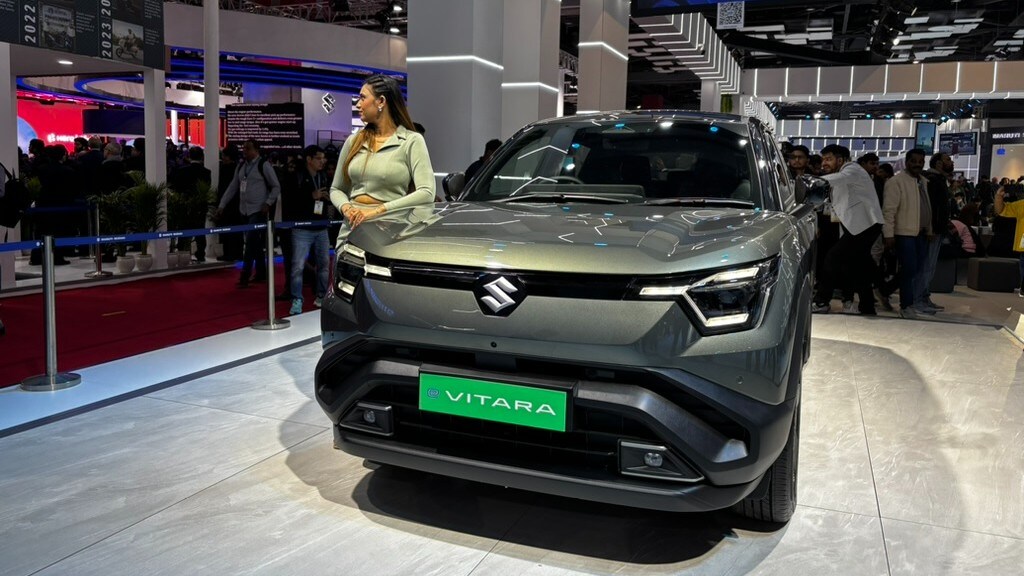
Maruti Suzuki India Ltd. aims to become India's largest electric car maker in the first year of production itself. That won't be possible without exports and sales to Toyota Motor Co.
“The one big advantage that helps us achieve this milestone will be the combined volume of exports to about 100 countries—including Japan and Europe—and sales to other OEMs (original equipment manufacturers),” Rahul Bharti, executive director (corporate affairs) at Maruti Suzuki, told NDTV Profit during a post-earnings interaction on Thursday.
The eVitara will also be rebadged as a Toyota globally, as part of the Toyota-Suzuki alliance that was formed in 2017 to collaborate on the production of electric vehicles.
Maruti Suzuki in India is the only subsidiary of Suzuki Motor Corp. that is manufacturing the eVitara for the world. Production of the company's first electric car will start at Suzuki Motor Gujarat in February. The midsize electric SUV is expected to go on sale in Europe, Japan and India in June.
“This was always our strategy to concentrate manufacturing at one location and leverage the economies of scale and manufacturing might that India has to offer,” Bharti said.
It's a good thing, then, that Maruti's exports are peaking at the right time.
In October-December 2024, India's largest carmaker shipped 99,220 units overseas—an all-time high. Its market share in India's total car exports stood at 49%, which interestingly is higher than in the domestic market. In the nine months through December, the company exported 1,21,286 units as against 1,47,915 units in the year-ago period.
The exports focus is also a hedge against India's still-nascent EV industry.
Less than one lakh electric cars were sold in India in 2024, albeit at a growth rate of 20% annually, according to industry data. Electric cars made up just 2.4% of the world's third largest automotive industry. Tata Motors is the largest electric car maker with 60% share.
Maruti Suzuki is confident of making inroads here.
“The biggest strength of the eVitara is that it is an electric vehicle built from the ground up,” Bharti said. “It's not a converted internal-combustion SUV.”
At 4,275 mm length, 1,800 mm width and 1,635 mm height, the eVitara is a smidge smaller than the India-spec Grand Vitara. It's built on the so-called ‘HEARTECT-e' platform that forms the underpinnings of several Suzuki cars, including the Swift hatchback.
The eVitara will be offered with two powertrains—142 bhp with a 49 kWh battery and 172 bhp with a 61 kWh battery—with the motor mounted at the front. The torque figures are identical at 140 NM. The claimed range is in excess of 500 km on a single charge.
Maruti is backing its electric overdrive by building the infrastructure for it.
The company has launched the so-called ‘e For Me' initiative that includes installation of home chargers for eVitara customers and fast-charging stations at dealerships. The idea is to have a Maruti Suzuki charging point every 5-10 km in the top 100 cities. Additionally, the company will set up 1,500 EV-focused service centres across the country and provide roadside assistance as well.
“This would give confidence to the customer,” Bharti said.
The Cost Of An EV
To be sure, a price has to be paid for making an EV from scratch.
Out of a total planned capital expenditure of Rs 10,000 crore for fiscal 2025, Maruti Suzuki has invested more than Rs 2,100 crore for the R&D and production of the eVitara. An EV assembly line is being set up at Suzuki Motor Gujarat that would eventually have an annual capacity of 2.5 lakh units. The localisation levels are low. The battery is being imported.
All that capex is, of course, margin dilutive.
“We have to acknowledge that EVs will have lower margins than ICE,” Bharti said. “If the margins were equal, why would the government have to give so many incentives?”
“Of course, there is viability pressure, which is why the government is also intervening. But that is something we have to take in our stride and balance the interests of all stakeholders. That is the task at hand.”
Watch: Maruti Suzuki's Rahul Bharti Speaks On Company's EV Plans

-
Indians Are Travelling, But Not Every Journey Is A Holiday | The Week In Whys

Pilgrims, patients and working women are the real travellers, and the system hasn't quite caught up with them.
-
Getting To Work Costs Women More | The Reason Why
It is not just about women paying more than men. It is about women paying much more in cities than in villages.
-
AI Bias In Investing Cannot Be Eliminated, But It Can Be Governed
Framing is a particularly important example as identical financial information presented in terms of gains rather than losses can lead an LLM to reach a different assessment.
-
Joining The Dots | Dark Skies, Steady Diya: Why Hope Holds This Diwali
With war, a weak rupee and foreign outflows weighing on sentiment, policymakers at the NDTV World Summit and market veterans at NDTV Profit Ignite: Diwali Edition offered the same advice: stay invested and filter out the noise.
-
The Curious Case of Equitas Small Finance Bank And A CEO Who Quit For Stock
PN Vasudevan believes persistent investor concerns over a perceived conflict of interest had become a governance overhang on Equitas Small Finance Bank's stock, even as the lender improved profitability and asset quality.
-
Talking Points This Week: AI Cash Burn, A Tiger Comeback And An India That Still Finds Its Own Path
India is not immune to higher oil or tighter global liquidity, yet its earnings base is broader, its domestic policy levers are still available.
-
Foreign Investors Own Half Of HDFC Bank and ICICI Bank. An LTCG Cut Could Matter Most Here
Foreign portfolio investors have US$115 billion parked in HDFC Bank, ICICI Bank. If the government cuts long-term capital gains tax, Jefferies says returning foreign money could land here first.
-
'Never Seen This Level Of Negativity': Sandeep Tandon Says The Next Rally May Be Closer Than You Think
Veteran investor Sandeep Tandon says foreign selling is easing, large-caps are due a comeback and mid-caps are crowded, while he turns positive on gold, power and pharma this Diwali.
-
Indians Stay With Family, Not In Hotels | The Reason Why
India still lacks enough clean, reliable and affordable hotels for budget-conscious travellers.
-
The Economic Imperative: Analysing The Material Driving Force Behind India-Canada Strategic Reset
This economic complementarity is further reinforced by deep institutional investment ties and talent mobility, which form the bedrock of the bilateral framework.










