Why Judicial Reform Should Start With Lower Courts

Of the 30 million pending court cases in India as of December 2014, over 80% are in district and subordinate courts, which are short of about 5,000 (23%) judges. But filling vacancies may not be the universal answer, according to our analysis, which found only a weak direct correlation between shortage of judges and performance of lower courts.
India's judicial delays are legendary, and its shortage of judges well-known, as IndiaSpend has reported (here, here and here). Yet, despite the constraints, some courts manage to perform better than others, sometimes significantly so. Data can help identify such courts, as well as their innovations and best practices, so that these can be replicated in other courts.
India has over 600 district courts. Identifying the high performers and replicating their best practices in other courts can make an immediate impact.
Here's an example from Tamil Nadu.
Tamil Nadu illustrates India's problem
Without standardisation in data across lower courts, their performance cannot be compared directly. So, we studied Tamil Nadu, whose average duration of pendency of cases approximates the national average.
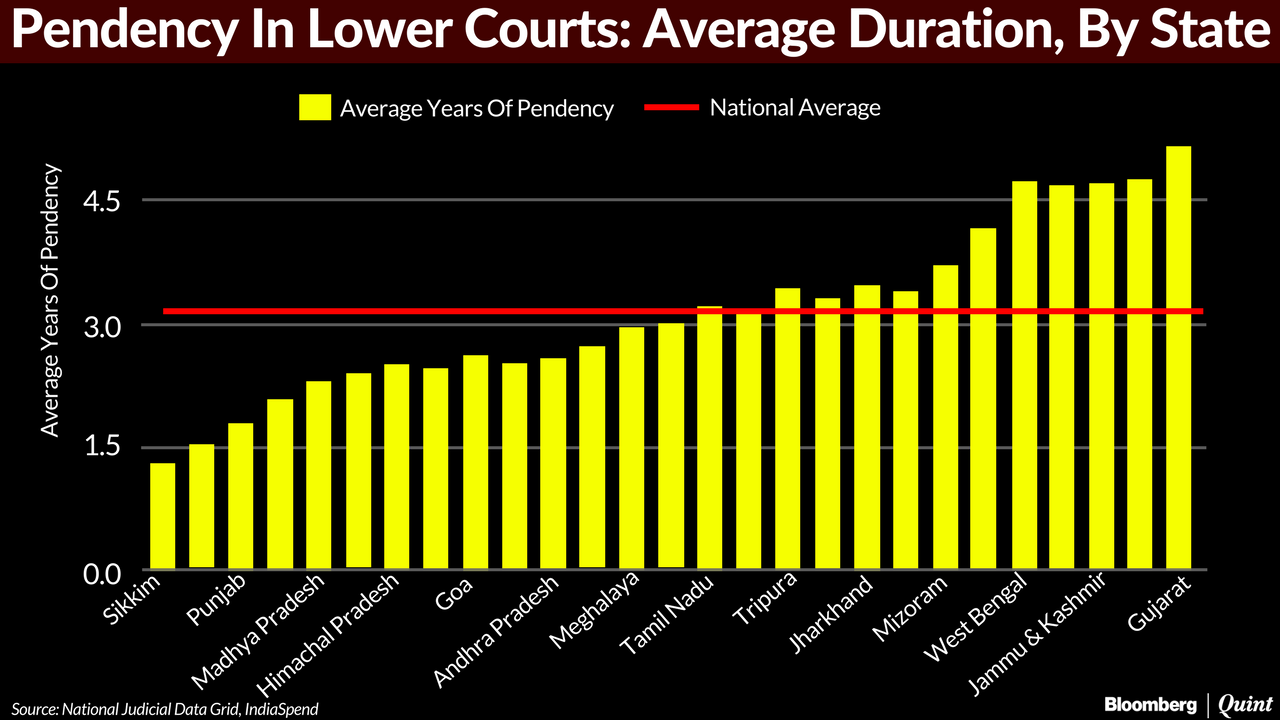
Also, the Madras High Court is one of the few in the country whose latest annual report, for 2015, provides a detailed analysis of the lower courts under its jurisdiction.
Civil case takes, on average, three years to conclude
Within Tamil Nadu, let's identify the laggard courts.
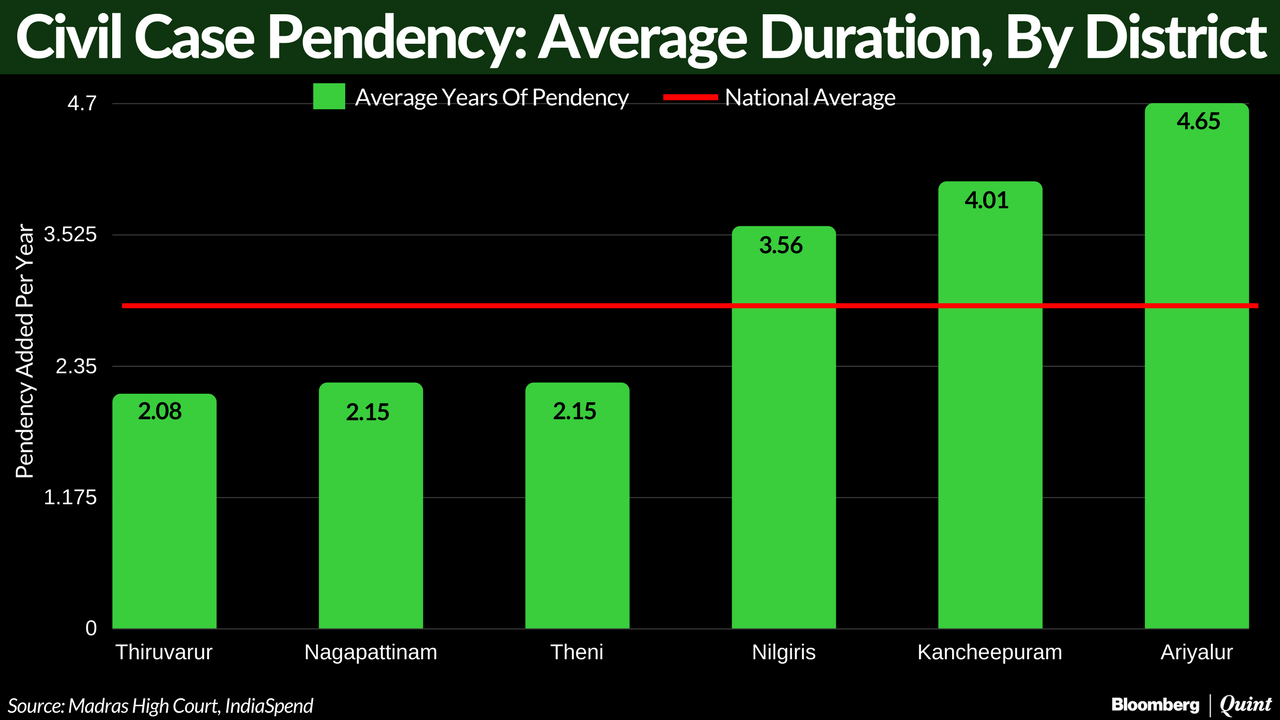
The state average for pendency duration of civil cases is 2.95 years–a civil case takes about three years to reach a conclusion. Ariyalur is the worst performing district in this regard–a civil case takes 4.65 years on average, that is, 50% slower than the state average.
Thiruvarur performs the best with an average pendency duration of just two years.
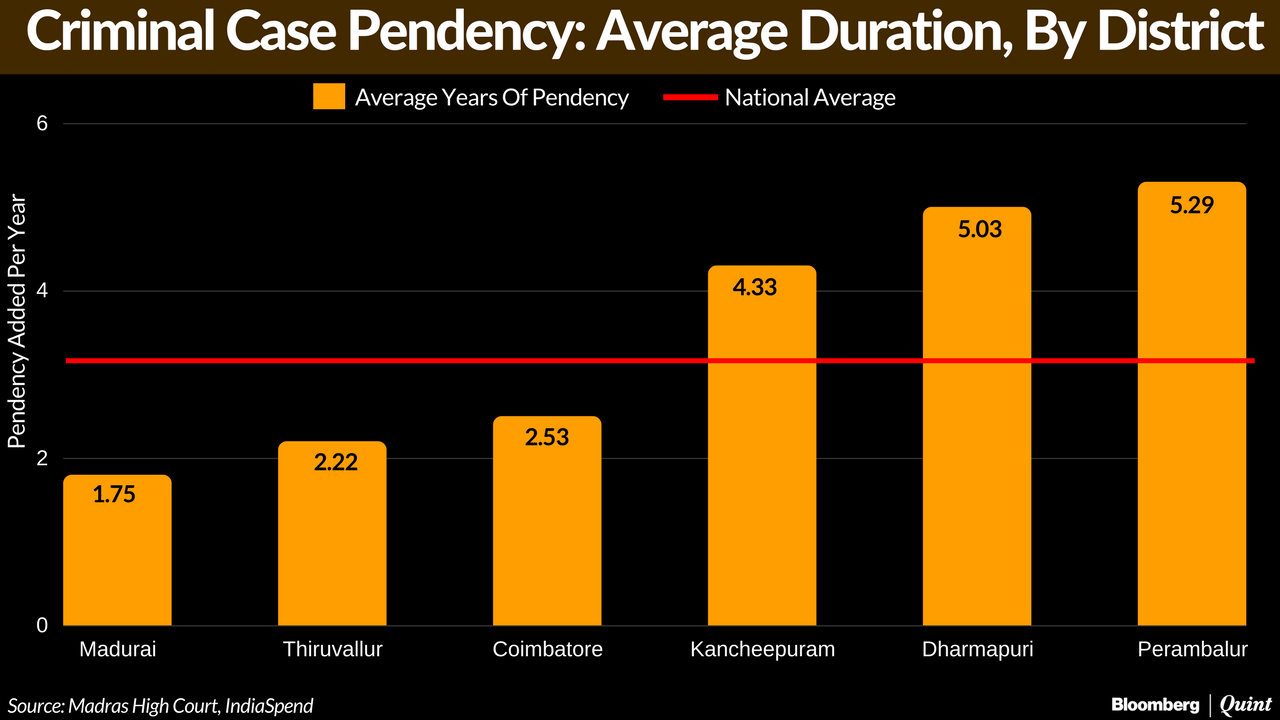
For criminal cases, average pendency duration is 3.23 years for all of Tamil Nadu. Madurai performs exceedingly well with an average pendency duration of 1.75 years, while Perambalur is the slowest with an average pendency duration of 5.29 years. Kancheepuram performs poorly in both civil and criminal cases, being significantly slower than the state average–it takes four years to resolve civil cases as against the state average of three, and takes 4.3 years to resolve criminal cases, as opposed to the state average of 3.2 years.
Cases accumulate when the rate of disposal is lower than the rate at which new cases are instituted. Tamil Nadu accumulated 43,973 cases in 2015. Of these, 36,945 were civil and 7,028 criminal cases.
Here's a look at the best and worst performing district courts with respect to case accumulation.
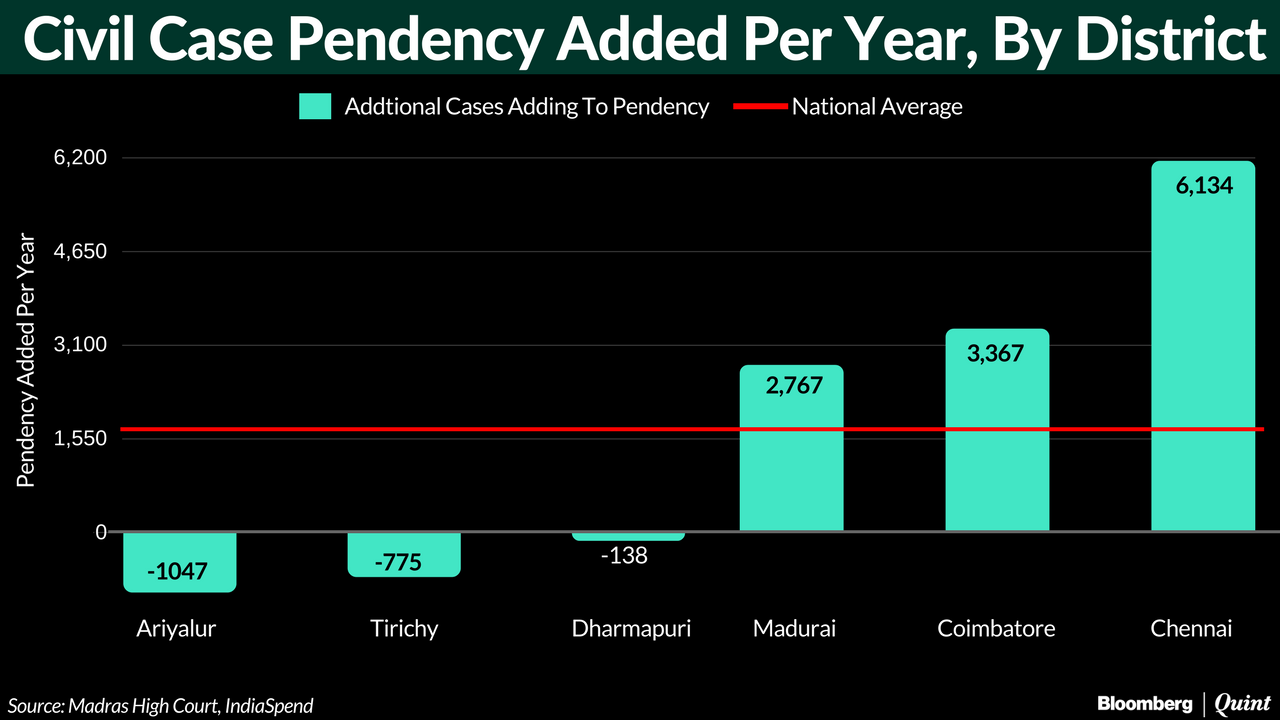
First, the civil cases: Of the 32 districts in Tamil Nadu, only five are disposing of more cases than the number of cases instituted, with Ariyalur performing the best and Chennai the worst.
Chennai lower courts accumulate more than 6,000 civil cases each year, while Ariyalur courts dispose of 1,000 cases from its pending pile each year. If this continues, Ariyalur courts will dispose of all their pending cases in nine years, after accounting for new cases that will be instituted each year.
The top three cities of Tamil Nadu–Chennai, Coimbatore and Madurai–have the highest case accumulation rate.
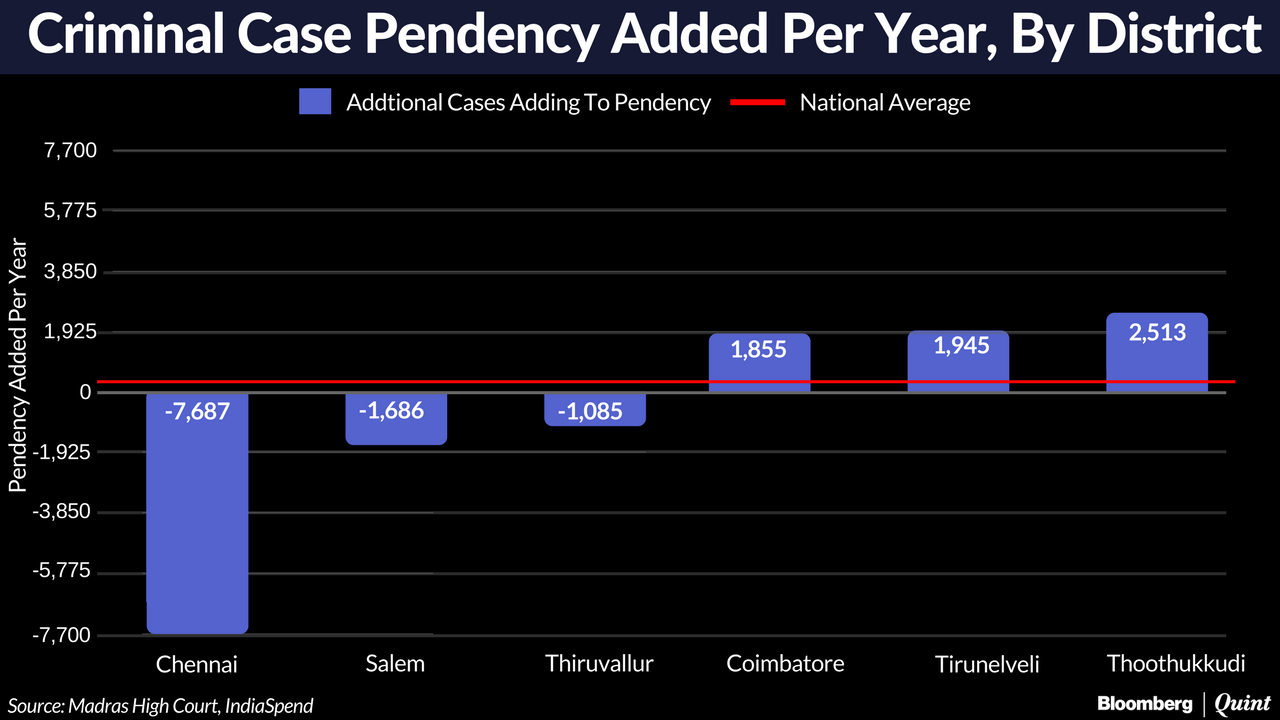
Next, the criminal cases: Chennai lower courts perform the best in disposing of criminal cases–they conclude 7,700 criminal cases more than instituted each year. At this rate, Chennai will dispose of all its pending cases in 5.4 years. This is far better than any other district in the state.
Coimbatore's lower courts are the slowest in disposing of criminal cases too.
What vacancies have to do with efficiency
We also analysed the number of judicial vacancies across all lower courts in Tamil Nadu. There are no significant differences in the number of vacancies between various lower courts, so the huge difference in their performances cannot be explained solely by shortage of judges.
The answer would seem to lie in procedural innovations, which needs to be analysed and documented at the high performing courts.
Our key point is: District courts can learn from each other's successes and failures. For example, Chennai courts may learn from Ariyalur courts how to better dispose of civil cases, and may learn from their own experience with disposing of criminal cases.
A nationwide analysis is possible if we have standardised data to compare lower courts across the country. There is an urgent need for collecting case data in a structured and standardised format across the various courts in India. This will enable deeper insights and precise policy prescriptions.
While long-term issues such as shortage of judges grab policymakers' attention, they must also tackle the immediate problems. In the near term, immediate improvements are possible by horizontally replicating proven procedural innovations.
This article has been published in arrangement with IndiaSpend.
(Authors of the article are Shobhit Mathur and Ram Prasath VR. Mathur is the Executive Director at Vision India Foundation, a non-profit policy research and training organisation based in New Delhi. Prasath is a Research Intern with Vision India Foundation.)
The views expressed here are those of the author's and do not necessarily represent the views of Bloomberg Quint or its editorial team.

-
Unhedged Position: Can India See An Indonesia-Style Time Correction?

The Nifty is trading below levels it first clocked in 2024. Is there, then, as I have suggested in the headline, potential that the current time correction drags on painfully for the next three-five, even ten years?
-
Navigating Friction And Energy Realities: An Analysis Of Marco Rubio's October Visit To India
Occurring at a critical juncture marked by stalled trade negotiations and escalating geopolitical pressures over global energy supplies, the visit offers a profound window into modern US-India relations.
-
India Exports Capital. Why Not Export Trusteeship?
The big question, then, is whether India can build an institution that global borrowers, investors, banks, and lawyers can trust, even without an Indian connection.
-
France's Economy & Politics Are In Crisis | The Reason Why
Let's look at how the French economy and politics evolved under Nicolas Sarkozy, Franois Hollande and Emmanuel Macron.
-
You May Inherit The Business. You Must Earn Its Credibility.
Succession tests the founder's ability to share authority as much as it tests the next generation's readiness to assume it.
-
Signing Deals Is One Thing; Making Them Work Is Another | The Week In Whys
Sometimes, things don't turn out as planned. Indian companies have lost some bids to rivals, some projects won't produce until 2030.
-
FOMC Wall, PERM Suspension, Hospital Stocks | Talking Points This Week
A PERM suspension would directly affect green-card sponsorship rather than H-1B visas, so the near-term earnings impact could remain relatively limited. The key question is whether this marks a new phase in US scrutiny of Indian IT.
-
Everything, Everywhere, All At Once: Dalal Street's Week To Forget | Joining The Dots
Visa curbs, a Starlink spat and cancer drug caps: what connects this week's shocks for Indian markets
-
India Is Going Abroad For Critical Minerals. But It May Take Years To Pay Off | The Reason Why
Although India's steps are in the right direction, they remain modest compared with India's growing dependence.
-
When Everyone Has AI, What Gives You An Edge?
India's young workforce is entering an uncertain world of work where powerful AI tools are becoming widely accessible. The advantage will belong to those who combine deep expertise with digital fluency, and the distinctly human capabilities that technology cannot manufacture.