UP’s Modi Wave Unprecedented In 40 Years
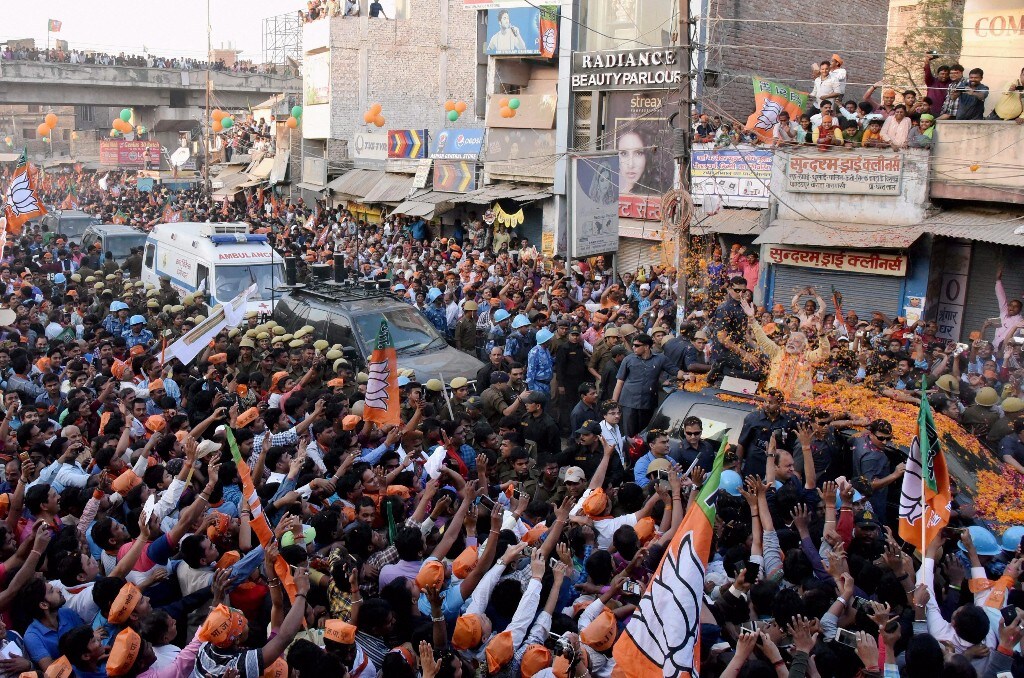
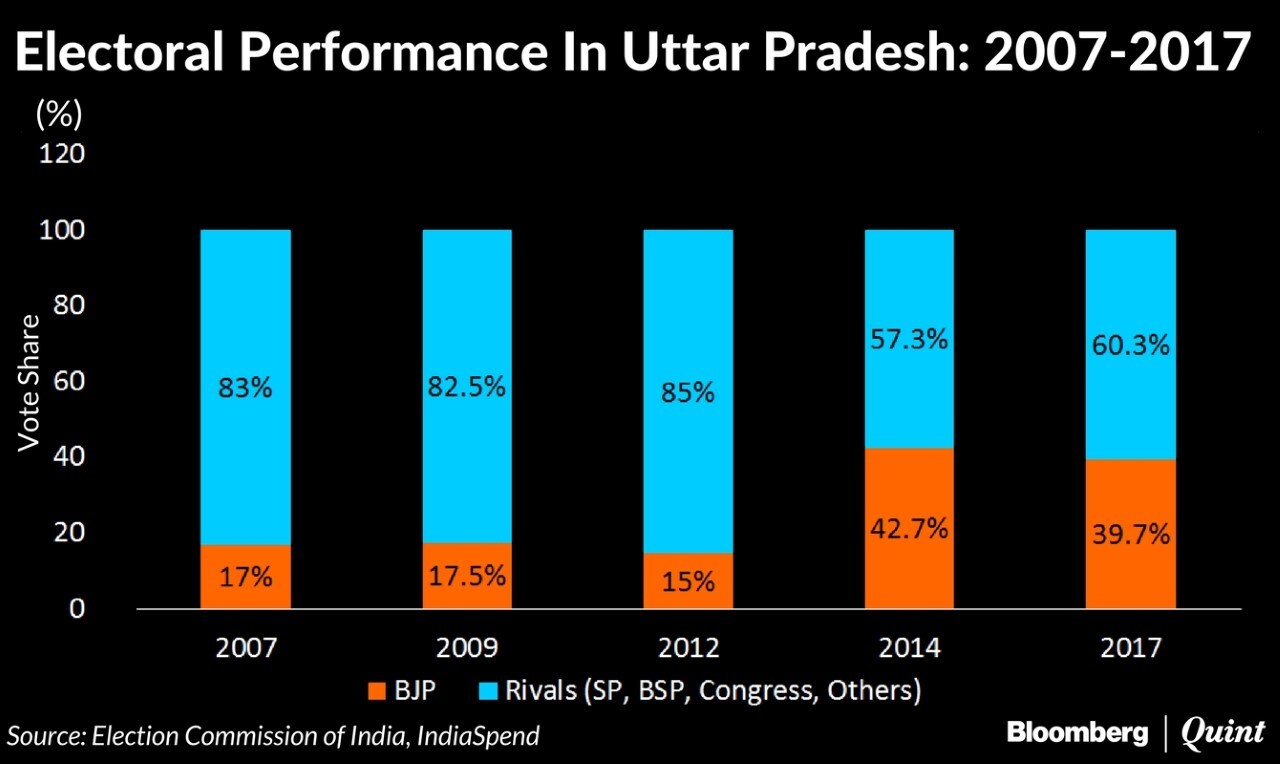
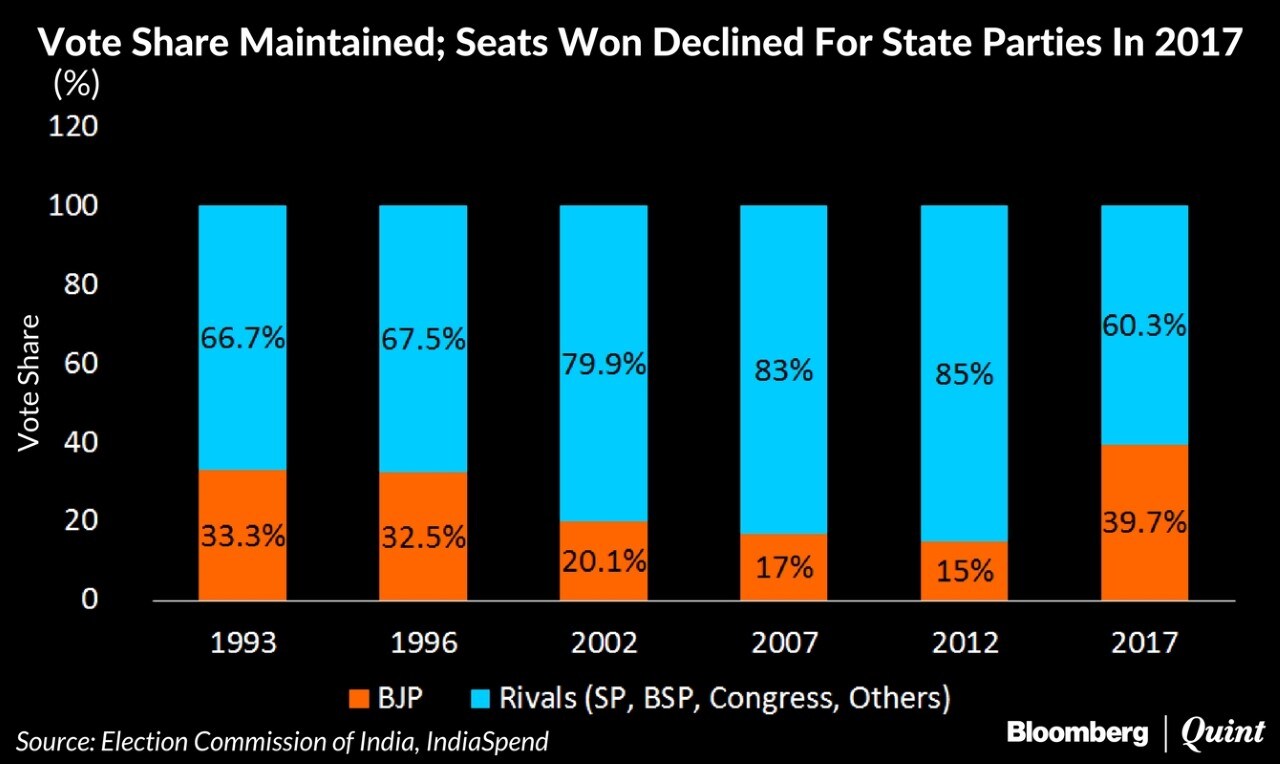
In an outcome unmatched over the last 40 years, the Bharatiya Janata Party (BJP) won 312 out of 403 (77.4 percent) seats in India's largest state assembly in its most-populous state, increasing its vote share by 25 percentage points from the 2012 assembly elections to 39.7 percent in 2017.
The BJP almost repeated its performance from the 2014 parliamentary elections, when it won 42.7 percent votes and 73 (more than 90 percent) of 80 Lok Sabha seats in Uttar Pradesh (UP). Despite the effects of demonetisation and the perception that voters behave differently in parliamentary and assembly elections, it would take a historic vote swing favouring the Samajwadi Party (SP)-Congress alliance or the Bahujan Samaj Party (BSP) to keep the BJP from sweeping UP, as IndiaSpend had predicted in January 2017.
This performance–vote share, and seats won as a percentage of total seats–is the best by any party after 1977, when, in the wake of the Emergency being lifted, the Janata Party won 352 seats of 425 (82.8 percent) seats and garnered 47.8 percent votes from the people of UP.
The BJP almost exactly replicated the performance of the Congress in 1980, when the Congress won 309 seats with 39.6 percent of the votes, while the BJP won 11 seats with 10.8 percent votes. In 2017, the BJP has 312 seats with 39.7 percent votes, while the Congress has seven seats with 6.2 percent of UP's votes.
Regional Parties SP And BSP Maintain Vote Share, Fail To Win Seats
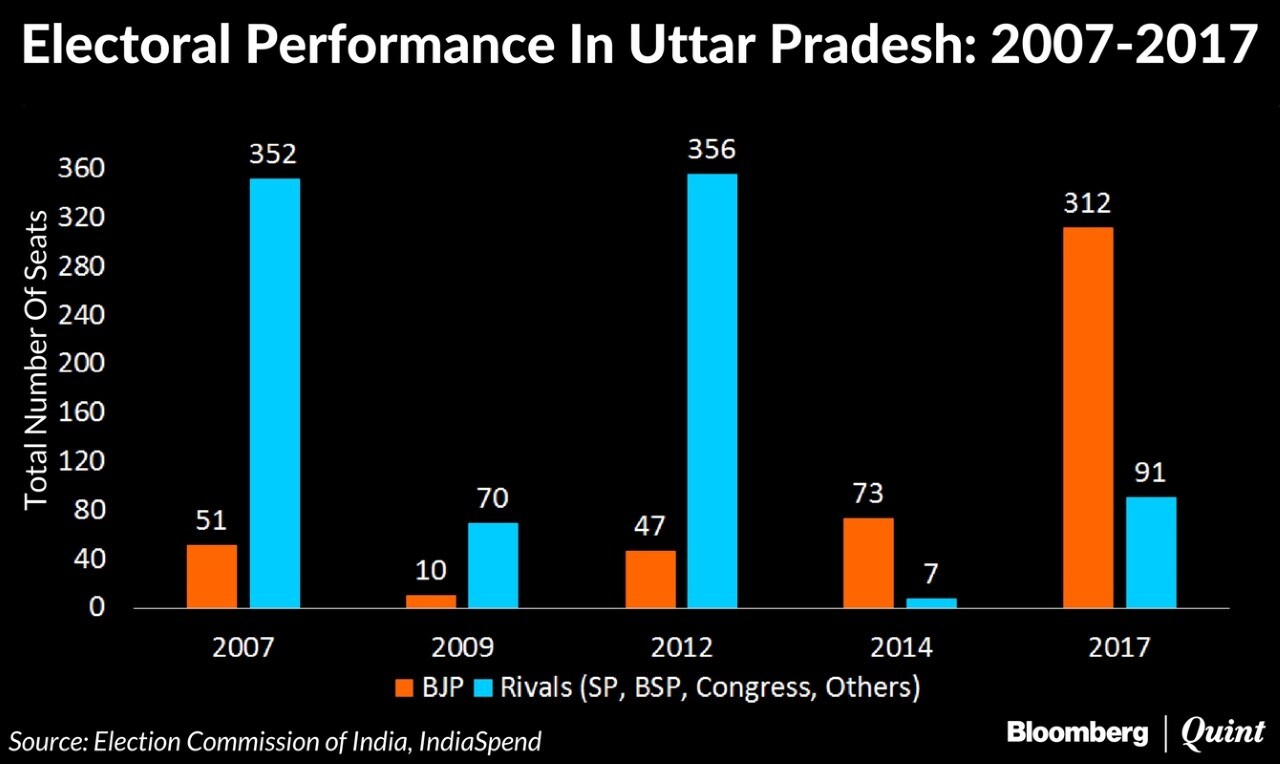
As the chart shows, the SP and BSP maintained their core vote share of at least 20 percent – the SP had 29 percent of the votes in 2012 and the BSP, 26 percent – in the 2017 assembly elections, but they could not translate those into seats.
Our analysis of assembly elections since 1993, after the formation of the SP, shows that both SP and BSP were consistent in growing their vote shares, while the vote shares of the major national parties, the BJP and the Congress, reduced.
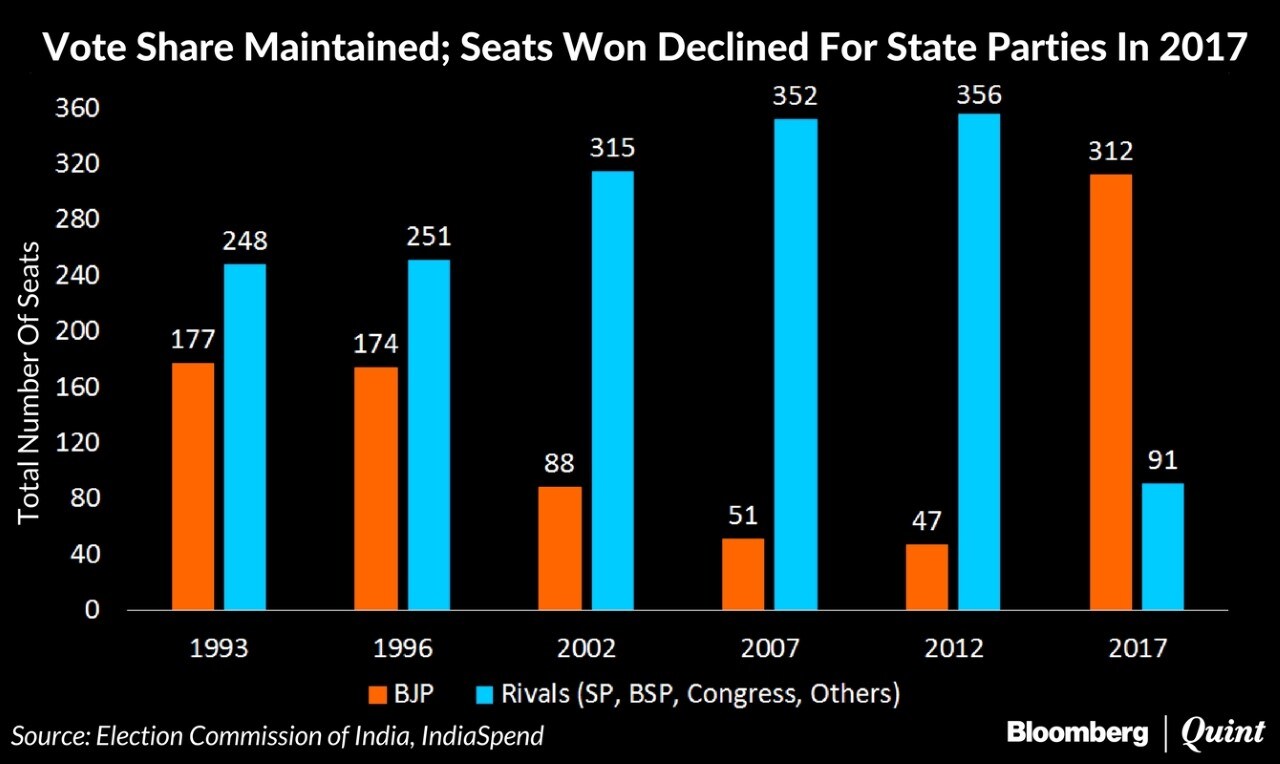
The BJP in 2017 has registered its best performance ever, the Congress its worst ever since 1977, and the SP and BSP the worst ever since their inception.
After being the single largest party and forming the government for one term (1997-2002) in the 1993-2002 period, the BJP remained out of power in UP for 15 years. The Congress never again achieved the 15 percent vote share it achieved in 1993.
The BSP improved its vote share from the 19.8 percent in 2014 Lok Sabha election to 22.2 percent in the 2017; in 2012, it won 26 percent of the vote share, winning 80 seats; in 2017 it is down to 19.
BJP Makes U-Shaped Recovery, Congress Continues Downfall
Looking back at the last four decades, the BJP started modestly in 1980, winning 11 seats with 11 percent of UP's votes, as we said.
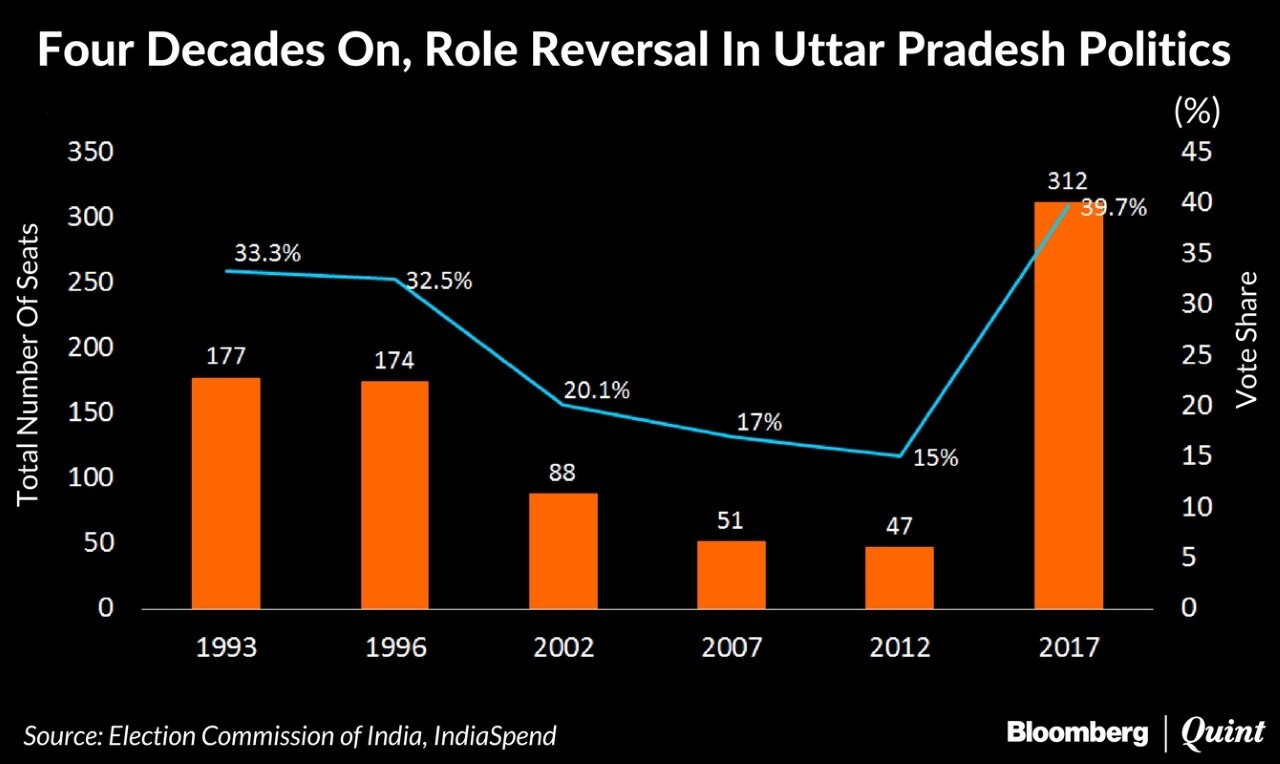
So dominant were the SP and BSP over the last 30 years, the BJP and Congress were compared with a third front.
Except for three of the last 11 state elections, non-Congress and non-BJP parties put together always garnered more than a third of the votes, winning more than half the state's vote in 2007.
In the four decades since 1980, UP was ruled by the Congress the first decade, followed by the BJP's rise and a fractured mandate that benefited regional parties in 1989 and 1993 during the second decade, followed by 15 years of regional party dominance.
Abhishek Waghmare is an analyst with IndiaSpend.
This story has been published in arrangement with IndiaSpend.

-
High US Salaries, No Green Card Certainty: The Financial Calculation Facing Indian H-1B Families

The suspension of PERM processing at eight technology employers does not cancel existing H-1B visas. What it does is force a question many Indian families have been avoiding: is the US salary worth tying your career and family plans to one employer?
-
Unhedged Position: Can India See An Indonesia-Style Time Correction?
The Nifty is trading below levels it first clocked in 2024. Is there, then, as I have suggested in the headline, potential that the current time correction drags on painfully for the next three-five, even ten years?
-
Navigating Friction And Energy Realities: An Analysis Of Marco Rubio's October Visit To India
Occurring at a critical juncture marked by stalled trade negotiations and escalating geopolitical pressures over global energy supplies, the visit offers a profound window into modern US-India relations.
-
India Exports Capital. Why Not Export Trusteeship?
The big question, then, is whether India can build an institution that global borrowers, investors, banks, and lawyers can trust, even without an Indian connection.
-
France's Economy & Politics Are In Crisis | The Reason Why
Let's look at how the French economy and politics evolved under Nicolas Sarkozy, Franois Hollande and Emmanuel Macron.
-
You May Inherit The Business. You Must Earn Its Credibility.
Succession tests the founder's ability to share authority as much as it tests the next generation's readiness to assume it.
-
Signing Deals Is One Thing; Making Them Work Is Another | The Week In Whys
Sometimes, things don't turn out as planned. Indian companies have lost some bids to rivals, some projects won't produce until 2030.
-
FOMC Wall, PERM Suspension, Hospital Stocks | Talking Points This Week
A PERM suspension would directly affect green-card sponsorship rather than H-1B visas, so the near-term earnings impact could remain relatively limited. The key question is whether this marks a new phase in US scrutiny of Indian IT.
-
Everything, Everywhere, All At Once: Dalal Street's Week To Forget | Joining The Dots
Visa curbs, a Starlink spat and cancer drug caps: what connects this week's shocks for Indian markets
-
India Is Going Abroad For Critical Minerals. But It May Take Years To Pay Off | The Reason Why
Although India's steps are in the right direction, they remain modest compared with India's growing dependence.









