UP Civic Polls: If BJP Won 184 Seats, Why Did TV Channels Say 340?
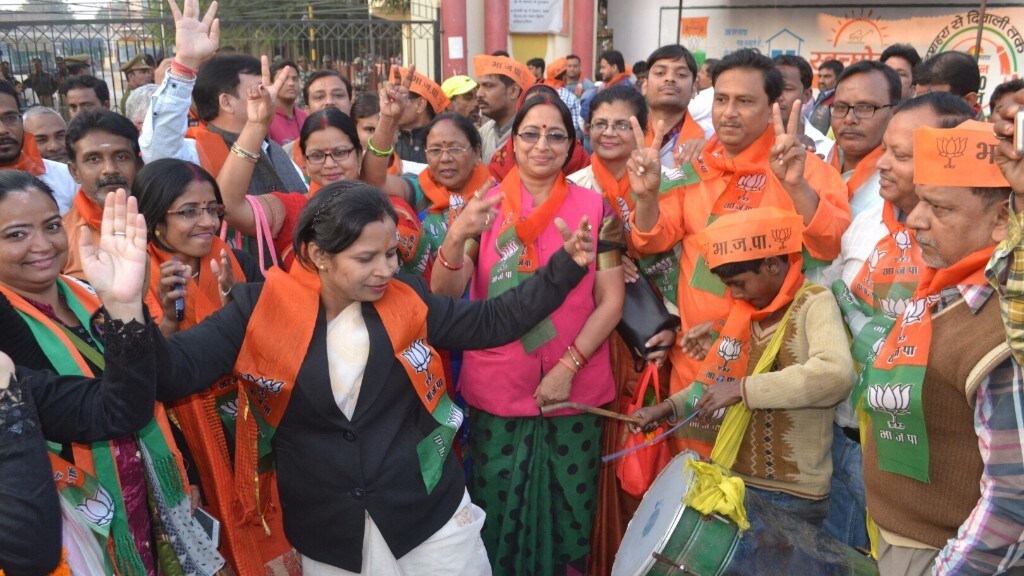
How did some media houses arrive at the figure of 341 seats for the BJP suggesting a sweep?
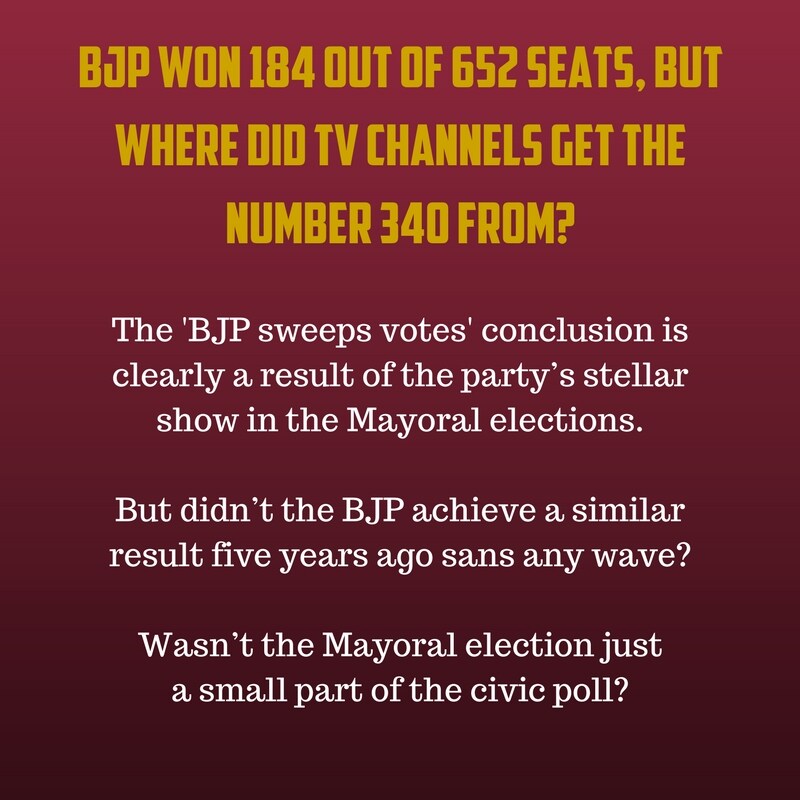
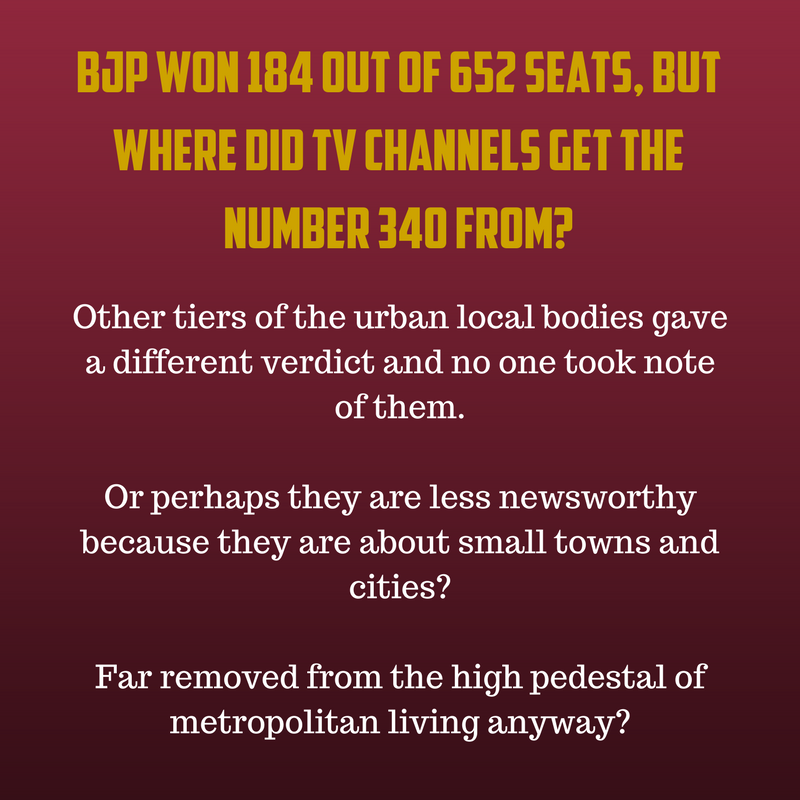
Simple calculation of numbers available at the Uttar Pradesh Election Commission website suggests the BJP won 184 of the total of 652 local bodies. How did media houses arrive at the 340-plus number? Perhaps they were leading at some point and considered a final tally?
Copies accompanying tables never explained the number. And once, the election was called a clean sweep for the BJP and nobody cared to check the actual number, perhaps?
So does this mean the BJP is losing some sheen in urban pockets?
The question posed may seem blasphemous given the kind of headlines we have seen in the last two days. But, there is a context to the question that needs examination.
We now have some idea of how urban voters have exercised their franchise, following the results of the Uttar Pradesh civic body elections. Nearly 3.4 crore voters, roughly 20 percent of all voters of the state, were asked to elect 652 heads of three-tier urban local bodies.
The Bharatiya Janata Party (BJP) won 184 of the 652 seats on offer. The winning percentage therefore stands at a modest 28. Is this as landslide a victory as it has been made out to be?
There is no denying that these elections are contested on local issues and perception about candidates matter more than their party affiliations. Since the turnout was a mere 52 percent, we can assume that people were not enthusiastic about the whole exercise as they usually are.
In the 2012 urban body elections, the BJP had won 88 of the 629 seats on offer, which translates to a winning percentage of just 14. But that was another era and the Akhilesh Yadav-led Samajwadi Party had won a thumping majority in the state Assembly elections only a few months earlier. The BJP's performance was rather dismal in the Assembly as well as urban body elections.
More appropriate comparison, therefore, would be to see the winning percentage of this round of elections with the recently-concluded Assembly elections in the state.
The winning percentage of the BJP stood at 77 in the March Assembly elections in Uttar Pradesh. Assuming that the pattern was the same throughout the state, the BJP would have won nearly 80 percent of all urban seats. From a winning percentage of 80 then to 28 now, is it a landslide?
Wide Variation Across Towns
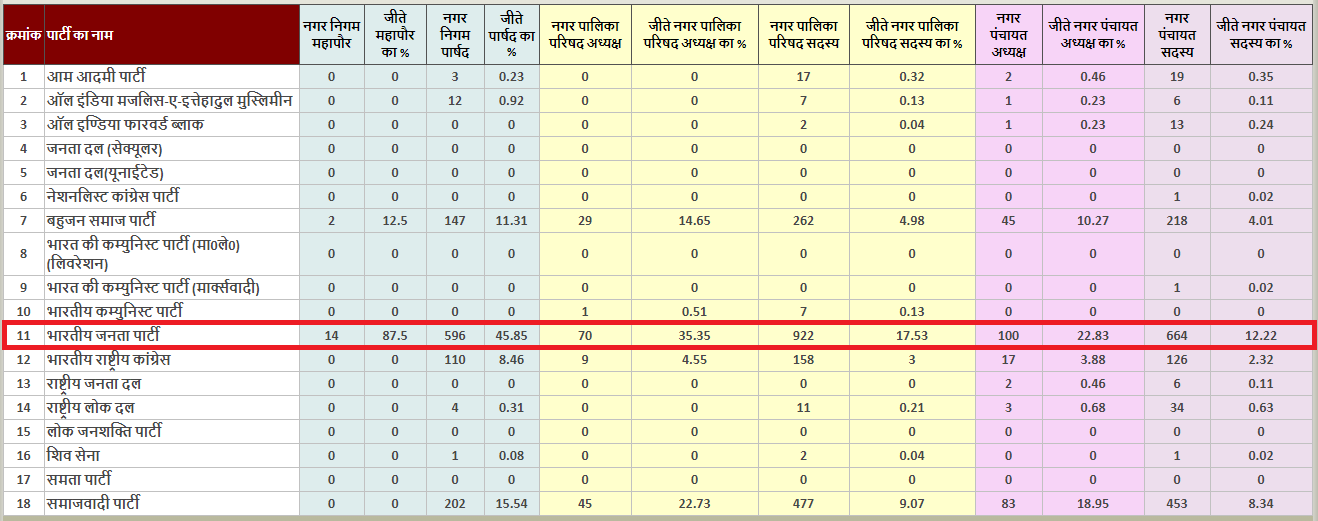
There is no denying that the BJP remains the most popular party in big cities. The party won 14 out of the 16 mayoral posts. The score was 10 out of 12 for the saffron party five years ago. However, in major cities too, the winning percentage fell to 45 in the elections for the less coveted posts of councillors.
The situation, however, was quite different in small cities and towns. In cities with municipal councils, the BJP won 70 posts of chairperson out the total of 198 seats on offer. This translates into a winning percentage of just 35.5. The Samajwadi Party won 45 of such seats with a winning percentage of nearly 23. The third most powerful block consists of independents with a winning percentage of 22.
Further down, for the posts of nagar panchayat heads, the BJP could win mere 100 of the 438 seats on offer. The winning percentage, in this case, is a very modest 23. Independents walked away with nearly 42 percent of such seats and the Samajwadis got 19 percent of the seats.
Is there a message here? Does this mean that while the residents of big cities negotiated the accompanying pains of demonetisation and Goods and Services Tax (GST) rather smoothly, people living in smaller towns and kasbas have not been all that lucky?
The point that needs to be emphasised, though, is that the central message coming out of the civic poll verdict is anything but uniform.
Message for All Parties
Reports of the Congress losing in its stronghold Amethi (the party did not do well in the March Assembly elections and the civic elections five years ago either), the BJP not doing as well as it should have done in high profile areas of Gorakhpur or Kaushambi must get the attention they deserve.
The fact that independents walked away with a major share of seats in municipal councils and nagar panchayats is a sort of warning for all major political parties.
A note of caution here though.
Since the vote share data is still awaited, drawing any hasty conclusion will be premature. But one message is pretty clear: the BJP is not as well placed as it was eight months ago. This is despite the index of Opposition unity being at an all time low with all parties fighting municipal elections separately.

-
Navigating Friction And Energy Realities: An Analysis Of Marco Rubio's October Visit To India

Occurring at a critical juncture marked by stalled trade negotiations and escalating geopolitical pressures over global energy supplies, the visit offers a profound window into modern US-India relations.
-
India Exports Capital. Why Not Export Trusteeship?
The big question, then, is whether India can build an institution that global borrowers, investors, banks, and lawyers can trust, even without an Indian connection.
-
France's Economy & Politics Are In Crisis | The Reason Why
Let's look at how the French economy and politics evolved under Nicolas Sarkozy, Franois Hollande and Emmanuel Macron.
-
You May Inherit The Business. You Must Earn Its Credibility.
Succession tests the founder's ability to share authority as much as it tests the next generation's readiness to assume it.
-
Signing Deals Is One Thing; Making Them Work Is Another | The Week In Whys
Sometimes, things don't turn out as planned. Indian companies have lost some bids to rivals, some projects won't produce until 2030.
-
FOMC Wall, PERM Suspension, Hospital Stocks | Talking Points This Week
A PERM suspension would directly affect green-card sponsorship rather than H-1B visas, so the near-term earnings impact could remain relatively limited. The key question is whether this marks a new phase in US scrutiny of Indian IT.
-
Everything, Everywhere, All At Once: Dalal Street's Week To Forget | Joining The Dots
Visa curbs, a Starlink spat and cancer drug caps: what connects this week's shocks for Indian markets
-
India Is Going Abroad For Critical Minerals. But It May Take Years To Pay Off | The Reason Why
Although India's steps are in the right direction, they remain modest compared with India's growing dependence.
-
When Everyone Has AI, What Gives You An Edge?
India's young workforce is entering an uncertain world of work where powerful AI tools are becoming widely accessible. The advantage will belong to those who combine deep expertise with digital fluency, and the distinctly human capabilities that technology cannot manufacture.
-
Wrong Labels, High Pesticide Residues Holding Back Agri Exports | The Reason Why
India needs stronger domestic food-safety and labelling standards, with best practices becoming part of everyday business for farmers, traders and food companies.










