Tanker-Fed Beed Is Struggling To Find Water To Drink
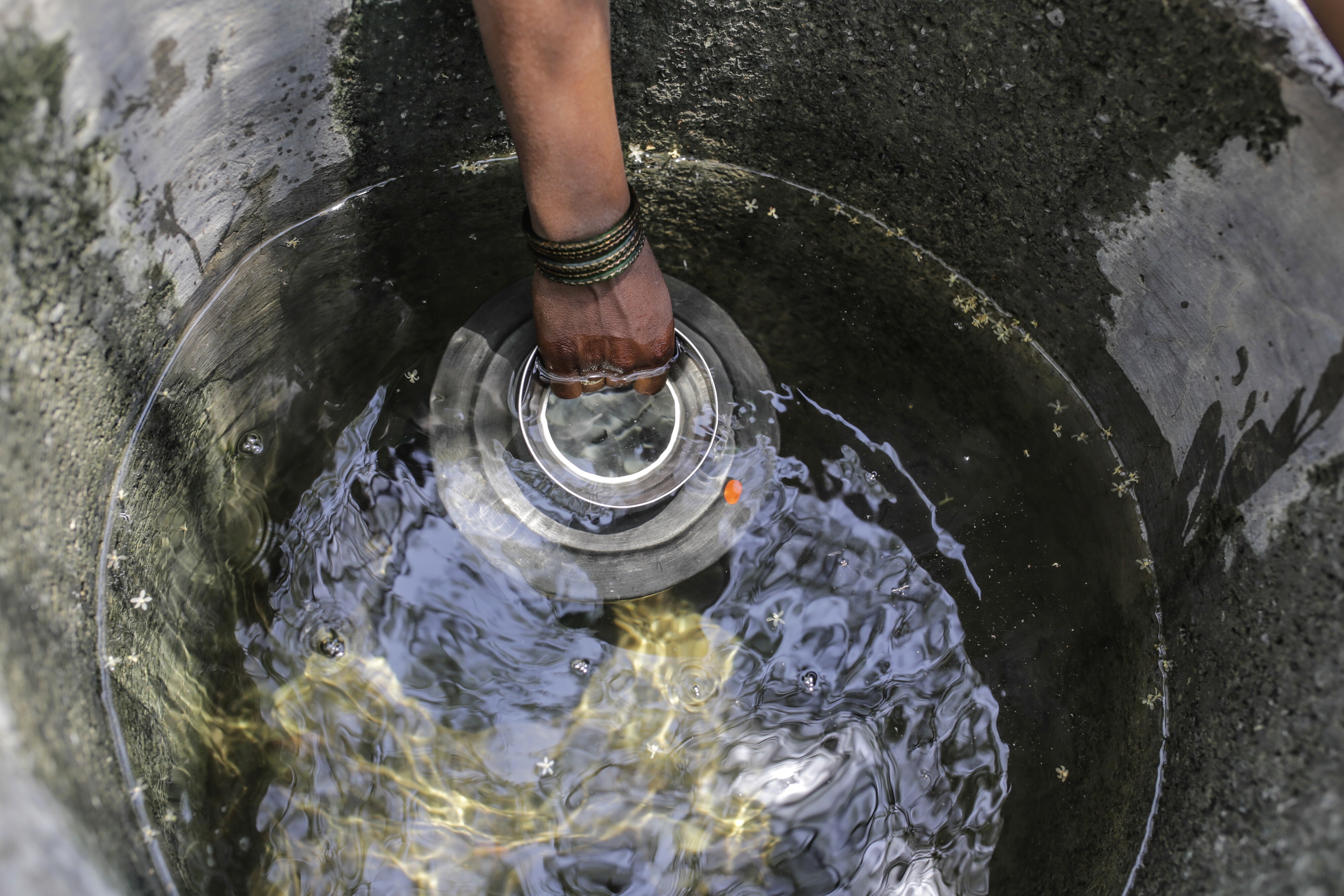
Every time a water tanker makes way through dusty bylanes of Khalapuri village in Beed, women and children scramble with coloured plastic drums for their share. They get supply once in eight days.
“But we can't use it for drinking,” said Rita Parjane. It's turbid and stinks. “For drinking, we buy water jars,” she said, referring to cans they buy from a local villager.
Anil Parjane, who grows cotton in his five-acre farm, sells drinking water in the village. He draws it from a 300-foot-deep borewell in is fields and filters it using a small purifier, he said over the phone—BloombergQuint couldn't visit to verify how he makes the water potable.
“We put the cans in a pick-up truck and deliver it to villagers,” said Parjane, who named his venture Jai Hanuman Aqua. For one can of 18 litres, he charges Rs 20.

Beed, about 350 kilometres east of Mumbai, falls in Maharashtra's Marathwada region that received only 33 percent of its long-term average rainfall last year. It's one of the 26 districts declared drought-hit. Most reservoirs have no water, and aquifers have depleted to such an extent that nearly all wells have run dry, leaving farmlands parched, and people without a drop to drink.
Before the farmer started providing potable water, local residents had to go to neighbouring villages in search of water, said Kiran Parjane, sarpanch of Khalapuri. Since the tanker supply is not clean, they spend up to Rs 1,000 a month to buy water.
Women from the neighbouring Arvi village also rely on such canisters of potable water. “Tanker water is very dirty, we can't drink it,” said Kesarbai Kashid. “We either walk two-three kilometres to fetch it from a well or buy the can.”

Arvi villagers said two local farmers also purified and sold water—BloombergQuint couldn't contact them.
The situation is bad despite the district administration supplying water through 602 tankers. At times the quality of the water is not good for drinking, admitted Astik Kumar Pandey, the district collector of Beed. “We have a shortage. Places where our tankers lift the water from are in dead storage (bare minimum level that can't be drawn),” he said. “When we get the reports that water is non-potable or dirty, we try to change the source.”
Pandey said Beed is a huge district and tankers travel 80-100 kilometres to fetch water from reservoirs. “We have only one big source that is Jaikawadi dam, which is 150 km away and also in dead storage.”

And whatever people get from tankers is used sparingly. Kashid said they recycle the water used for bathing for other purposes.
Help For Livestock
Drought in the predominantly rural region means farmers also have to ensure their livestock has enough water. Most families rear cows and buffaloes but there has been a shortage of fodder and water.

The local administration is providing help. It started 532 animal fodder camps in the district for more than 2 lakh animals.
But farmers have to stay with their cattle 24x7. They aren't complaining though. “Here, the cattle is looked after very well,” Raosaheb Shilke, a farmer at a fodder camp said. “We hope the rains will come soon.”

-
Opinion | India at 38: From Innovation Overperformer to Innovation Powerhouse

India now has 453 VC-backed deep science startups, 18 of them late-stage, after 117 percent growth since 2020. Laurus Labs, at USD 9.3 billion, is the most valuable deep science company in any middle-income economy outside China.
-
Navigating Energy Crossroads: S Jaishankar's Call For Diversified Supply Chains At G20 Ministerial Meeting
As geopolitical fault lines continue to test maritime trade routes and commodity flows, Jaishankar's message remains pertinent: true economic resilience requires open markets, protected transit lines, and a genuine commitment to multilateral cooperation rather than coercion.
-
Indians Are Travelling, But Not Every Journey Is A Holiday | The Week In Whys
Pilgrims, patients and working women are the real travellers, and the system hasn't quite caught up with them.
-
Getting To Work Costs Women More | The Reason Why
It is not just about women paying more than men. It is about women paying much more in cities than in villages.
-
AI Bias In Investing Cannot Be Eliminated, But It Can Be Governed
Framing is a particularly important example as identical financial information presented in terms of gains rather than losses can lead an LLM to reach a different assessment.
-
Joining The Dots | Dark Skies, Steady Diya: Why Hope Holds This Diwali
With war, a weak rupee and foreign outflows weighing on sentiment, policymakers at the NDTV World Summit and market veterans at NDTV Profit Ignite: Diwali Edition offered the same advice: stay invested and filter out the noise.
-
The Curious Case of Equitas Small Finance Bank And A CEO Who Quit For Stock
PN Vasudevan believes persistent investor concerns over a perceived conflict of interest had become a governance overhang on Equitas Small Finance Bank's stock, even as the lender improved profitability and asset quality.
-
Talking Points This Week: AI Cash Burn, A Tiger Comeback And An India That Still Finds Its Own Path
India is not immune to higher oil or tighter global liquidity, yet its earnings base is broader, its domestic policy levers are still available.
-
Foreign Investors Own Half Of HDFC Bank and ICICI Bank. An LTCG Cut Could Matter Most Here
Foreign portfolio investors have US$115 billion parked in HDFC Bank, ICICI Bank. If the government cuts long-term capital gains tax, Jefferies says returning foreign money could land here first.










