Ready For Negotiations If East Jerusalem Made Capital, Palestine Says
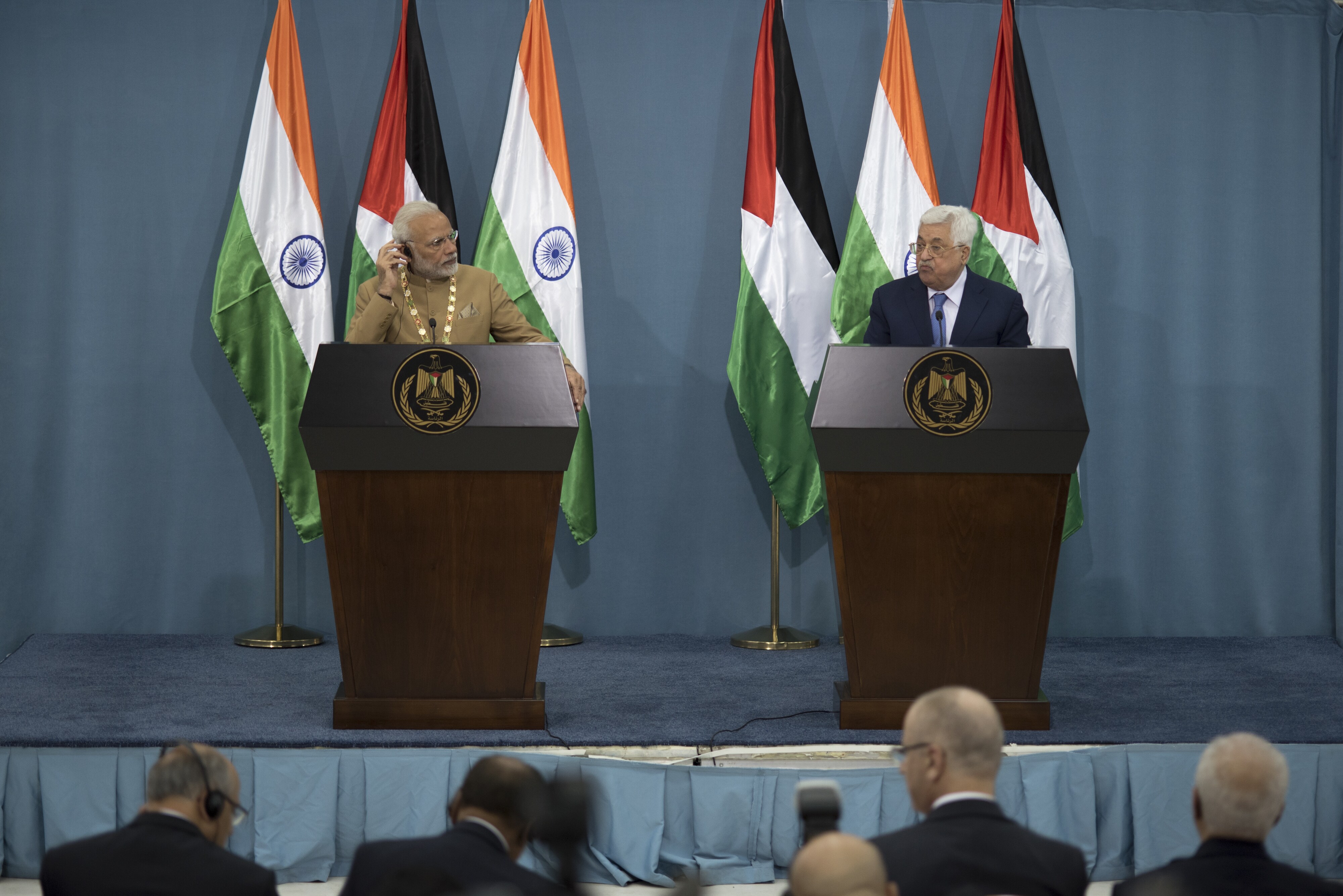
Palestinian President Mahmoud Abbas today said he is ready to engage in negotiations with Israel but made it clear that East Jerusalem should be the capital of Palestine, as he held talks with visiting Prime Minister Narendra Modi.
In December last year, U.S. President Donald Trump recognised Jerusalem as the capital of Israel, a controversial decision which angered the Palestinians, sparked protests in the Middle East and raised concern that it could further destabilise the already volatile region.
The unilateral U.S. decision to declare Jerusalem as the capital of Israel was challenged at the UN General Assembly where 128 nations, including India, voted to turn down the move as "null and void".
The status of Jerusalem is the centre of Palestine's conflict with Israel. The historic city is home to key religious sites sacred to Judaism, Islam and Christianity, especially in East Jerusalem.
“I would like to re-assure our commitment to political action and negotiations as a means of achieving our national goals to freedom and independence in accordance with the two-state solution along the lines of 1967 and internationally legitimate resolutions so that both Palestine and Israel can co-exist in peace and security, provided that East Jerusalem is the Capital of the state of Palestine,” Abbas said at a joint press statement with Prime Minister Modi.
"We have not and will not reject negotiations ever and we have said and we still say that we are ready to engage in negotiations, the formation of a multi-lateral mechanism that is produced by an international peace convention is the most ideal way to broker such negotiations," the 82-year-old Palestinian leader said.
With a multi-lateral mechanism, Abbas was referring to a framework that would apparently replace the U.S.' long-standing monopoly as a mediator in the vexed Middle East peace talks.
President Abbas received Modi who said that India hopes for Palestine to soon become a sovereign and independent country in a peaceful environment.
Modi, the first Indian Prime Minister to make an official visit to Palestine, re-assured Abbas that “we are committed to take care of the cause and well-being of Palestinian people”.
Also Read: Prime Minister Modi To Have Packed Schedule During UAE Visit

-
Where You Live Shapes How You Get To Work | The Reason Why

Two-wheelers are the most popular way to get to work in India, accounting for nearly 43% of workplace commutes.
-
High US Salaries, No Green Card Certainty: The Financial Calculation Facing Indian H-1B Families
The suspension of PERM processing at eight technology employers does not cancel existing H-1B visas. What it does is force a question many Indian families have been avoiding: is the US salary worth tying your career and family plans to one employer?
-
Unhedged Position: Can India See An Indonesia-Style Time Correction?
The Nifty is trading below levels it first clocked in 2024. Is there, then, as I have suggested in the headline, potential that the current time correction drags on painfully for the next three-five, even ten years?
-
Navigating Friction And Energy Realities: An Analysis Of Marco Rubio's October Visit To India
Occurring at a critical juncture marked by stalled trade negotiations and escalating geopolitical pressures over global energy supplies, the visit offers a profound window into modern US-India relations.
-
India Exports Capital. Why Not Export Trusteeship?
The big question, then, is whether India can build an institution that global borrowers, investors, banks, and lawyers can trust, even without an Indian connection.
-
France's Economy & Politics Are In Crisis | The Reason Why
Let's look at how the French economy and politics evolved under Nicolas Sarkozy, Franois Hollande and Emmanuel Macron.
-
You May Inherit The Business. You Must Earn Its Credibility.
Succession tests the founder's ability to share authority as much as it tests the next generation's readiness to assume it.
-
Signing Deals Is One Thing; Making Them Work Is Another | The Week In Whys
Sometimes, things don't turn out as planned. Indian companies have lost some bids to rivals, some projects won't produce until 2030.
-
FOMC Wall, PERM Suspension, Hospital Stocks | Talking Points This Week
A PERM suspension would directly affect green-card sponsorship rather than H-1B visas, so the near-term earnings impact could remain relatively limited. The key question is whether this marks a new phase in US scrutiny of Indian IT.
-
Everything, Everywhere, All At Once: Dalal Street's Week To Forget | Joining The Dots
Visa curbs, a Starlink spat and cancer drug caps: what connects this week's shocks for Indian markets









