Rahul Gandhi’s Allahabad Speech: Exaggerated, False Claims
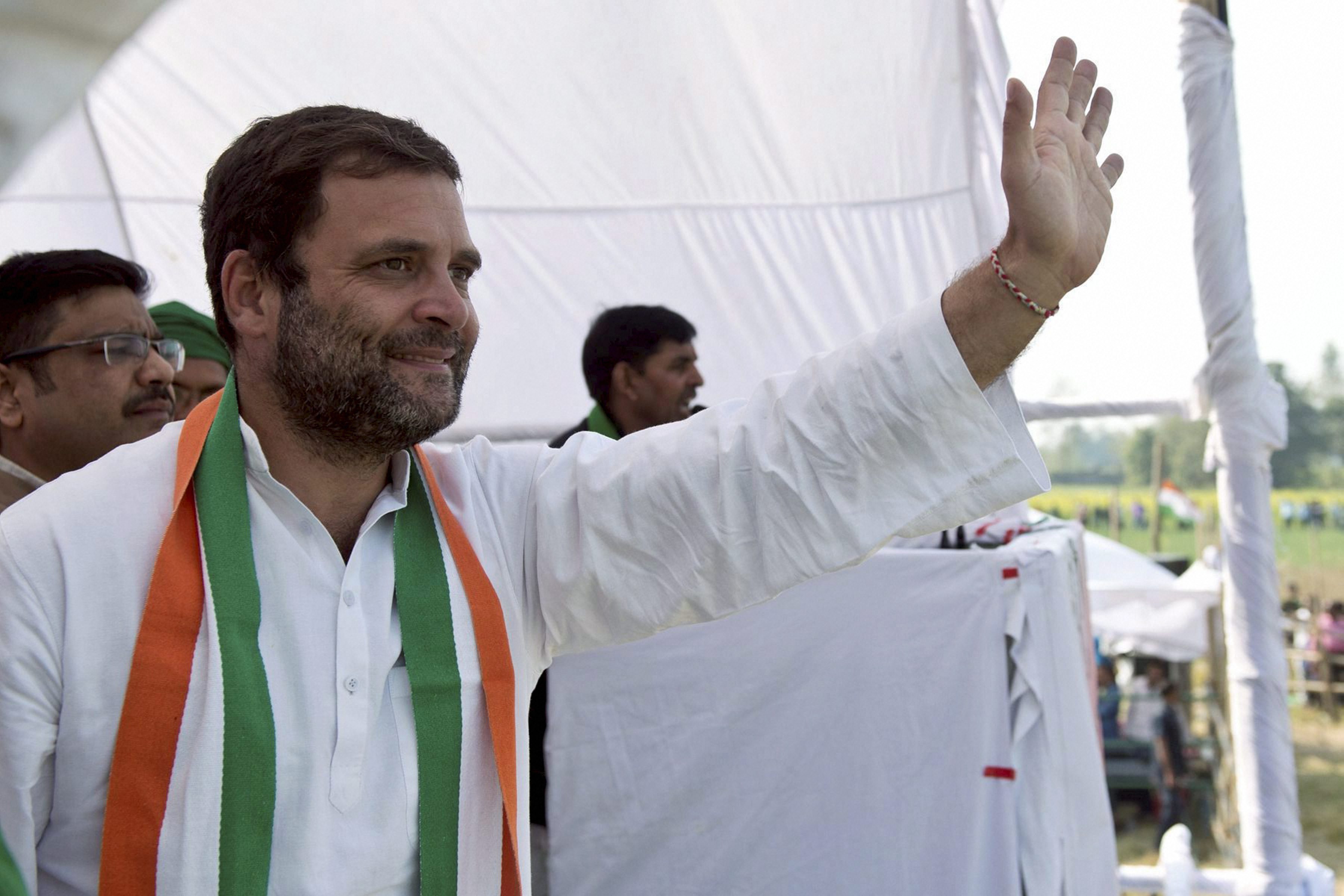
Congress Vice President Rahul Gandhi, who along with Uttar Pradesh (UP) chief minister Akhilesh Yadav is leading the campaign of the Congress-Samajwadi Party coalition, addressed an election rally in Allahabad on February 21, 2017.
He repeated the claims about the performance of the Congress-led United Progressive Alliance government (UPA) and the current National Democratic Alliance (NDA) government in his speech in Jalaun, 100 kilometres southwest of Kanpur, on February 20, 2017.
We fact checked three claims and found that, like Prime Minister Narendra Modi who made exaggerated or false claims in a public rally in Barabanki, as Factchecker reported on February 22, 2017, Rahul Gandhi, too, exaggerated the facts.
Claim 1: (Time: 04:40)
“Narendra Modi ji ne MNREGA ko rok rakha hai. Jaise pehle paisa aata tha, aaj nahin aata hai. MNREGA pe congress party saal mein, 35,000 karod rupaye lagaati thi. Narendra Modi ji ne dhaai saal mein 1,40,000 karod rupaya sirf 50 parivaro ko diya hai. Kahaan MNREGA ke 35,000 karod, karodo hindustaniyo ki madat karne ke liye; aur kahan 1.4 lakh karod rupaya, sirf 50 logonki madat karne ke liye.”
Narendra Modi has stopped MNREGA (Mahatma Gandhi National Rural Employment Guarantee Scheme). It is not funded as it used to be. Congress party used to spend Rs 35,000 crore a year on MNREGA. Narendra Modi, on the other hand, gave away Rs 1.4 lakh crore to 50 families. On the one hand, Rs 35,000 crore for crores of Indians, and on the other, Rs 1.4 lakh crore for just 50 families.Rahul Gandhi, Vice President, Congress
Fact
Rahul Gandhi is wrong on the claim about MNREGA.
The ruling NDA government has increased the budgetary allocation and actual spending to the world's biggest employment scheme since 2015, with spending peaking at Rs 47,500 crore in 2016-17.
MNREGA spending by the UPA government peaked in 2010-11 at Rs 35,800 crore, after which spending went down to Rs 29,000 crore in the following year, and remained less than Rs 33,000 crore over the four years that followed.

Considering average inflation at 6 percent over six years from 2010-11 (year of highest spending) to 2016-17, a spend of Rs 50,000 crore would have matched the spending of 2010-11 in real terms. The NDA government was quite close.
We could not find any official source of the Rs 1.4 lakh crore that appeared in Rahul Gandhi's claim.
Considering that he was referring to corporate loans ‘written off' by banks, here is what we found.
Public sector (government) banks wrote off Rs 1.14 lakh crore–bad debts owed to banks by big companies–in 2013-14 and 2014-15, which was more than half of Rs 2.11 lakh crore written off in 11 years since 2004.
“Bad loans written off by them between 2004 and 2015 amount to more than Rs 2.11 lakh crore. More than half such loans (Rs 1.14 lakh crore) have been waived off between 2013 and 2015”, Indian Express reported on February 9, 2016.
The ‘writing off' of corporate loans or clearing the balance sheets of banks and companies for tax purposes was started in the early 2000s, according to Reserve Bank of India (RBI) data.
The ‘technical' write offs, as the RBI terms it, were about Rs 2 lakh crore in the 13-year period 2000 to 2013, covering the periods of the earlier Atal Bihari Vajpayee-led NDA government and the Manmohan Singh-led UPA government.
The reference to 50 individuals could not be found.
Claim 2: (Time 10:20)
“Humne 70000 karod (kisanonka) karja maaf kiya tha Manmohan ji ne. Congress party ki sarkar nahi thi UP mein”
We waived off farmers' loans to the tune of Rs 70,000 crore under Manmohan Singh's prime ministership. There was no Congress government in power in UP at that time.Rahul Gandhi, Vice President, Congress
Fact
Rahul Gandhi has exaggerated the data on farm-loan waivers.
From an initial estimated cost of Rs 71,000 crore, the scheme disbursed Rs 52,000 crore over four years to 2011-12.
The UPA government introduced the Agricultural Debt Waiver and Debt Relief Scheme in 2008 to address the large scale agricultural debt issue.
While the scheme was a political success in the subsequent general elections of 2009, when a Congress-led coalition was re-elected (Congress increased its Lok Sabha seats from 145 to 206), it was criticised by some economists.
The debt relief scheme encouraged default with respect to future loans, according to this 2013 report from the Tata Institute of Social Sciences.
“The stimulus had no effect on productivity, wages, or consumption, but led to significant changes in credit allocation and an increase in defaults,” said this 2016 World Bank research working paper.
Farm-loan waivers damage the agricultural credit (loans) system, former RBI governor Raghuram Rajan said in November 2014.
Claim 3: (Time 14:20)
Aap jaante ho rojgar kaun dilwata hai? chote udyog jo chalate hai..informal sector ke log jo hote hai…jo choti dukan chalate hai..rojgar yeh log dete hai. Jo bade udyog hote hai, woh itna rojgar nahin dete hai
Do you know who gives you employment? It is the informal sector, small shops and factories. Big industries do not provide as much jobs as small industries provide.”Rahul Gandhi, Vice President, Congress
Fact
This statement is true.
The organised sector employs 42 million (4.2 crore) people, according to the budget speech by finance minister Arun Jaitley on February 1, 2017. The informal sector employs about 500 million, (see data here and here), according to the government.
There are 56 million employment-generating enterprises in the informal sector, more than 42 million formal sector individuals.
“More broadly, the informal and formal economies are inextricably entwined so that problems in one inevitably affect the other; for example, many firms that operate in the formal economy depend on suppliers from the informal economy,” said the Economic Survey 2016-17.
Abhishek Waghmare is an analyst with IndiaSpend.
This article has been published in arrangement with IndiaSpend.

-
High US Salaries, No Green Card Certainty: The Financial Calculation Facing Indian H-1B Families

The suspension of PERM processing at eight technology employers does not cancel existing H-1B visas. What it does is force a question many Indian families have been avoiding: is the US salary worth tying your career and family plans to one employer?
-
Unhedged Position: Can India See An Indonesia-Style Time Correction?
The Nifty is trading below levels it first clocked in 2024. Is there, then, as I have suggested in the headline, potential that the current time correction drags on painfully for the next three-five, even ten years?
-
Navigating Friction And Energy Realities: An Analysis Of Marco Rubio's October Visit To India
Occurring at a critical juncture marked by stalled trade negotiations and escalating geopolitical pressures over global energy supplies, the visit offers a profound window into modern US-India relations.
-
India Exports Capital. Why Not Export Trusteeship?
The big question, then, is whether India can build an institution that global borrowers, investors, banks, and lawyers can trust, even without an Indian connection.
-
France's Economy & Politics Are In Crisis | The Reason Why
Let's look at how the French economy and politics evolved under Nicolas Sarkozy, Franois Hollande and Emmanuel Macron.
-
You May Inherit The Business. You Must Earn Its Credibility.
Succession tests the founder's ability to share authority as much as it tests the next generation's readiness to assume it.
-
Signing Deals Is One Thing; Making Them Work Is Another | The Week In Whys
Sometimes, things don't turn out as planned. Indian companies have lost some bids to rivals, some projects won't produce until 2030.
-
FOMC Wall, PERM Suspension, Hospital Stocks | Talking Points This Week
A PERM suspension would directly affect green-card sponsorship rather than H-1B visas, so the near-term earnings impact could remain relatively limited. The key question is whether this marks a new phase in US scrutiny of Indian IT.
-
Everything, Everywhere, All At Once: Dalal Street's Week To Forget | Joining The Dots
Visa curbs, a Starlink spat and cancer drug caps: what connects this week's shocks for Indian markets
-
India Is Going Abroad For Critical Minerals. But It May Take Years To Pay Off | The Reason Why
Although India's steps are in the right direction, they remain modest compared with India's growing dependence.









