Congress’ Rahul Gandhi Promises Minimum Income Of Rs 12,000 A Month For India’s Poorest
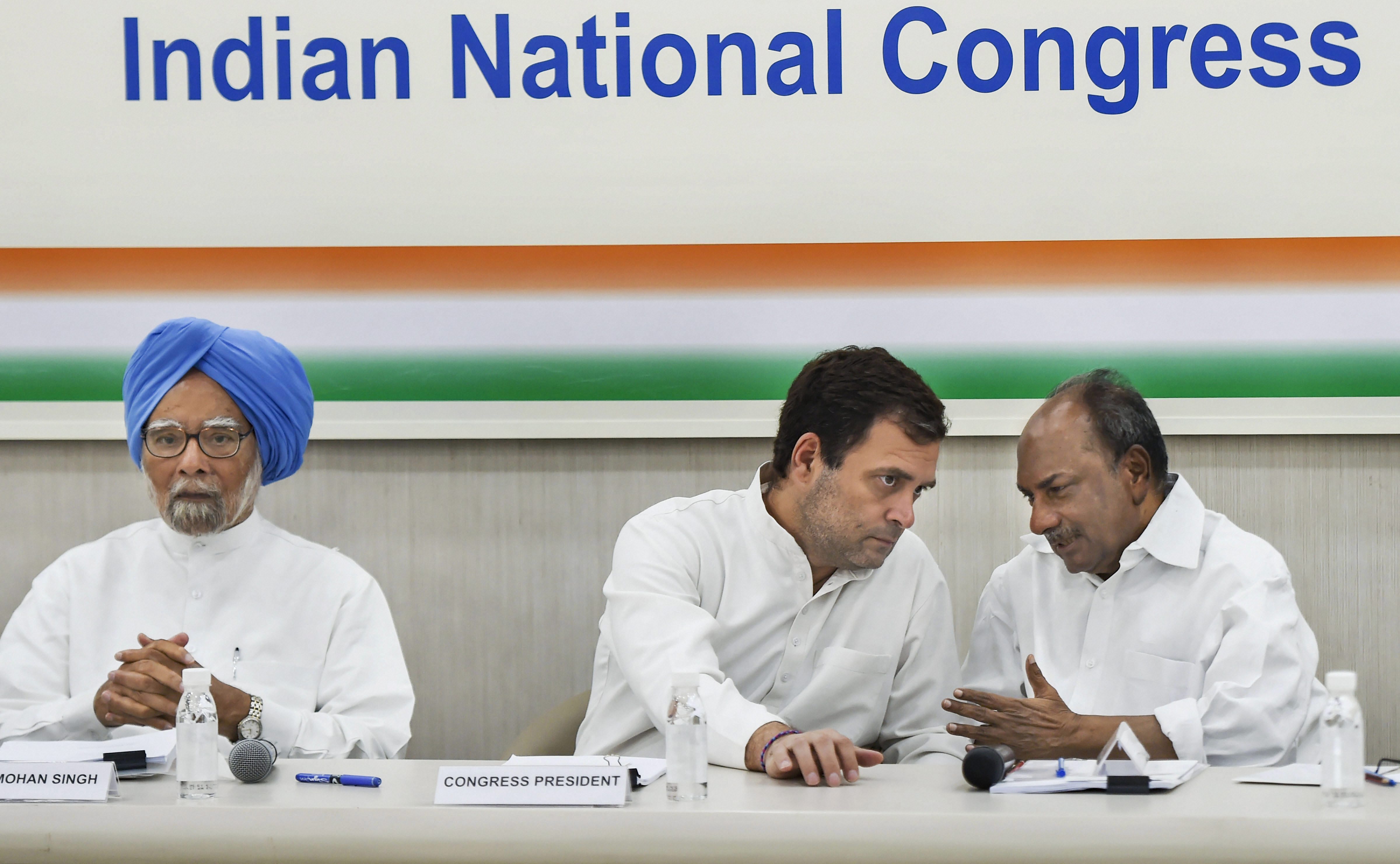
The Congress pledged to guarantee a minimum income of Rs 12,000 a month if voted to power in the Lok Sabha elections due in less than two months. The party estimates that five crore families earn less than that, and the scheme will make up the difference.
Dubbing it “the world's largest minimum income scheme”, party President Rahul Gandhi said the Nyunatam Aay Yojana, or NYAY, is aimed at covering close to 25 crore individuals. The scheme will transfer up to Rs 72,000 into the accounts of poor households annually, he said after a party meeting to give final shape to the Congress manifesto.
#IndiaElections2019 | The Congress (@INCIndia) party guarantees that the poorest 20% families of India will get Rs 72,000 per year: @RahulGandhi
March 25, 2019
Read: https://t.co/s0zrBzrcci pic.twitter.com/sOQH5LL8FQGandhi did not give details on how the party arrived at the Rs 72,000 figure or whether it would change household to household but said the Congress has studied the fiscal implications and consulted renowned economists and experts before finalising the scheme.
“[The] final assault on poverty has begun. We will wipe out poverty from the country,” he said.Later, Congress leader Rajeev Gowda explained the numbers in a tweet. “The poorest 20 percent of India's families have an average income of Rs 6,000 per month. NYAY will provide them an unconditional transfer of Rs 6,000 per month totalling to Rs 72,000 per year.”
That suggests the proposal would cost the exchequer up to Rs 3.6 lakh crore per annum.
Praveen Chakravarty, chairperson of the party's data analytics department, said on social media that the income transfer will be fixed at Rs 72,000 per household per year.
- Every poor family in the bottom 20 percent will get the same, uniform amount of Rs 72,000 a year.
- Beneficiary identification at every decile is possible.
- This will be a federal scheme with state participation.
- It will be rolled out in phases.
While the Congress party has not yet spelled out how they propose to finance and administer such a scheme, party leader and former finance minister P Chidambaram said on twitter that they “have consulted economists, this is doable, and we will adhere to fiscal discipline”.
The Congress had first announced its intention of offering a minimum income guarantee scheme in January. It had said then that it may review and terminate certain demerit subsidies, but didn't specify which ones. Chidambaram said in an interview to BloombergQuint then “we will ask ourselves in May or June, which are the schemes that have outlived their utility. And whichever are the ones that continue to deliver the outcomes, those schemes will continue".
That was followed by the incumbent BJP-led government announcing a farm income support scheme - PM Kisan - in the union budget presented in parliament on Feb. 1. As per recent data, the government has already transferred two installments of Rs 2,000 each to 2.7 crore farmers. PM Kisan intends to pay Rs 6,000 per year ( in three equal installments) to over 12 crore small and marginal farmers. The scheme's estimated cost for financial year 2019-20 is Rs 75,000 crore.
The world's largest democracy is set to vote the next government into power with the final results being announced on May 23. The Congress is leading the opposition's challenge against Prime Minister Narendra Modi's Bharatiya Janata Party on jobs, agrarian distress and poverty. Modi, beside a host of schemes, is banking on national security, with the air strikes on a terror camp Pakistan increasing his popularity.

-
Talking Points This Week: Tech Nerves, FII Buying, And A Faraway Banking Shock

The global markets are not shining this Diwali. The exception in the large markets is, India.
-
Midterm Rally Lasted A Day. The Hard Reality Of A Divided US May Last Two Years | Opinion
Between a contested AI boom, a debt ceiling that arrives in 2027 and a president with every incentive to act alone, the next two years may prove more volatile than the first day's rally suggests.
-
Blue Wave Will Derail the AI Trade but Won't Dismantle the AI Era | Unhedged Position
The Democrats' sweep of the US Congress will see politics collide with economic forces both over the long and short term.
-
It's Time To Take The GST Council's Bet On Trust Global
Payment records can prove India's services exports, and clear, proportionate rules can bring foreign digital sellers into the tax net.
-
Opinion | India at 38: From Innovation Overperformer to Innovation Powerhouse
India now has 453 VC-backed deep science startups, 18 of them late-stage, after 117 percent growth since 2020. Laurus Labs, at USD 9.3 billion, is the most valuable deep science company in any middle-income economy outside China.
-
Navigating Energy Crossroads: S Jaishankar's Call For Diversified Supply Chains At G20 Ministerial Meeting
As geopolitical fault lines continue to test maritime trade routes and commodity flows, Jaishankar's message remains pertinent: true economic resilience requires open markets, protected transit lines, and a genuine commitment to multilateral cooperation rather than coercion.
-
Indians Are Travelling, But Not Every Journey Is A Holiday | The Week In Whys
Pilgrims, patients and working women are the real travellers, and the system hasn't quite caught up with them.
-
Getting To Work Costs Women More | The Reason Why
It is not just about women paying more than men. It is about women paying much more in cities than in villages.
-
AI Bias In Investing Cannot Be Eliminated, But It Can Be Governed
Framing is a particularly important example as identical financial information presented in terms of gains rather than losses can lead an LLM to reach a different assessment.









