Modi Says Meeting With Xi Will Add Vigour To India-China Ties
Prime Minister Narendra Modi today said he had detailed discussions with Chinese President Xi Jinping on bilateral and global issues which will add further vigour to the India-China friendship after their ‘milestone' informal summit in Wuhan.
An MoU on sharing hydrological information of the Brahmaputra River by China to India and another pact on amendment of the protocol on phytosanitary requirements for exporting rice from India to China to include non-Basmati rice were signed after the Modi-Xi talks here in the eastern Chinese port city.
During their meeting, which came nearly six weeks since the Wuhan summit, the two leaders discussed a blueprint for deepening bilateral relationship and reviewed the implementation of decisions they had taken in the central Chinese city.
The meeting took place ahead of the Shanghai Cooperation Organisation (SCO) summit and covered key aspects of the bilateral engagement, reflecting the resolve by the two countries to reset relations and bring back trust in their ties which was hit by the Doklam standoff and several other thorny issues.
Modi tweeted about his meeting with Jinping in the evening.
Met this year's SCO host, President Xi Jinping this evening. We had detailed discussions on bilateral and global issues. Our talks will add further vigour to the India-China friendship. pic.twitter.com/PNVi6fQ3SD
June 9, 2018Recalling that he and Prime Minister Modi successfully had an informal meeting and reached important consensus in Wuhan, President Xi said the meeting had been well received by both countries and the international community, and a positive atmosphere is taking shape to pay close attention to and support the development of China-India relations.
China is willing to work with India to take the Wuhan meeting as a ‘new starting point' to continuously enhance political mutual trust and engage in mutually beneficial cooperation across the board, so as to push forward China-India relations in a better, faster and steadier manner, Xi was quoted as saying by China's state-run Xinhua news agency.
Briefing the media on the Modi-Xi meeting, Foreign Secretary Vijay Gokhale said it was ‘very positive and forward looking' with both leaders lauding the spirit of the Wuhan summit.
President Xi has accepted Prime Minister Modi's invitation for an informal summit in India in 2019, Gokhale said, adding that the dates and other formalities will be worked out later through diplomatic channels.
China's defence minister as well as the Minister for Public Security will visit India.
The two leaders agreed to maintain strategic communications and meet on the sidelines of international meetings. The next Modi-Xi meeting would take place in South Africa in July on the sidelines of the BRICS summit, he said.
India and China have agreed to set up a mechanism to enhance people-to-people exchanges. The new mechanism would be headed by External Affairs Minister Sushma Swaraj and Chinese State Councilor Wang Yi. The first meeting of the new mechanism would be held this year, Gokhale said.
The meeting between the leaders of two Asian powers came after their informal summit in the Chinese city of Wuhan to solidify the relationship in a broad spectrum of areas and ensuring better coordination between the border guarding forces of the two countries after the Doklam standoff.
After their talks in Wuhan, Modi and Xi had decided to issue “strategic guidance” to their militaries to strengthen communications to build trust and understanding as part of efforts to avoid a Doklam-like situation in the future.
The two leaders had also discussed ways to give impetus to their economic ties as well as people-to-people relations.
Luo said it was the 14th meeting between the two leaders over past four years.
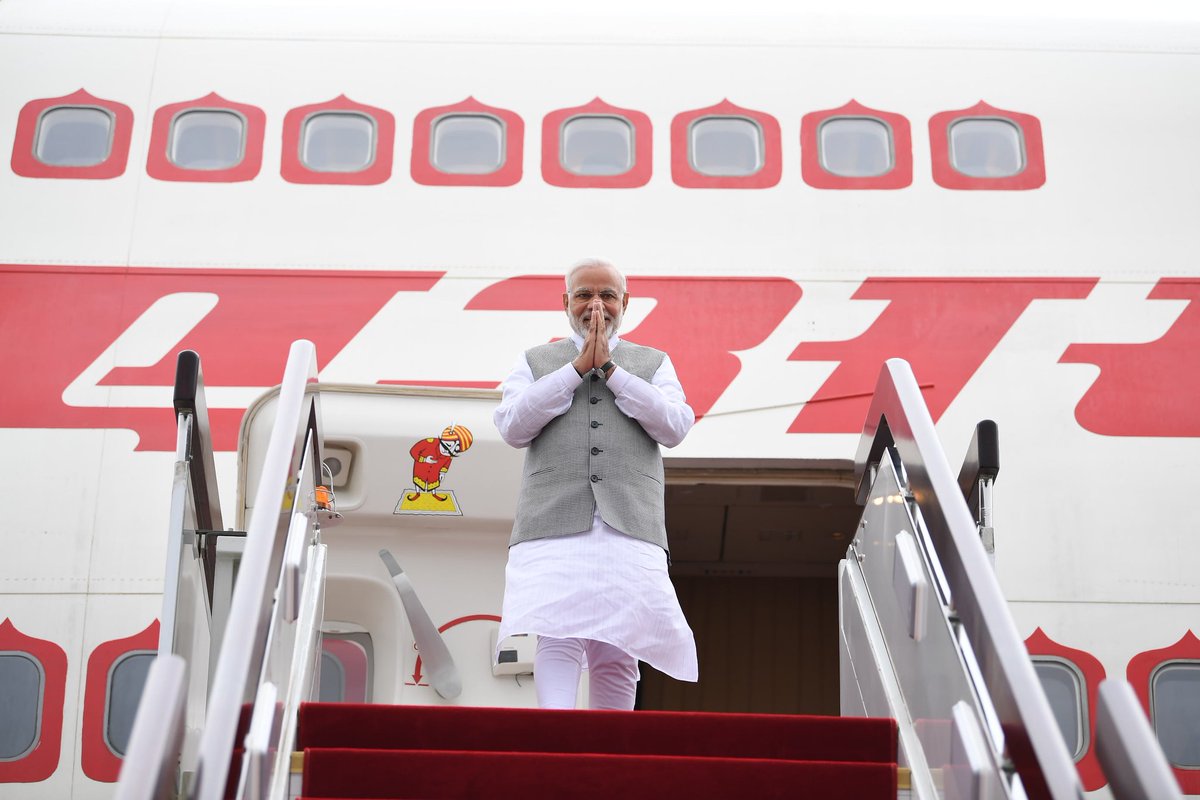
Modi arrived in Qingdao on a two-day visit to attend the annual SCO summit.
The Prime Minister landed in China to join the SCO Summit. This will be India's first SCO Summit as a full member. On the sidelines of the Summit, he will meet leaders of other member nations and discuss ways to boost bilateral cooperation. pic.twitter.com/lvuVUenwW7
June 9, 2018The ties between the two neighbouring nuclear powers had nosedived following last year's Doklam standoff as well as due to a number of other issues issues including China blocking India's move to get Pakistan-based Jaish-e-Mohammad chief Masood Azhar banned by the UN and its opposition to India's bid for the Nuclear Suppliers Group membership.
China's Belt and Road Initiative was also strongly opposed by India as part of it goes through Pakistan-occupied Kashmir.
Troops of India and China were locked in the 73-day standoff in Doklam since June 16 last year after the Indian side stopped the construction of a road by the Chinese Army in the disputed area. Bhutan and China have a dispute over Doklam. The face-off had ended on Aug. 28.
However, there have been concerted efforts by both sides to reset ties leaving behind the Doklam episode.
Last week, Modi had said that Asia and the world will have a better future when India and China work together with trust and confidence while being sensitive to each other's interests. Modi also said that an ‘Asia of rivalry' will hold the region back while an Asia of cooperation will shape the current century.
The prime minister's comments at the Shangri-La Dialogue in Singapore were appreciated by China.
It is for the first time the Indian prime minister will be attending the SCO summit after India along with Pakistan became full-fledged members of the grouping last year.

-
Navigating Energy Crossroads: S Jaishankar's Call For Diversified Supply Chains At G20 Ministerial Meeting

As geopolitical fault lines continue to test maritime trade routes and commodity flows, Jaishankar's message remains pertinent: true economic resilience requires open markets, protected transit lines, and a genuine commitment to multilateral cooperation rather than coercion.
-
Indians Are Travelling, But Not Every Journey Is A Holiday | The Week In Whys
Pilgrims, patients and working women are the real travellers, and the system hasn't quite caught up with them.
-
Getting To Work Costs Women More | The Reason Why
It is not just about women paying more than men. It is about women paying much more in cities than in villages.
-
AI Bias In Investing Cannot Be Eliminated, But It Can Be Governed
Framing is a particularly important example as identical financial information presented in terms of gains rather than losses can lead an LLM to reach a different assessment.
-
Joining The Dots | Dark Skies, Steady Diya: Why Hope Holds This Diwali
With war, a weak rupee and foreign outflows weighing on sentiment, policymakers at the NDTV World Summit and market veterans at NDTV Profit Ignite: Diwali Edition offered the same advice: stay invested and filter out the noise.
-
The Curious Case of Equitas Small Finance Bank And A CEO Who Quit For Stock
PN Vasudevan believes persistent investor concerns over a perceived conflict of interest had become a governance overhang on Equitas Small Finance Bank's stock, even as the lender improved profitability and asset quality.
-
Talking Points This Week: AI Cash Burn, A Tiger Comeback And An India That Still Finds Its Own Path
India is not immune to higher oil or tighter global liquidity, yet its earnings base is broader, its domestic policy levers are still available.
-
Foreign Investors Own Half Of HDFC Bank and ICICI Bank. An LTCG Cut Could Matter Most Here
Foreign portfolio investors have US$115 billion parked in HDFC Bank, ICICI Bank. If the government cuts long-term capital gains tax, Jefferies says returning foreign money could land here first.
-
'Never Seen This Level Of Negativity': Sandeep Tandon Says The Next Rally May Be Closer Than You Think
Veteran investor Sandeep Tandon says foreign selling is easing, large-caps are due a comeback and mid-caps are crowded, while he turns positive on gold, power and pharma this Diwali.
-
Indians Stay With Family, Not In Hotels | The Reason Why
India still lacks enough clean, reliable and affordable hotels for budget-conscious travellers.










