President Calls For Electoral Reforms, Increasing Parliamentary Seats
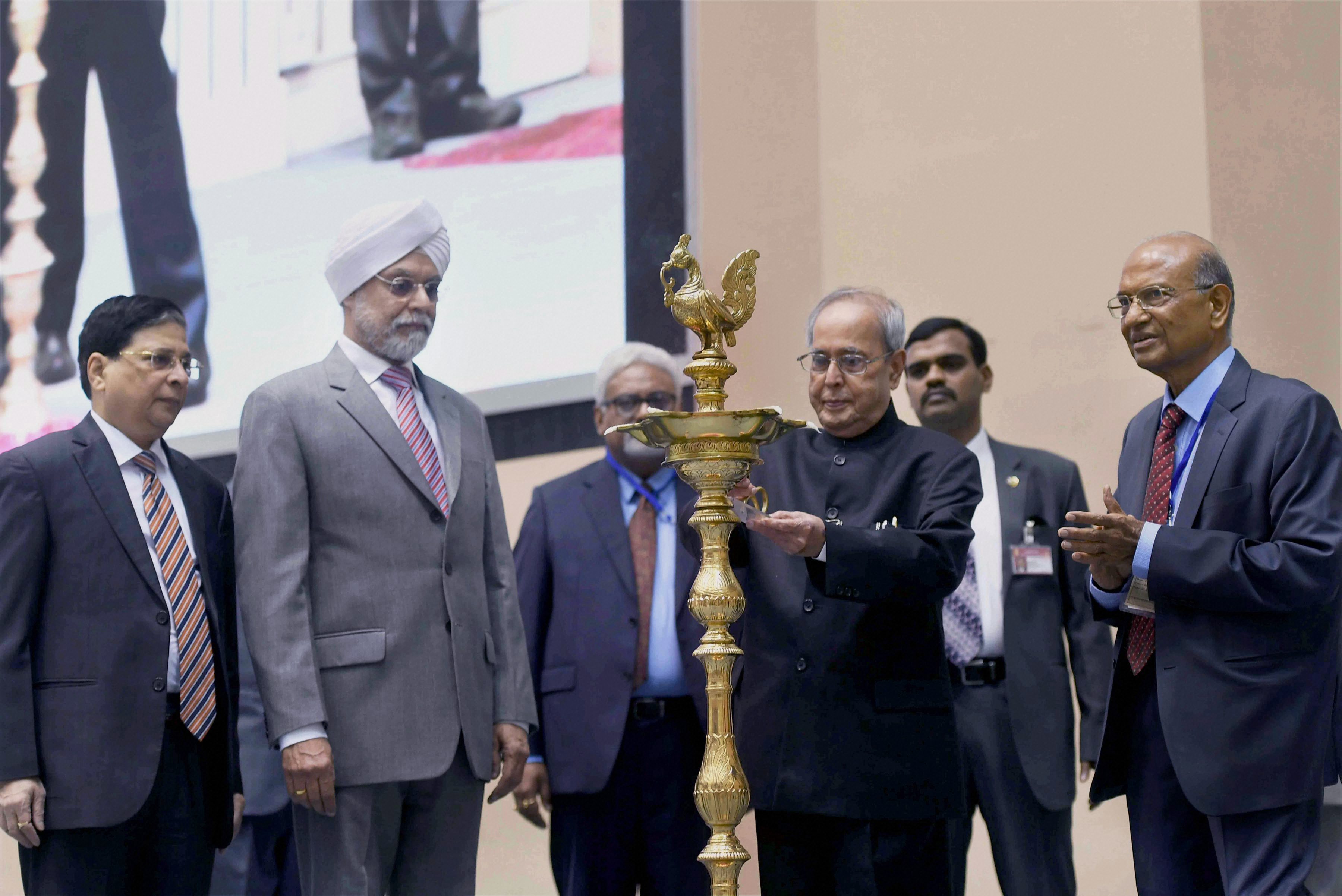
President Pranab Mukherjee advocated the need for strong electoral reforms to strengthen the democratic process, saying it is time to look at legal provisions for increasing the number of parliamentary seats.
He said in the existing Indian parliamentary system, though political parties with less numbers of seats enjoy equal rights and authority with the party in power, they have “no responsibility”.
It is necessary to undertake a “dispassionate analysis of the way in which our electoral process is functioning with a view to address the shortcomings in the system”.
The President was speaking at a seminar on ‘Economic Reforms With Reference To Electoral Issues where Chief Justice of India J S Khehar said electoral promises routinely remain unfulfilled and manifestos turn out to be mere pieces of paper, for which parties have to be held accountable.
Also Read: Chief Justice Khehar Criticises Lack Of Accountability In Poll Promises
“Chief Justice of India very emphatically and relevantly pointed out accountability, but the system of parliamentary governance is such that if somebody gets 51 (majority) out of 100, 51 has all the rights and authority and in our electoral process, less than 51 have all the rights and authorities but no responsibility,” Mukherjee said.
The President said freeze on the population figure was imposed in 1976 which has been extended till 2026 by an Act in 2001 due to which Parliament today represents the figure of 1971 census, though the population has increased manifold.
“This gives rise to an anomalous situation wherein today, India has over 800 million voters and 543 Lok Sabha constituencies represent 1.28 billion people,” he said.
“To give true expression to the will of the people, it is time that we look at the legal provisions on the delimitation of the Parliamentary constituencies with a view to increase their number.
“If Great Britain can have more than 600 Parliamentary constituencies, why can't India, with a much higher population, have more number of seats?" the President said.
Stressing the need for reforms, he said, “A strong electoral system and timely reforms are necessary to strengthen the democratic structure of India. Timely reforms are necessary which not only would give justice to people but also to the ideals enshrined in the Constitution of India.”
Referring to instability in governance, the President said, in the past, coalition governments at the Centre contributed to unstable governments necessitating frequent elections.
“Between 1989-1999, as per constitutional practice there should have been three elections in 1989, 1994 and 1999 but actually what happened was that five general elections took place in 1989, 1991, 1996, 1998 and 1999.
“To avoid that, fragile opportunistic coalitions were formed but they did not last and some of the issues to my mind can never be addressed through the real system. Some of these issues have to be addressed by the law,” he said.

-
Unhedged Position: Can India See An Indonesia-Style Time Correction?

The Nifty is trading below levels it first clocked in 2024. Is there, then, as I have suggested in the headline, potential that the current time correction drags on painfully for the next three-five, even ten years?
-
Navigating Friction And Energy Realities: An Analysis Of Marco Rubio's October Visit To India
Occurring at a critical juncture marked by stalled trade negotiations and escalating geopolitical pressures over global energy supplies, the visit offers a profound window into modern US-India relations.
-
India Exports Capital. Why Not Export Trusteeship?
The big question, then, is whether India can build an institution that global borrowers, investors, banks, and lawyers can trust, even without an Indian connection.
-
France's Economy & Politics Are In Crisis | The Reason Why
Let's look at how the French economy and politics evolved under Nicolas Sarkozy, Franois Hollande and Emmanuel Macron.
-
You May Inherit The Business. You Must Earn Its Credibility.
Succession tests the founder's ability to share authority as much as it tests the next generation's readiness to assume it.
-
Signing Deals Is One Thing; Making Them Work Is Another | The Week In Whys
Sometimes, things don't turn out as planned. Indian companies have lost some bids to rivals, some projects won't produce until 2030.
-
FOMC Wall, PERM Suspension, Hospital Stocks | Talking Points This Week
A PERM suspension would directly affect green-card sponsorship rather than H-1B visas, so the near-term earnings impact could remain relatively limited. The key question is whether this marks a new phase in US scrutiny of Indian IT.
-
Everything, Everywhere, All At Once: Dalal Street's Week To Forget | Joining The Dots
Visa curbs, a Starlink spat and cancer drug caps: what connects this week's shocks for Indian markets
-
India Is Going Abroad For Critical Minerals. But It May Take Years To Pay Off | The Reason Why
Although India's steps are in the right direction, they remain modest compared with India's growing dependence.
-
When Everyone Has AI, What Gives You An Edge?
India's young workforce is entering an uncertain world of work where powerful AI tools are becoming widely accessible. The advantage will belong to those who combine deep expertise with digital fluency, and the distinctly human capabilities that technology cannot manufacture.