Experts Call RSS’ Bluff, Say Hindus Will Always Outnumber Muslims
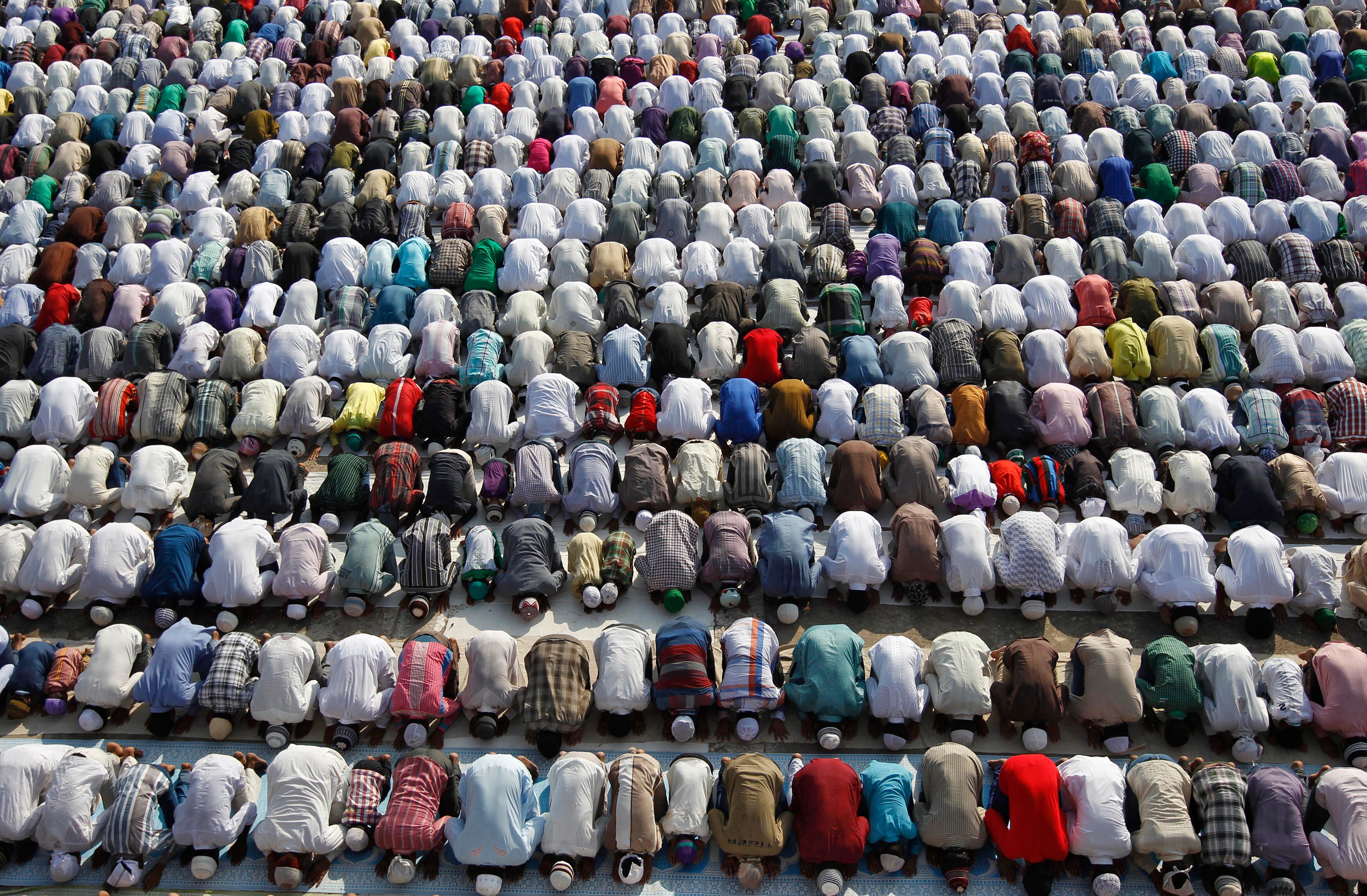
Rashtriya Swayamsevak Sangh (RSS) Chief Mohan Bhagwat is back in the middle of a controversy after he suggested that Hindus should produce more children as the Muslim population was “rising”. His assumption that Muslims are producing more children than Hindus is partly correct. The census data does show that the proportion of Muslims in India has grown from 13.4% in 2001 to 14.2% of thetotal population in 2011. In the same time, the proportion of Hindushas reduced from 80.5% to 79.8%.
If these figures are viewed in isolation, one may feel that Muslims will pose a challenge to Hindu dominance in the future. To the paranoid, it may appear as a conspiracy of Muslims to take over the country.
But if numbers are seen in context and experts are to be believed, all of these fears are baseless. The decision to have a child is an extremely complex process which includes a multitude of factors. It cannot be simply reduced to religion, which is only one of many factors, and not even a major one.
Religion Is Not A Major Factor

Contrary to what the RSS propagates, Population Sciences have proven that availability of health care, female literacy and economic conditions are the 3 most important factors that affect population growth..
The RSS preoccupation with the possibility of Hindus losing theirmajority status is absurd. While religion might influence fertility via beliefs regardingcontraceptive practices, it is well-known that the greatest impact onfertility is development. The Muslim community is a generally impoverished community asthe Sachar Commission report has shown. The focus should be on their developmental improvements, and not on silly exhortations to Hindu to increase theirpopulation.S Subramanian, Co-author, ‘Poverty, Inequality And Population'
So, Muslims are producing more children not because they are Muslims, but largely because they are poorer. World over it is observed that the fertility rate of a country or a community falls as development rises.
It's North vs South, Not Hindu vs Muslim!

It is incorrect to consider that Hindu couples across India will make similar decisions regarding children. Nor do Muslim couples show any similarities across India. The 3 main factors of health care, poverty and literacy are varied across the country.
The best way to understand this is a comparison between Uttar Pradesh and Kerala. Between 2001 and 2011, while Hindus in Uttar Pradesh grew by 18.9%, Muslims in Kerala grew by 12.83%.
So, data shows that Hindus in underdeveloped North Indian states are showing more population growth compared to relatively developed states in South India.
Muslim Growth Rate Is
Actually Falling Faster!

It is heartening to see that all religious groups, including Muslims and Hindus, are showing decline in population growth rate. In fact, the population growth rate is declining faster than projected.
Although Muslims have higher growth rate of population, between 2001 and 2011, the fall in their rate is faster than Hindus. Muslims fell 4.9percentage points from 29.5% in 2001 to 24.6% in 2011, while that of Hindusfell 3.5 percentage points, from 20.3% to 16.8%.
This shows that India is in a transition phase as far as population growth is concerned. The transition phase will continue until we reach a time when Fertility Rate converts into Replacement Rate, i.e. when an average couple gives birth to 2 children each.
States like Kerala have reached that stage where population growth has stabilised. Tamil Nadu and Karnataka will soon reach that stage. North Indian states will need time, but all of them are on the right track.
Just like various states are running at various paces to reach the goal of stabilised population, various communities are running at various paces. While Hindus and Christians are ahead in the race, Muslims are running faster to bridge the gap, shows data.
Contraceptive Usage Lower In Muslims

Muslims are clearly lagging behind in usage of contraceptives. Since there are differences of opinion on whether Islam allows contraceptives or not, the community seems confused. But the picture seems to be changing of late. Referring to NFHS survey, population expert PM Kulkarni writes:
While contraceptive acceptance is lower among Muslims than others, it is still substantial. Regardless of the position of Islam, Muslim population (in India) has generally accepted contraceptive practice, if not to the same extent as the other populations.
Professor Sriya Iyer of University of Cambridge too has foundout that religion does not have a statistically significant effect on fertilityand that over the long term, Fertility Rates of all religious groups areprojected to converge.
Can Muslims Overtake Hindus In India?

No! Data shows that Muslims in Indian can never overtake Hindus in terms of population. Nor will they ever be in a position to pose a challenge to Hindu domination in terms of numbers.
Since we are in the transition phase and Hindu growth rate is falling faster than Muslims, there is no need to worry for Hindus. Because Muslims are reaching that stage sooner rather than later.
Prof Robert Cassen, a British economistfrom Oxford, has studied population patterns in India and has written extensively on it. He predicts that the proportion of Muslims in India will finally settle around 14%. But when will that happen?
It is difficult to predict as growth rates of all communities are falling faster than expected. But Muslims will stabilise around 14% in the next 2-3 decades. People don't listen to religious leaders to make such important personal decisions. In fact, media is playing a bigger role (in population decline) by showing smaller families and raising aspirational values.D Jayaraj, Professor of Economics, Madres Institute of Development Studies
What If Hindus Produce More Children?

Hindus are showing a sharp decline in their population growth rate and process is unlikely stop because Sadhvi Prachi or Mohan Bhagwat ask them to. But what will happen if some Hindus actually listen to the RSS leader and decide to produce more kids? We put this hypothetical question to an expert:
The suggestion by Mohan Bhagwat is not surprising, but it's irresponsible. If Hindus actually decide to produce more children, it is ultimately Hindu women who will have to bear the cost of it. It will be a burden on their health, their career and their time. Standard of living of Hindus will go down. It will cause serious consequences on the society and to the development of this country.K Nagaraj, Adjunct Professor, Asian College of Journalism
After Mayawati, Kejriwal and other opposition parties attacked Bhagwat for his rather ambiguous statement, RSS is trying to douse the fire by issuing a clarification.
The concern raised by the supreme leader of the Hindu nationalist organisation is partly genuine, feel experts, but the solution he's suggested is unacceptable to them. They say only education, employment and empowerment of Muslims will bring down the rate of their population growth faster.

-
Where You Live Shapes How You Get To Work | The Reason Why

Two-wheelers are the most popular way to get to work in India, accounting for nearly 43% of workplace commutes.
-
High US Salaries, No Green Card Certainty: The Financial Calculation Facing Indian H-1B Families
The suspension of PERM processing at eight technology employers does not cancel existing H-1B visas. What it does is force a question many Indian families have been avoiding: is the US salary worth tying your career and family plans to one employer?
-
Unhedged Position: Can India See An Indonesia-Style Time Correction?
The Nifty is trading below levels it first clocked in 2024. Is there, then, as I have suggested in the headline, potential that the current time correction drags on painfully for the next three-five, even ten years?
-
Navigating Friction And Energy Realities: An Analysis Of Marco Rubio's October Visit To India
Occurring at a critical juncture marked by stalled trade negotiations and escalating geopolitical pressures over global energy supplies, the visit offers a profound window into modern US-India relations.
-
India Exports Capital. Why Not Export Trusteeship?
The big question, then, is whether India can build an institution that global borrowers, investors, banks, and lawyers can trust, even without an Indian connection.
-
France's Economy & Politics Are In Crisis | The Reason Why
Let's look at how the French economy and politics evolved under Nicolas Sarkozy, Franois Hollande and Emmanuel Macron.
-
You May Inherit The Business. You Must Earn Its Credibility.
Succession tests the founder's ability to share authority as much as it tests the next generation's readiness to assume it.
-
Signing Deals Is One Thing; Making Them Work Is Another | The Week In Whys
Sometimes, things don't turn out as planned. Indian companies have lost some bids to rivals, some projects won't produce until 2030.
-
FOMC Wall, PERM Suspension, Hospital Stocks | Talking Points This Week
A PERM suspension would directly affect green-card sponsorship rather than H-1B visas, so the near-term earnings impact could remain relatively limited. The key question is whether this marks a new phase in US scrutiny of Indian IT.
-
Everything, Everywhere, All At Once: Dalal Street's Week To Forget | Joining The Dots
Visa curbs, a Starlink spat and cancer drug caps: what connects this week's shocks for Indian markets









