Mueller Asked Barr for Earlier Release of Redacted Probe Summary
(Bloomberg) -- Special Counsel Robert Mueller asked Attorney General William Barr in late March to quickly release a fuller summary of his investigation, saying that Barr's initial letter summarizing the findings caused “public confusion” and risked undermining public confidence in the investigation.
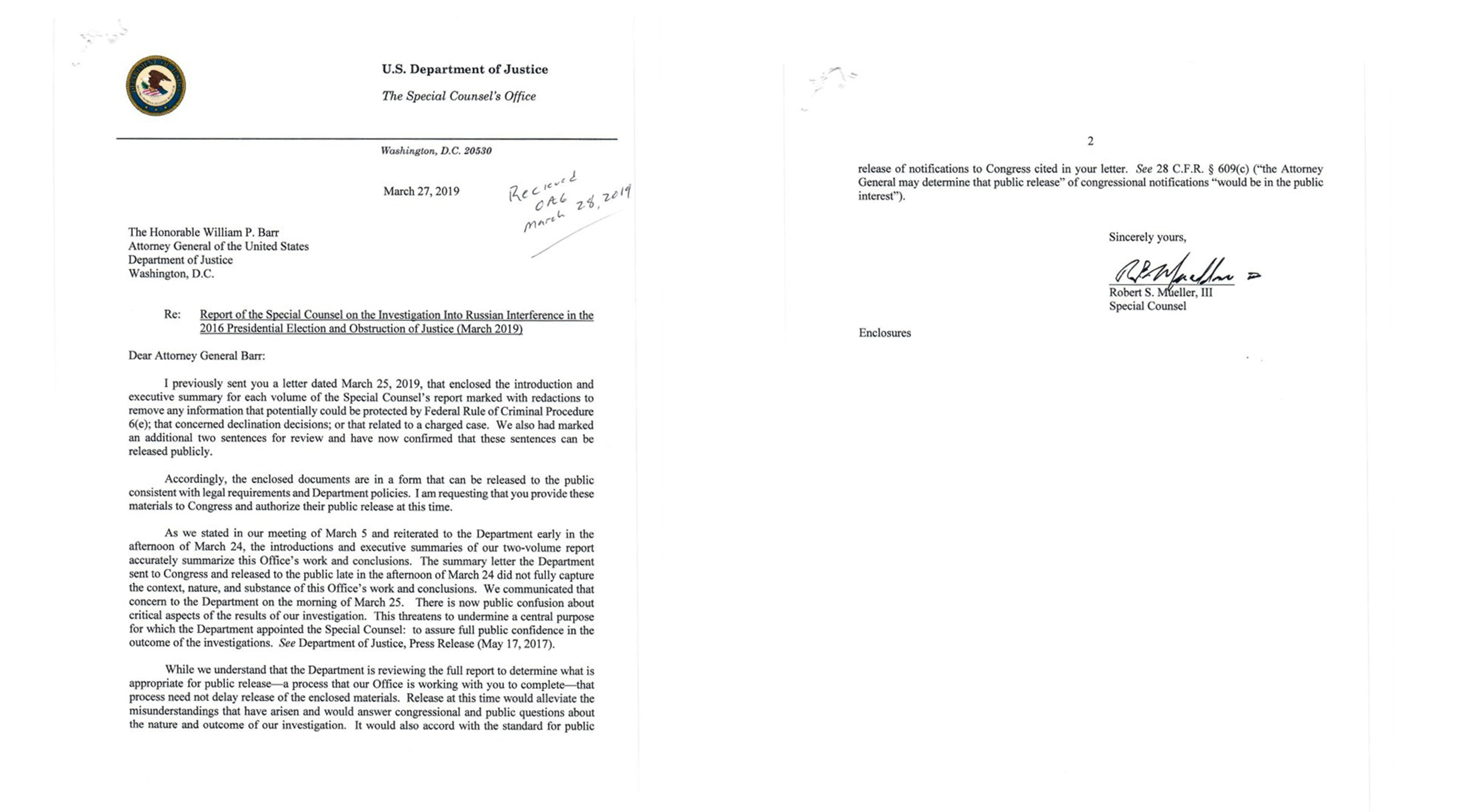
Mueller wrote in a letter to Barr on March 27 that he was providing an introduction and executive summaries that had been scrubbed of sensitive information.
“I am requesting that you provide these materials to Congress and authorize their public release at this time,” Mueller wrote, noting that he was following up on a request he first made two days earlier. “Release at this time would alleviate the misunderstandings that have arisen and would answer congressional and public questions about the nature and outcome of our investigation.”
Read Mueller's letter to Barr questioning his summary of the Russia report
The letter was released Wednesday morning by the Justice Department after the Washington Post reported on it Tuesday. Mueller wrote in it that Barr's initial March 24 letter to Congress on Mueller's report “did not fully capture the context, nature and substance of this office's work and conclusions.
“There is now public confusion about critical aspects of the results of our investigation,” Mueller wrote in a letter to Barr on March 27. “This threatens to undermine a central purpose for which the department appointed the special counsel: to assure full public confidence in the outcome of the investigation.”
Barr told the Senate Judiciary panel on Wednesday that he wanted to release the full report, with appropriate redactions, all at once.
“I told Bob that I was not interested in putting out summaries and I was not interested in putting out the report piecemeal,” Barr told the panel.
Barr's initial characterization of Mueller's findings stood uncontested until a redacted version of Mueller's report was released on April 18.
In fact, Mueller said he didn't make a “traditional” prosecution judgment on obstruction, mainly because he decided to abide by a Justice Department policy that says a sitting president cannot be indicted.
Yet he cited at least 10 examples of efforts to interfere in the investigation and pointedly added, “If we had confidence after a thorough investigation of the facts that the president clearly did not commit obstruction of justice, we would so state. Based on the facts and the applicable legal standards, however, we are unable to reach that judgment.”
Justice Department spokeswoman Kerri Kupec said in a statement Tuesday evening that Barr called Mueller after receiving the special counsel's letter.
“In a cordial and professional conversation, the special counsel emphasized that nothing in the attorney general's March 24 letter was inaccurate or misleading,” Kupec said in the statement. “But, he expressed frustration over the lack of context and the resulting media coverage regarding the special counsel's obstruction analysis.”
--With assistance from Steven T. Dennis.
To contact the reporter on this story: Kevin Whitelaw in Washington at kwhitelaw@bloomberg.net
To contact the editors responsible for this story: Kevin Whitelaw at kwhitelaw@bloomberg.net, Justin Blum
©2019 Bloomberg L.P.

-
Talking Points This Week: Tech Nerves, FII Buying, And A Faraway Banking Shock

The global markets are not shining this Diwali. The exception in the large markets is, India.
-
Midterm Rally Lasted A Day. The Hard Reality Of A Divided US May Last Two Years | Opinion
Between a contested AI boom, a debt ceiling that arrives in 2027 and a president with every incentive to act alone, the next two years may prove more volatile than the first day's rally suggests.
-
Blue Wave Will Derail the AI Trade but Won't Dismantle the AI Era | Unhedged Position
The Democrats' sweep of the US Congress will see politics collide with economic forces both over the long and short term.
-
It's Time To Take The GST Council's Bet On Trust Global
Payment records can prove India's services exports, and clear, proportionate rules can bring foreign digital sellers into the tax net.
-
Opinion | India at 38: From Innovation Overperformer to Innovation Powerhouse
India now has 453 VC-backed deep science startups, 18 of them late-stage, after 117 percent growth since 2020. Laurus Labs, at USD 9.3 billion, is the most valuable deep science company in any middle-income economy outside China.
-
Navigating Energy Crossroads: S Jaishankar's Call For Diversified Supply Chains At G20 Ministerial Meeting
As geopolitical fault lines continue to test maritime trade routes and commodity flows, Jaishankar's message remains pertinent: true economic resilience requires open markets, protected transit lines, and a genuine commitment to multilateral cooperation rather than coercion.
-
Indians Are Travelling, But Not Every Journey Is A Holiday | The Week In Whys
Pilgrims, patients and working women are the real travellers, and the system hasn't quite caught up with them.
-
Getting To Work Costs Women More | The Reason Why
It is not just about women paying more than men. It is about women paying much more in cities than in villages.
-
AI Bias In Investing Cannot Be Eliminated, But It Can Be Governed
Framing is a particularly important example as identical financial information presented in terms of gains rather than losses can lead an LLM to reach a different assessment.