This Newly Inducted MoS Was Once Jailed in Cash-For-Votes Scam
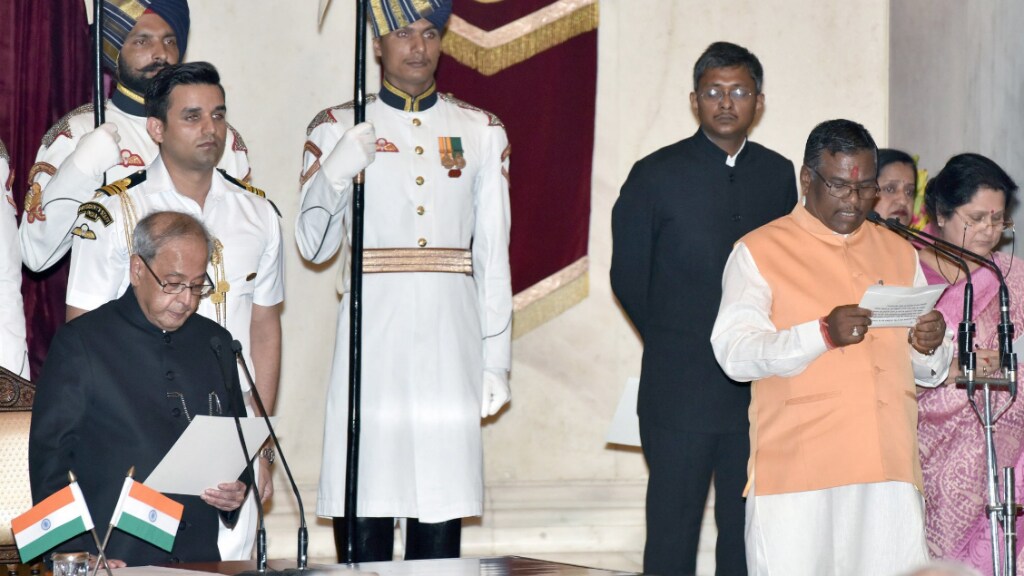
On Tuesday, Faggan Singh Kulaste made news for his induction into the Narendra Modi's Cabinet as a Minister of State. Eight years ago, the 57-year-old lawmaker made news for his involvement in a scandal that came to be known as the “cash-for-votes” scam.
Kulaste and his colleague in 2008 had claimed that they had been “bribed” to vote in favour of the Manmohan Singh government in the trial of strength in the Lok Sabha. That led him to spend two months in jail. Later, he was acquitted.
Veteran journalist Rajdeep Sardesai, in his book, 2014: The Election That Changed India, had revealed the making of the “cash-for-votes” sting operation. Sardesai wrote:
The cash-for-votes scandal had broken out during the nuclear deal vote in Parliament in 2008. There had been much speculation at the time that MPs were being offered bribes by both sides but we were not being given any evidence. CPI leader AB Bardhan had even claimed that Rs 25 crore was being offered to each MP for their vote...
He further wrote:
I was sitting in Parliament's central hall listening to the nuclear debate when Jaitley joined us. The BJP leader claimed some of his MPs had been contacted by the government to switch sides. ‘We are planning to expose this in a sting operation,' he said. He agreed to allow our cameras to be a fly on the wall, watching MPs being ‘purchased'. That evening, we got a phone call from Jaitley, and sent Siddharth and a production unit to meet Sudheendra Kulkarni who was supervising the entire sting operation.
Kulkarni possessed an obsessive desire to see his leader as Prime Minister.
The silver-haired Kulkarni, a former journalist, had worked in the Vajpayee PMO. He was now an Advani loyalist with an obsessive desire to see his leader as prime minister. Kulkarni had also played an important role in shaping Advani's contentious homage to Jinnah. Now, he was hoping that the sting would bring down the Manmohan Singh government. With Kulkarni were three BJP MPs, Ashok Argal, Faggan Singh Kulaste and Mahavir Bhagora, who had offered to be ‘whistleblowers'. None of us had met or heard of these MPs till that day.
Despite the scandal, Kulaste was inducted as Minister of State Parliamentary Affairs in the Atal Behari Vajpayee government. Later, he moved as Minister of State for Tribal Affairs.
For The Cause of Tribals
An BJP MP from Mandla (Scheduled Tribes) reserved constituency in Madhya Pradesh, Kulaste belongs to the class of politicians who have struggled hard to survive in politics. BJP watchers consider him a party's disciplined “man for all seasons”.
Otherwise a man of few words, he has been the party's voice in taking up issues concerning the Scheduled Castes and the Schedules Tribes.Heading the Parliamentary Committee on the Welfare of the Scheduled Castes and the Scheduled Tribes, Kulaste and his colleagues said earlier this year in a parliamentary report that elite educational institutes like the Jawaharlal Nehru University should have no place for caste discrimination, but the malady prevails in an “overt and covert” manner in the premier varsity.
Kulaste has been a key tribal leader in Madhya Pradesh. He holds a Master's degree and is a law graduate.
(With IANS inputs.)
Also Read:
Cabinet Reshuffle: 20 Ministers Take Oath, Five Names Dropped
Modi's Cabinet Reshuffle: Know Your Ministers

-
Unhedged Position: Can India See An Indonesia-Style Time Correction?

The Nifty is trading below levels it first clocked in 2024. Is there, then, as I have suggested in the headline, potential that the current time correction drags on painfully for the next three-five, even ten years?
-
Navigating Friction And Energy Realities: An Analysis Of Marco Rubio's October Visit To India
Occurring at a critical juncture marked by stalled trade negotiations and escalating geopolitical pressures over global energy supplies, the visit offers a profound window into modern US-India relations.
-
India Exports Capital. Why Not Export Trusteeship?
The big question, then, is whether India can build an institution that global borrowers, investors, banks, and lawyers can trust, even without an Indian connection.
-
France's Economy & Politics Are In Crisis | The Reason Why
Let's look at how the French economy and politics evolved under Nicolas Sarkozy, Franois Hollande and Emmanuel Macron.
-
You May Inherit The Business. You Must Earn Its Credibility.
Succession tests the founder's ability to share authority as much as it tests the next generation's readiness to assume it.
-
Signing Deals Is One Thing; Making Them Work Is Another | The Week In Whys
Sometimes, things don't turn out as planned. Indian companies have lost some bids to rivals, some projects won't produce until 2030.
-
FOMC Wall, PERM Suspension, Hospital Stocks | Talking Points This Week
A PERM suspension would directly affect green-card sponsorship rather than H-1B visas, so the near-term earnings impact could remain relatively limited. The key question is whether this marks a new phase in US scrutiny of Indian IT.
-
Everything, Everywhere, All At Once: Dalal Street's Week To Forget | Joining The Dots
Visa curbs, a Starlink spat and cancer drug caps: what connects this week's shocks for Indian markets
-
India Is Going Abroad For Critical Minerals. But It May Take Years To Pay Off | The Reason Why
Although India's steps are in the right direction, they remain modest compared with India's growing dependence.
-
When Everyone Has AI, What Gives You An Edge?
India's young workforce is entering an uncertain world of work where powerful AI tools are becoming widely accessible. The advantage will belong to those who combine deep expertise with digital fluency, and the distinctly human capabilities that technology cannot manufacture.









