Lok Sabha Passes CGST Amendment Bill: All You Need To Know
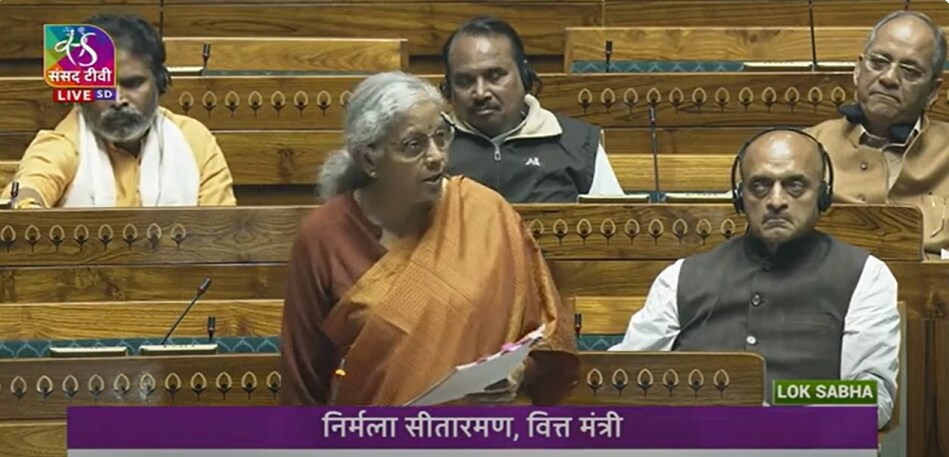
The lower house of the Parliament passed the Central Goods and Services Tax (Second Amendment) Bill, 2023, on Tuesday, following a discussion on the subject and in line with the recommendation of the 52nd GST Council held earlier in October.
The bill, which was introduced on Dec. 13, sought to incorporate the legislative changes in Sections 109 and 110 of the CGST Act, 2017, for the council's recommendation to increase the age limit of the judicial authorities of the GST Appellate Tribunal.
Earlier in October, the Council unanimously agreed to extend the age limit for the president of the GSTAT from 67 years to 70 years and that of the judicial member from 65 to 67.
In terms of the qualification of judicial member, it also approved that an advocate with an experience of 10 years was eligible to be a state judicial member.
Speaking at the Lok Sabha on Tuesday, Union Finance Minister Nirmala Sitharaman said that the changes were required to align the CGST Act, 2017, with the Tribunal Reforms Act, 2021.
She said the reason for the amendment was because it was brought to the notice of the ministry by the Chief Justice of India, who in his administrative capacity flagged that the aspects of the service terms did not align with the provisions of the Tribunal Reforms Act, 2021.
"The two points on which the Chief Justice of India drew our attention is that the maximum age limit for the post of the President of the Appellate Tribunal and members is 67 and 65 years in the CGST Act... under the Tribunal Reforms Act of 2021, it is 70 and 67 (respectively)," she said.
"...the second point on which amendment became necessary is that the CGST (Act) did not have a provision relating to the eligibility of an advocate with a standing of 10 years at the bar for appointment as a judicial member, whereas the same is available in the Tribunal Reforms Act. These two were, therefore taken up in the (GST) council and they were approved."
According to the council's approval, the quorum of the appellate tribunal is one principal bench and multiple state benches as notified by the state representative on the GST council.
The principal bench would be in New Delhi and would have one president, a judicial member, a technical member belonging to the central government and a technical member of the state. The state benches would have two judicial members, a technical member belonging to the central government and a technical member from the state.
After the bill is passed in both houses, the selection of the members would begin. The minister said that the CJI has agreed to head the search and selection committee and nominated senior judge Justice Sanjeev Khanna to chair the search and selection committee for members, including the judicial and the central government's technical member.
'Government Is Sensitive To MSME Tax Dues'
Fielding questions on the GST dues owed to MSMEs, the minister said that the central government has been "fairly sensitive to the needs of MSMEs" and enacted a provision in the budget to ensure that the credit and tax incentives to larger companies and PSUs would be held back until actual payment of dues to MSMEs has been accounted for in that fiscal.
"This understanding that PSU means central (PSU) may not always be correct. Yes, there are central PSUs which owe money to MSME and all of us ministers have been very keenly observing them so that the delay should not be beyond 45 days, and the central PSU largely now go by that understanding," Sitharaman told the Parliament.
"...but I don't have an authority to speak about state PSUs and it is not a secret that state PSUs owe a large amount to MSMEs, and the problem therefore remains for the MSMEs but it is outside of my realm. It is very much the realm of the states where the same concern for MSME should be understood by the state governments and they should quickly clear the bills."
The Finance Minister clarified that the tax liability towards winnings in online gaming is prospective, meaning that it does not include the past period. "I would like to put it on record again that the valuation rules to exclude winnings is prospective. So, I hope there's no confusion," she said.
On the pendency of cases pertaining to the appellate tribunal, she said that the taxpayer is at liberty to withdraw his/her case from the High Court or from the Supreme Court and go to the respective State Tribunal Bench that is being set up.

-
High US Salaries, No Green Card Certainty: The Financial Calculation Facing Indian H-1B Families

The suspension of PERM processing at eight technology employers does not cancel existing H-1B visas. What it does is force a question many Indian families have been avoiding: is the US salary worth tying your career and family plans to one employer?
-
Unhedged Position: Can India See An Indonesia-Style Time Correction?
The Nifty is trading below levels it first clocked in 2024. Is there, then, as I have suggested in the headline, potential that the current time correction drags on painfully for the next three-five, even ten years?
-
Navigating Friction And Energy Realities: An Analysis Of Marco Rubio's October Visit To India
Occurring at a critical juncture marked by stalled trade negotiations and escalating geopolitical pressures over global energy supplies, the visit offers a profound window into modern US-India relations.
-
India Exports Capital. Why Not Export Trusteeship?
The big question, then, is whether India can build an institution that global borrowers, investors, banks, and lawyers can trust, even without an Indian connection.
-
France's Economy & Politics Are In Crisis | The Reason Why
Let's look at how the French economy and politics evolved under Nicolas Sarkozy, Franois Hollande and Emmanuel Macron.
-
You May Inherit The Business. You Must Earn Its Credibility.
Succession tests the founder's ability to share authority as much as it tests the next generation's readiness to assume it.
-
Signing Deals Is One Thing; Making Them Work Is Another | The Week In Whys
Sometimes, things don't turn out as planned. Indian companies have lost some bids to rivals, some projects won't produce until 2030.
-
FOMC Wall, PERM Suspension, Hospital Stocks | Talking Points This Week
A PERM suspension would directly affect green-card sponsorship rather than H-1B visas, so the near-term earnings impact could remain relatively limited. The key question is whether this marks a new phase in US scrutiny of Indian IT.
-
Everything, Everywhere, All At Once: Dalal Street's Week To Forget | Joining The Dots
Visa curbs, a Starlink spat and cancer drug caps: what connects this week's shocks for Indian markets
-
India Is Going Abroad For Critical Minerals. But It May Take Years To Pay Off | The Reason Why
Although India's steps are in the right direction, they remain modest compared with India's growing dependence.









